Nicolas Poussin
Biography of French Classical Baroque Painter.
MAIN A-Z INDEX - A-Z of ARTISTS

|
Nicolas Poussin
|
|
|
Nicolas Poussin (1594-1665)Contents • Biography |
|
COLOURS USED IN
PAINTING |
One of the most respected Old Masters, and one of the foremost artists in Rome during the era of Baroque art, French painter Nicolas Poussin was greatly influenced by historical Greek and Roman mythology, and as a result abandoned mainstream Baroque painting in his early 30s, preferring to develop his own unique style of classicism. In terms of subjects, he is best known for his religious art, notably his Christian history painting and - along with his contemporary Claude Lorrain (1600-82) - his narrative landscape painting. He was also influenced by Italian artists like Caravaggio (1571-1610) and the pioneer engraver Raimondi Marcantonio (1480-1534). Among the greatest examples of his painting are: Abduction of the Sabine Women, (1634-8, Met NY/ Louvre, Paris), Et in Arcadia Ego (1637, Louvre), The Continence of Scipio (1640, Pushkin Museum), the series of the Seven Sacraments (1644-8, National Gallery of Scotland), The Holy Family (1650, Harvard University Art Museum); Death of Sapphira (1652, Louvre); The Rest on the Flight into Egypt (1657, Hermitage), and The Four Seasons (1660-64, Louvre). For context, see also: Classicism and Naturalism in Italian 17th Century Painting. |
|
WORLD'S BEST ART |
|
BAROQUE ART WORLDS TOP ARTISTS
|
Born in 1594 near Les Andelys, in Normandy, he came from a relatively poor family. It is clear however that he received some education as a child and studied Latin, which was to prove useful later in life. His early drawing was noticed by a local artist, Quentin Varin, who decided to teach him. At the age of eighteen, Poussin moved to Paris. En route he stopped for a short time in the town of Rouen, where he is reported to have worked in the studio of Noel Jouvenet, grandfather of the great Rouen religious painter Jean Jouvenet (1644-1717). In Paris, he entered the studio of Dutch artist Ferdinand Elle, and then the atelier of Georges Lallemand one of the leading French mannerist artists. He also studied the engraving of the great Italian printmaker Marcantonio which was a strong influence. However, Poussin did not remain with his early teachers; instead, he set up independently, working partly in Paris and partly in the provinces, executing whatever commissions he could get. He worked in the south-west, probably at the Chateau de Momay, near Niort, and also at Lyons and Blois. By 1622 he must have settled in Paris because he received commissions from the Jesuits and the Archbishop of Paris, and collaborated with Philippe de Champaigne on decorative work in the Luxembourg (all lost). During his late 20s, Poussin made two abortive attempts to visit Rome - still the art capital of Europe. Once he even got as far as Florence but for reasons unknown turned back. It wasn't until 1624, that he finally reached Rome, after a short diversion to study Renaissance art in Venice. He remained in the city for most of his painting life. |
|
|
|
|
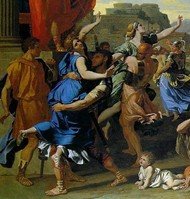
Poussin had been given introductions by an Italian friend to a number of prosperous connoisseurs of fine art in Rome who would become extremely good patrons. They included Cardinal Francesco Barberini (1597-1669), nephew of the new Pope Urban VIII, for whom he painted La Mort de Germanicus (The Death of Germanicus) (1628, Minneapolis Institute of Arts), and the cardinal's secretary Cassiano dal Pozzo (1588-1657), a great enthusiast of the arts, with a keen interest in the study of antiquity and contacts with men of learning all over Europe. It was under Pozzo's tutelage and influence that Poussin was to mature and to become the erudite painter who appealed to the connoisseur. In addition, it was from hereon that Poussin began to reveal his talents as a draughtsman and sketch artist. His drawings were in great demand from his friends, especially Pozzo and Cardinal Camillo Massimi, whose albums are now in the Royal Library at Windsor Castle. The Louvre in Paris also has an outstanding collection of the sketches Poussin made for his landscape paintings and other compositions. Abandons Baroque Painting For Classical Style During his first years in Rome, however, Poussin seems to have been quite different kind of artist - even a different person - from what he was later to become. Hot-tempered and impetuous, he was involved in several brawls with members of the anti-French faction. At the same time he made a concerted attempt to establish himself as a painter of large religious works, culminating in his commission to paint an altarpiece for a Chapel in St. Peter’s Cathedral. This work, the Martyrdom of St. Erasmus (1628), was a conventional example of Baroque painting, which was the dominant style in Europe at the time. However the altarpiece did not bring him the acclaim he had hoped, a setback followed, in 1630, by a further rebuff when he failed to win the contract to decorate a chapel in the Church of S. Luigi dei Francesi, which was awarded instead to Charles Mellin. At the same time he fell seriously ill, and only survived thanks to the efforts of Anna Maria, the daughter of his landlord - a French cook and restaurant proprietor called Jacques Dughet - whom he married as soon as he recovered. Nevertheless, disappointed by the cool response to his Baroque altarpiece, he never attempted to paint in the same style again. Instead he moved towards a more intellectual, classical style, which was later to appeal to neoclassical artists, like Jacques Louis David. In the process, he withdrew from the highly competitive world of public art in Rome, and focused on the production of small canvases intended for the private houses of a modest but devoted group of collectors, of whom the most important was Cassiano dal Pozzo. These works were sometimes on conventional religious themes (The Triumph of David (1630) Prado, Madrid; The Massacre of the Innocents, Musee Conde, Chantilly; The Lamentation over Christ (1627) Alte Pinakothek, Munich), while some are simple allegories, such as The Inspiration of the Poet (1628, Louvre, Paris). Others deal with melancholy themes, such as the frailty of human happiness (The Shepherds of Arcadia (1627) Duke of Devonshire's Collection, Chatsworth; Echo and Narcissus (1627-28) Louvre) or the futility of wealth (Midas Bathing in Pactolus (1627) Metropolitan Museum). Some have more erudite allusions as allegories of death and resurrection (Diana and Endymion (1630) Detroit Institute of Arts; Venus Lamenting over Adonis (1628) Caen Museum; and The Triumph of Flora (1628) Louvre). Other works from his first stay in Rome include The Rescue of Pyrrhus (1634) Louvre, The Rape of the Sabine Women (1637-8) Louvre, The Israelites Gathering Manna in the Desert (1637-9) Louvre, The Destruction of the Temple in Jerusalem (1640) Kunsthistorisches Museum, Vienna, and The Continence of Scipio (1640) Pushkin Museum of Fine Art, Moscow.During this time Poussin's style was marked by his admiration for Titian, whose Bacchanals he studied and copied at the Villa Ludovisi in Rome. Poussin Summoned to Paris by Richlieu By about 1635 Poussin's reputation had reached Paris, almost certainly as a result of paintings sent as presents by Cardinal Barberini to Cardinal Richelieu (1585-42). In 1635-6 Poussin began two canvases commissioned by Richelieu which were intended to hang in a place of honour in the Chateau de Richelieu: Le Triomphe de Pan (The Triumph of Pan), Morrison Collection, UK; and Le Triomphe de Bacchus (The Triumph of Bacchus), known from a copy in the Kansas City Museum. Over the course of the next few years, links with France became closer and in 1639 Poussin received an invitation to move to Paris to work for King Louis XIII and Richelieu, something he didn't want to do: in fact it was only when his presence was demanded that he finally set out for Paris, arriving there in December l640.
|
|
|
From Poussin's point of view, his visit to Paris was a disaster. After a brief period of happiness resulting from the enthusiastic reception given to him by the King, the Cardinal and the Surintendant des Bariments, Sublet des Noyers, - who agreed to place him in charge of all artistic and decorative works in the Royal palaces - Poussin soon realized that the tasks which he was called upon to execute were wholly uncongenial to him: large altarpieces (Institution de l'Eucharistie for St Germain, Miracles de Saint Francois Xavier for the Novitiate of the Jesuits, both in the Louvre), large allegorical paintings for Cardinal Richelieu (Time Revealing Truth with Envy and Discord (1640-2) Louvre; The Burning Bush, Staten Kunstmuseum, Copenhagen) and in particular the decoration of the Louvre's Long Gallery (not completed, later destroyed). His difficulties were increased by the hostile intrigues of the influential First Painter to the King, Simon Vouet (1590-1649), another student of Italian art who had returned to Paris in 1627, as well as other artists who felt that their livelihoods were threatened by Poussin's arrival. Eventually he left Paris towards the end of 1642, ostensibly only to fetch his wife. However, it was clear that he had no desire to return and the situation was soon resolved by the death of Richelieu, followed shortly after by that of the King. The only positive element about Poussin's stay in Paris was that it enabled him to consolidate his contacts with certain French art collectors who were to be his best patrons in his later years. Of these, the most important was Paul Freart de Chantelou, secretary to Sublet des Noyers.
In the ten years following his return to Rome, Poussin established himself as one of the leading painters in Europe, and completed the series of works on which his reputation rested for two centuries after his death. See, for instance, his influence on the Neapolitan School of Painting (c.1600-56). The most celebrated of these was the second set of canvases representing the Seven Sacraments, painted for Chantelou 1644-1648: they include, The Confirmation (1645), The Baptism of Christ (1647), The Ordination (1647), The Eucharist (1647) National Gallery of Scotland, Edinburgh, The Marriage of the Virgin (1647) - all in the National Gallery of Scotland, Edinburgh. In these pictures the solemnity already evident in the first series is intensified. The monumental works are based on rigorous symmetry and perfect spatial planning. The figures possess the gravitas of marble statues; the colours are clear, the gestures explicit, and all inessentials are eliminated. Poussin set out to portray the subjects in accordance with the doctrines and liturgy of the Early Christian Church, a design in which he was helped by his learned friends in Rome, and also by the study of the burial caskets and fresco paintings which had recently been unearthed during the excavation of the Catacombs. Other works included The Baby Moses Saved from the River (1647, Louvre); Eliezer and Rebecca (1648, Louvre); The Judgment of Solomon (1649, Louvre); Christ and the Woman Taken in Adultery (1653, Louvre); and St. Peter and St. James Cure the Lame Man (1655, Metropolitan Museum of Art, New York). Above all Poussin was attracted to situations where the moral characters of his subjects revealed and exposed themselves, almost like on a stage. He had a box of wax figures which he would set up to build his composition, then made preliminary sketches, and only when he was satisfied, would he start painting. Thus, in addition to his Christian art, he produced a series of paintings depicting pagan subjects. Inspired by Poussin's own Stoic philosophy, the paintings illustrate events from Plutarch's Lives or themes with moral lessons, such as The Testament of Eudamidas (1643-44) Staten Kunstmuseum, Copenhagen, even if taken from non-Stoic writers. Like many of his contemporaries in Rome, Poussin saw no great contradiction between the ethics of Stoicism and those of Christianity. During the 1640s, Poussin also explored the beauty of nature. Although in his earlier oil painting the landscape is a secondary element, it now it takes on a new importance. Sometimes, as in the two canvases illustrating the story of Phocion - Landscape with the Funeral of Phocion (1648-1650) National Museum of Wales; Landscape with the Cinders of Phocion (1647) Walker Art Gallery, Liverpool - the stately trees and classical town in the background are used to underline the grandeur of the hero's character. In Diogene (Diogenes) (Louvre) the lush vegetation expresses the philosopher's ideal of nature as the source of all the bountiful things required for human happiness. In the mysterious Landscape with a Man Running from Serpent (1648, National Gallery, London) there is no explicit theme, but the landscape expresses the mysterious forces of nature, more powerful than man. This feeling for the overwhelming mystery and power of nature is the prime characteristic of the landscapes which Poussin painted during his last years. In Landscape with the Blind Orion Looking for Sun (1658, Metropolitan Museum New York) humanity is nothing - even the mighty Orion himself is dwarfed by the great oaks among which he moves. Here, Poussin alluded to the cyclical processes of nature - in this case the source of clouds and rain, the fertilizing forces in nature. Similar motifs occur in La Naissance de Bacchus (The Birth of Bacchus) (Cambridge, Massachusetts, Fogg Art Museum) and in his final work, Apollon et Daphne (Apollo and Daphne) (1664, Louvre). This allegorical landscape painting is perhaps the most evocative of Poussin's late works, but he did not abandon religious subjects altogether. His last figure paintings in some ways continue the themes of the 1640s but they have a remote detachment and a monumental calm which are quite distinctive: see for instance, The Holy Family (1650, Harvard University Art Museum, Cambridge, MA); Death of Sapphira (1652, Louvre); The Rest on the Flight into Egypt (1655-1657, Hermitage, St Petersburg). The most important work from this late Roman period is his series The Four Seasons (1660-64, Louvre), painted for the Duc de Richelieu. In this, Poussin creates a synthesis of all the elements of his late style. The biblical narrative is now combined with allusions to classical mythology and medieval theories. Poussin started to suffer from ill health in 1650. He finally died in 1665, at the age of 71. When he died he was revered within artistic circles but he was neither loved nor imitated. He was not loved because of his aloofness, his unyielding personality and his less than charitable attitude towards other painters. Furthermore, he had become a kind of recluse, seeing only a few close friends, and remaining wholly devoted to his art. The fact that he wasn't imitated was because - unlike all his Roman contemporaries - he never used assistants and never established a studio. Lastly, his style of painting was designed solely to satisfy his own delicate sensibility and that of his circle of intimates and admirers, and was actually quite contrary to current taste in Rome. In Paris, and especially in the French Academy of Fine Arts (Academie Royale de Peinture et de Sculpture), Poussin's name ranked second only to that of Raphael. He was the model set up before all the young students, for whom his works served as essential reference points on the nature of art. In spite of this, even Vouet's successor Charles Le Brun (1619-90), the arbiter of good taste under Louis XIV, as well as his fellow academicians failed to understand the real qualities of Poussin's last works. As it was, the situation soon changed. The Moderns - the defenders of colour as opposed to drawing - challenged the Ancients and their supremacy of Raphael and Poussin in order to press the counter-claims of Rubens and the Venetians. As a result, by 1700 the more inventive artists working in Paris had moved on to a very different conception of painting which was, in fact, quite antipathetic to Poussin's style. As the pendulum of taste swung back to classicism, in the later part of the 18th century, however, Poussin's fortunes rose once again, causing neoclassical pioneers like Joseph-Marie Vien (1716-1809) and, above all, his pupil Jacques-Louis David (1748-1825) to proclaim his genius. David, the leader of neoclassical painting, empathized strongly with Poussin's classical severity, and the clarity, order and logical treatment of his works. Among artists of the next generation it was natural that Jean-Auguste-Dominique Ingres (1780-1867) - the darling of the Academy - should have named him as one of his heroes, but it is revealing of the ambiguous relationship between Neoclassicism and Romanticism at this stage that Delacroix (1798-1863) should have manifested almost equal enthusiasm for him, and should have written one of the most perceptive essays in his honour. He continued to be revered by the followers of Ingres, but he was a much more fertile influence on artists such as Edgar Degas (1834-1917) and Paul Cezanne (1839-1906), who made no attempt to copy his style but instead applied the principles underlying his classical French painting to the issues which were real to them and relevant to the art of their age. Sadly, a number of Poussin's paintings have not stood the test of time, owing to the fact that the colour in them has faded or changed. As a result, the overall harmony of his works is sometimes better appreciated in his engraving. Works by Nicolas Poussin can be seen in the best art museums around the world, notably the Louvre in Paris. |
|
• For a guide to more modern artists,
see: Famous Painters.
Visual
Artists, Greatest |