Roman Sculpture
Reliefs, Portrait Busts of Ancient Rome.
MAIN A-Z INDEX

|
Roman Sculpture
|
Roman Sculpture (c.55 BCE onwards)
|
Long before the Romans became the rulers of a world empire, Rome was a prosperous city, and the squares and public buildings were decorated with statues and reliefs. Our knowledge of early Roman sculpture depends almost entirely on history books on the art of classical antiquity, since comparatively few monuments of regal or republican Rome have been preserved. The most important are a few portraits of late republican date, which are carved, in general, in a decidedly realistic manner. From the literary notices, however, it is clear that the earliest sculpture was strongly influenced by Etruscan art - Etruscan artists were invited to Rome to decorate public buildings, such as the temple of Jupiter Capitolinus, erected in the sixth century BCE - and that later, especially from the third century BCE onwards, Greek influences more and more prevailed, until in the Greco-Roman age (c.100 BCE - 100 CE), many Greek sculptors found profitable employment in catering to Roman demands.
Since many monuments of Etruscan sculpture have been preserved, we can gain some idea of the nature of the earliest statues and reliefs in Rome. The well-preserved terracotta Apollo found on the site of Veii in 1916, is a remarkable example of Etruscan sculpture from the last years of the sixth century. It is evident at a glance that the artist was familiar with contemporary Greek figures. In the almond-shaped eyes, the smiling mouth, the elaborate locks of hair, and the robe with its zigzag edge, the mannerisms of Archaic Greek Sculpture are readily recognized. Other Etruscan works show similar dependence on Greek models of different periods. Although Etruscan sculpture has certain traits of its own, especially a fondness for rather heavy figures, decided realism in portraiture and, usually, careless execution in details, it clearly owed much to Greek inspiration.
For other influences, see: Egyptian Sculpture (3,000 - 100 BCE), Mesopotamian Sculpture (3000-500 BCE) and the Parthenon Temple on the Acropolis (447-422 BCE).
Greek art, therefore, appears to have exercised a double influence on Rome, at first indirectly through Etruria, and later directly, through the transportation to Rome of Greek originals and the production by Greek artists of copies and imitations for the Roman market. Throughout the period of the Empire, the Greek influence persisted. Most of the sculptors of this period appear to have been Greeks, and the making of copies and imitations of Greek statues and reliefs formed a considerable part of their activity. But alongside of these essentially Greco-Roman works, other monuments were created which expressed Roman ideas, and it is to these, rather than to the imitations of Greek models, that the term Roman sculpture is commonly applied. The most important classes of such monuments are historical reliefs, carved to decorate memorials of military triumphs or other important events, and portrait statues and busts. Many critics, to be sure, see little that is essentially Roman in these works, arguing that the innovations found in them are to be traced to Hellenistic Greek sculpture, to schools of sculpture in Asia Minor, Alexandria, and Antioch. But even if many of the characteristic traits of Roman sculpture are dependent on new ideas from the Hellenized East, it seems clear that the need of expressing the power and the grandeur of Rome led the sculptors to develop the new ideas more elaborately than before and that the monuments thus created may properly be called Roman.
[Note: For biographies of important Greek sculptors, see: Phidias (488-431 BCE), Myron (Active 480-444), Callimachus (Active 432-408), Skopas (Active 395-350), Lysippos (c.395-305), Praxiteles (Active 375-335), Leochares (Active 340-320).]
Augustan Sculpture (27 BCE - 14 CE)
The sculpture of the reign of Augustus shows the effect of that reaction against the exaggerations of Hellenistic art which appears in the sculpture of the Greco-Roman period. Augustan sculpture is characterized by academic correctness and dignity. Very Greek in many of its qualities, it nevertheless exhibits new tendencies that are essentially Roman.
One of the noblest monuments of the Augustan period is the portrait statue of the Emperor discovered at Prima Porta in 1863. Augustus is represented as a military commander haranguing his troops. Many details are obviously copied from life and reveal the realistic spirit that is found in the portraits of republican times. The reliefs on the breastplate, the fringes of the tunic, the folds of the military cloak are carefully imitated. But the bare feet and the similarity in pose and proportions to the statue known as Doryphorus (440 BCE), by Polykleitos, all show how strongly the sculptor was influenced by Greek ideas. The calm, self-contained expression of the face is very characteristic of the Augustan age, and is found in many other portraits of the time.
The finest examples of Augustan relief sculpture, are the numerous fragments that have been preserved from the decoration of the Ara Pacis Augustae - the so-called "Altar of Augustan Peace" which was voted by the Senate on the return of Augustus from Gaul and Spain in the year 13 BCE, and was dedicated not quite four years later, in the year 9. The actual altar was surrounded by a paved square and enclosed by a marble wall some twenty feet high, measuring about thirty-seven feet long on two sides and about thirty-five on the other two. The wall was elaborately decorated with reliefs both inside and out. Among the subjects were scenes of sacrifice, an allegorical figure of Tellus, Mother Earth, between personifications of the Air and the Water, elaborate garlands of fruit and flowers suspended from ox-skulls, scrolls of foliage with buds and flowers attached, and two long processions of dignitaries, presumably representing the ceremonies at the foundation of the altar. Some portions merely continue the Hellenistic tradition. (Please see, for instance, Hellenistic Statues and Reliefs c.323-27 BCE.) The scenes of sacrifice and the Tellus relief closely resemble the "pictorial" reliefs. The garlands and the scrolls have their prototypes in Hellenistic decoration, but are much more elaborate and more realistically treated than anything that we know of earlier date. In the garlands, the relief is very high at the centre and grows lower towards the sides, suggesting the form of an actual garland much more closely than the rather flat relief, with sharply defined edges, which is common in the simpler garlands of the Hellenistic age; and in the scrolls of foliage, a growing vine is suggested not merely by the addition of buds and flowers, but also by the introduction of small birds and insects, which hover about the leaves or crawl upon them. In these novel features, we may reasonably see the influence of the Roman liking for what is real and tangible.
On the north side of the monument - opposite the procession of Augustus and members of his family, is the parallel, converging procession of members of the Roman priestly colleges, magistrates, senators, and representatives of the Roman people with their children. Both of these large processional scenes are typically Roman - slow, stately, and purposeful, yet with their casual and homely touches: a young couple chatting, officials with their attention wandering, one child obviously frightened, another child tired of walking and asking to be picked up. But the treatment of the main figures, with their rhythmic draperies and idealised hair and features, is thoroughly classical and there can be little doubt that the sculptors of the Ara Pacis Augustae were Greeks. The dress in all cases is that of daily life and the faces are clearly portraits, although modern attempts to identify individuals have not yet met with much success. The rather cold correctness and the dignity of Augustan sculpture are here very evident. It is noticeable, also, that the figures are not all carved in one plane, as is the normal method in Greek reliefs, but some are in considerably higher relief than others, so that there is an attempt to suggest actual depth in space by varying the depth of the relief. This attempt at "spatial," or "tri-dimensional" effects, which in recent years is often called "illusionism," is one of the striking innovations of the Roman age. It probably had its origin in experiments made by the artists of the Hellenistic period. In the reliefs of the Ara Pacis, we have a comparatively early stage of the development, with figures arranged in two distinct planes. Later, the principle was carried much further.
The reliefs of the Ara Pacis offer a superb example of the interweaving of the actual present with the legendary past, of concrete fact with symbol and allegory, of classical dignity and poise in the human figures with an uninhibited delight in all the details of Nature in the decorative friezes. In their own kind they remained unsurpassed throughout the history of Roman sculpture.
Note About Art Evaluation
In order to learn more about plastic art, see: How to Appreciate Sculpture.
Julio-Claudian Sculpture after Augustus (14 BCE - 68 CE)
From the reigns of the Julio-Claudian emperors from Tiberius to Nero, few remains of larger sculpture have been preserved. What we have consists mostly of small marble urns for the ashes of the dead and altars which were set up over graves. In these, the decoration usually consists of elaborate garlands, reminiscent of the garlands of the Ara Pacis, carved with the same fidelity to nature, and associated with birds and other animals. The so-called "mural reliefs," slabs of terracotta used for the decoration of houses and other buildings, sometimes exhibit similar qualities, but often their designs were copied directly from Greek models, and show the strength of Greek influence. In portraits, on the other hand, the calm, academic type of the Augustan age was gradually modified by an increasing realism, in which we may fairly see the Roman spirit once more asserting itself.
One of the best-preserved larger reliefs of this time is a long frieze ornamenting one side of what would appear to have been a large base or altar, the reliefs on its other sides being wholly lost, apart from tiny fragments indicating that they once existed. It was found in Rome beneath the Papal Chancellery and shows a procession of city magistrates (vicomagistri) accompanied by ministers (camilli) holding statuettes of the imperial Genius and Lares, sacrificial victims with attendants, musicians, and other male figures. The men and animals are ranged side by side along the field with little overlapping. In parts of the frieze there is a second row of figures carved in low relief on the background and of these the chief stylistic interest lies in the fact that their heads are slightly raised above those of the figures in the foreground, as though the spectator were viewing the procession from a somewhat elevated point of vantage. This device of vertical perspective reflected the general Roman passion for factual detail, which naturally expressed itself in attempting to display all the participants in an action, including those in the second plane, as fully as possible.
Flavian Era Sculpture (69-96 CE)
The reigns of the Flavian emperors, Vespasian, Titus, and Domitian, produced the most impressive examples that we have of the illusionist manner. These are the famous reliefs on the arch of Titus in Rome. Erected to commemorate the Jewish War of 71 CE, this arch was dedicated in the year 81. In its large reliefs, one on either side of the central passageway, are represented two scenes from the triumphal procession. In one, we see the Emperor in his chariot, accompanied by lictors and Roman citizens, much as he doubtless appeared in the actual procession. Other figures, however, are clearly allegorical: Victory crowns the Emperor, the goddess Roma leads the horses, and in front of the chariot is the Genius Populi Romani. All of these are ideal figures, which are frequently inserted into reliefs commemorating historical events. In the second relief, another part of the triumphal procession is shown, with soldiers carrying the spoils from the temple at Jerusalem, the long trumpets which summoned the people to prayer, the table of the shewbread, and the seven-branched candlestick, as well as tablets on which were inscribed, originally, the names of the conquered cities of Judea. The principle of varying the height of the relief to suggest distance is here carried very far. There is no longer any question of two or three different planes such as we noted in the processional reliefs of the Ara Pacis. Some figures are almost in the round, others are sketched in low relief on the background, and between these extremes, many different heights are employed. The result is that light and air play among the figures, creating the illusion of beings actually moving in space, in a way that had not been so successfully attempted before. The reliefs imply an original and very skilful sculptor. His failure to make his moving crowds absolutely convincing is due to his ignorance of the laws of perspective, which were not discovered until many centuries later. The modern spectator cannot fail to be disturbed by the false lines of the horses and the chariot, and by the slewing of the archway through which the soldiers are supposed to pass. But in spite of such faults in these and similar reliefs, it still remains true that the artists of the Flavian age introduced new ideas and realized new possibilities in sculpture.
Similar experiments with effects of light and shadow appear in the portraits of the Flavian age, in which a combination of illusionist principles together with a return to the realism of earlier days, produced some of the most successful portrait busts ever created. The suggestion of character in these heads is no less remarkable than the skilful modelling, so that it is the portraits, quite as much as the reliefs of the time, that lead many critics to regard the Flavian period as the golden age of Roman sculpture.
|
Trajan Era Sculpture (98-117 CE) The monuments from the reign of Trajan are similar, in many ways, to those of the Flavian age. Most conspicuous among them is the famous Trajan's Column (100 Roman feet in height, constructed of Parian marble), erected as part of the decoration of the forum that the Emperor completed and dedicated about 113 CE. It is world famous for its unique historical relief sculpture, which is carried in a spiral band about the shaft of the column and exemplifies most completely another innovation that plays a great part in the sculpture of the Roman age, namely, the elaborate working out of the continuous method of narration. In these reliefs, the attempt is made to record the whole history of Trajan's two campaigns against the Dacians (101-2 and 105-6) from the crossing of the Danube to the final victory. The single episodes are of many kinds - the sacrifice at the beginning of the campaign, the building of bridges and fortified camps, the Emperor reviewing or exhorting his troops, battles and sieges, the bringing in of prisoners, the reception of delegates to sue for peace - and these are so combined that one scene passes into the next without any sharp dividing line. Everywhere the Emperor is prominent; he appears some ninety times in the 660 feet of the sculptured band. The result of this insistence on the imperial figure is that instead of the unity of time and place which the Greek sculptors regularly observed, we have a kind of unity of idea - the idea of the power of the Roman Empire, symbolized by the figure of its ruler. One other feature of the column of Trajan suggests oriental rather than Greek models. This is the elaborate background of trees and buildings and even whole towns and fortified camps, carved on a much smaller scale than the human figures, to give the setting of the various events. In these portions of the relief and also in the careful rendering of the armor, the standards of the legionaries, the facial traits, and the dress of the barbarians, the Roman love of realistic detail is everywhere evident. The designer of the spiral reliefs on Trajan's Column did not invent the Roman documentary method of historical narration in art. Nor did he invent the continuous style of composition, according to which successive episodes in a story are unfolded in one unbroken series. This style is found in a limited form on fifth century BCE Attic red-figure cups painted with the labours of Theseus, and in the Telephus frieze from the Altar of Zeus at Pergamon (c.166-156 BCE). See also: Pergamene School of Hellenistic Sculpture (c.200-150 BCE). What the Trajanic artist did was to produce the most complete, extensive, and novel example of both the documentary method and the continuous narrative style that had yet been seen. Historically, the reliefs are highly impressive. They portray certain particular events and places in the Dacian campaigns that are outstanding and unique - the initial crossing of the Danube by the Roman army, the emperor's voyage up the Danube, the submission of the Dacians at the end of the first war, Trajan's embarkation at Ancona for the second war, the great sacrifice by the Danube bridge, the storming of the Dacian capital, the death of the Dacian king Decabalus; and these things must have happened, for the most part, in the particular order in which they are recorded on the Column. If not photographically true, the reliefs almost certainly provide a faithful outline of the story combined with a most minute and circumstantial description of the sort of problems that the Roman troops had to face in Dacia. The accuracy of the rendering on the Column of Roman military details and of Dacian physiognomy, arms, dress, fortifications, etc. can be established from archeological material; and there can be little doubt that behind these reliefs lie sketches made at the 'front' by eyewitnesses, namely army draftsmen who accompanied the troops to war. It is likely that such sketches would have been originally made for the imperial archives, without the Column in view. But when it was decided that the Dacian wars should be depicted in relief on its shaft, a master artist, commissioned to prepare measured drawings or cartoons for the sculptors, would have made a selection from the army draftsmen's work, elaborated their sketches, and fused them together within a single framework, using vertical perspective so as to fill each band from top to bottom with an 'all,over', tapestry-like design and to display the maximum amount of detail. A striking instance of this urge to omit nothing and to present everything in its greatest extent is the scene of a legionary wading a river and carrying his shield, piled with his equipment, on his head. Here vertical perspective for the river, which is shown spread out as on a map, is illogically combined with the horizontal viewpoint for the man, who is seen from behind. This combination of viewpoints must have been a deliberate part of the design, not just due to naivety on the pact of the carver, whose modelling of the soldier's back and arms reveals him as a very skilful artist. Similarly, the illogical disproportion in scale, throughout the reliefs, between the human figures and the architectural and landscape accessories was due, not to childishness, but to the necessity of making the human actors, whose activities were, after all, of primary importance, stand out and be distinguishable from a distance. Who designed the cartoons for the relief bands has not been recorded. We know that Trajan's Syrian-Greek architect, Apollodotus of Damascus, was responsible for the whole complex of forum, basilica, and Greek and Latin libraries, of which the Column was the central and dominating feature. So if he did not draw the cartoons himself, he must have supervised and approved them. But whoever he was, this master draftsman produced the classic example of the developed continuous narrative style in Roman sculpture, converting what had probably been isolated pictures into a single, unified, running frieze of closely interlocking scenes - a space-time continuum. (NOTE: For Roman buildings in Ancient Egypt, such as Trajan's Pavilion (c.164 CE), see: Ancient Egyptian Architecture up to 200 CE.) Trajanic Reliefs on the Arch of Constantine Nothing as exciting as the frieze on Trajan's Column has survived from Trajan's reign. The nearest thing to it in content and style - so near, in fact, that it must have been designed by the same hand or in the same workshop - is a large, long frieze on a flat, straight surface, four substantial portions of which are re-used on the walls of the central passageway of the Arch of Constantine in Rome, erected in 315. When casts were taken of each of the four sections on the Arch, it was found that all fitted together. On the left, the Emperor enters Rome in triumph, escorted by Victory and the goddess Roma; on the right, the Roman cavalry led by Trajan charge the Dacians, two actions widely separated in time and place. Meeting this battle scene in a leftward direction is a group of Roman soldiers presenting to the charging emperor Dacian prisoners and the severed heads of dead Dacians (a very similar presentation of severed heads to the emperor appears on the Column); and further to the right is a group of Roman horsemen charging over the prostrate bodies of their foes. Thus, whereas on the Column the main stream of the story flows consecutively from left to right, here, at least in the portions that we have, it ebbs and flows alternately to left and right and the scenes are grouped together with a total disregard of spatial and temporal logic. Moreover, whereas on the Column the emperor is never involved in the actual conflict and the Roman troops wear battle-dress, here Trajan leads the charge and the soldiers wear 'parade' uniforms with plumed and decorated helmets. These are, in fact, scenes of 'ideal' or dramatised war, such as we find on battle sarcophagi of later periods; and it is not impossible that this great Trajanic frieze was designed after Trajan's death to adorn the temple dedicated by Hadrian to his adoptive parents and erected to the north/west of the forum and basilica that bore Trajan's name. The triumph of the emperor on this frieze is not terrestrial only, but also celestial - his victory over death by apotheosis. As compared with that on the Column, the relief on the frieze is high and the main figures have a relatively statuesque and richly plastic quality. Landscape accessories are very few; but there is the same urge here as there to fill the whole field by means of the more restrained use of vertical perspective that the scheme of the design allowed. The well-known Arch of Trajan at Beneventum in southern Italy bears the date 114 CE and was certainly decreed by the Senate, possibly already built and dedicated as a structure, before the emperor's death. Its fourteen large, rectangular reliefs present an epitome of Trajan's achievements at home and abroad - his recruiting of troops, his founding of colonies in Italy and in the provinces, his establishment of new ports in Italy, his social policy, his pacification of the Danube lands (in the person of their patron deities), his friendly relations with Spanish and Germanic tribesmen, and his eastern conquests. One of the most appealing of these sculptured pictures is the passageway relief that depicts the alimenta, the emperor's charitable foundation for the poor children of Italy, who appear in person to receive his bounty, along with their fathers and personifications of their native cities. All these reliefs form isolated, self-contained pictures, apart from the two in the lower tiers of the pylons on the side of the Arch that faces Beneventum, which constitute the single scene of Trajan's solemn welcome by the citizens of Rome in the Roman Forum, and those on the attic on the same side, again forming a single scene in which Trajan is greeted on the Capitol by the Triad and other divinities and receives from Jupiter the latter's thunderbolt, the symbol of his vocation to govern the world as the god's vice-regent. In this picture Hadrian is shown in imperial dress next to the emperor, while Italia lays a hand upon his shoulder as though to point him out as Trajan's heir. These sculptures are wholly different from that of the Column reliefs. The compositions are crowded, but the main monumental figures stand out boldly in even higher relief against the massed company behind them. Background architectural and landscape elements are either absent or reduced to a minimum; and the use of vertical perspective is very limited. Gods, personifications, and human beings mingle freely. Some of the heads are badly weathered; but there still remain several striking likenesses of Trajan, and in the emperor's entourage are persons with arresting, portrait-like features.
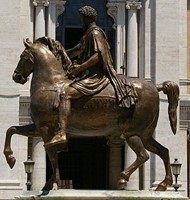
Hadrian Era Sculpture (117-138) In the sculpture of the reign of Hadrian, the most noticeable change is a reaction from the elaboration of Flavian and Trajanic art towards a simpler and more idealistic treatment. Portraits lose something of their intense realism, and in reliefs there is less attempt at spatial effects and less crowding of the figures. It is natural to attribute these changes to a new wave of Greek influence. Since Hadrian himself was a lover of Greek art and lived for some time in Athens, it is generally assumed that they were due largely to his personal taste and influence, and the new movement is conveniently called the "Hadrianic revival". An excellent example of the new tendencies is a relief found in 1908 not far from Rome, in which Antinous is represented as the God Silvanus. Antinous was a favorite of Hadrian's, who, after his mysterious death in Egypt, where he is said to have killed himself to avert some danger from the Emperor, was deified and worshipped throughout the empire. He was frequently identified with one of the youthful divinities, as he is here with Silvanus. The simple, standing figure, holding a pruning-hook and accompanied by a dog, is reminiscent of the Attic grave reliefs of the fourth century, while the altar and the grapevine suggest comparison with the Hellenistic "pictorial" reliefs. On the altar is the signature of the sculptor, Antonianus of Aphrodisias, a town in Caria. There are several other works of the early second century signed by artists from Aphrodisias, so that it seems clear that at this time a "school of Aphrodisias" must have established a considerable reputation. Antonine Dynasty Sculpture (138-192 CE) The effects of the Hadrianic revival lasted for many years. They are evident in most of the reliefs from the reigns of the Antonine emperors, Antoninus Pius (138-161), Marcus Aurelius (161-180), and Commodus (180-192). In these, in general, there is little crowding of the figures, and attempts at spatial effects are not pronounced. The "Relief of Marcus Aurelius" (Capitoline Museum, Rome) in which Marcus Aurelius is represented sacrificing before the temple of Jupiter Capitolinus, is a good example. The careful representation of actual buildings to show the setting of an action is very common in Roman reliefs throughout the period of the Empire and is another bit of evidence of the Roman love of what is real and tangible, in contrast to the idealistic tendency of most Greek reliefs. The most impressive relic of the Antonine period is the column of Marcus Aurelius, in which the triumphs of that emperor over the Germans and the Sarmatians are celebrated. This monument is clearly an imitation of the column of Trajan, with a spiral band of reliefs worked out in the continuous method. The transitions, however, are not quite so cleverly managed as in the earlier monument, and the workmanship, on the whole, is rather less skilful. In the portraits of the period, a number of interesting changes appear. Hadrian had introduced the fashion of wearing a short beard. Under the Antonines, longer beards and longer hair were worn, and the sculptors of the time were quick to realize the possibilities of contrast between the masses of hair and the flesh of the face. Hair and beard were rendered in flowing locks, deeply undercut with the drill so as to produce shadows, whereas for the face the marble was carefully smoothed and sometimes polished. At the same time, the practice of suggesting the eye more definitely by outlining the iris and introducing one or two drill holes for the pupil - a method occasionally used in earlier times - became general. Severan, Diocletian, Constantine Sculpture (192-330 CE) After the death of Commodus, the decline in the sculptor's art appears to have been rapid. Even on the arch of Septimius Severus (dedicated in 203), the small and carelessly carved figures offer a striking contrast to the dignified and carefully studied compositions of the public monuments of the preceding centuries; and from the greater part of the third century, no historical reliefs have survived. The brief and troubled reigns of the many emperors of this time were naturally unfavorable to the production of elaborately decorated monuments. Our knowledge of the period, therefore, depends largely on the marble sarcophagi which were carved to receive the bodies of the dead. Such monuments are not unknown from the earlier centuries, but their use became more general during the third century, and great numbers of them have been preserved. Since they were made to be placed against a wall in underground tombs, only three sides, ordinarily, were decorated with reliefs. The subjects were taken almost exclusively from Greek mythology, an interesting proof of the persistence of Greek influence. Sometimes these subjects are such as have a possible reference to death - the carrying off of Persephone, Diana and Endymion, Cupid and Psyche, and many others. Often, however, they have no connection with the use of the sarcophagi - Dionysus and his train were constantly represented - and it is evident that the makers were simply reproducing traditional compositions for decorative effect. But though the subjects are largely Greek, the style, with rare exceptions, is that of the later Roman monuments. Figures are closely crowded, with deep undercutting to produce heavy shadows, though the relief, in general, is kept in one plane. Proportions are often incorrect, facial expression is exaggerated, and the work usually betrays haste and carelessness. In the composition, the continuous method is frequently employed. In the portraits of the later Roman age, the decline is not so pronounced. Throughout the third century and even well into the fourth, the makers of portraits were still able to reproduce the features of their subjects and to suggest character with no little skill, in marked contrast to the cruder workmanship of the mass of the sarcophagi. Reliefs on the Arch of Constantine The condition of the sculptor's art towards the close of the period can best be seen on one of the most famous of Roman monuments, the Arch of Constantine. This arch, which probably was erected as early as the first century after Christ and afterwards dismantled, was rededicated by Constantine in the year 315, to commemorate his triumph over Maxentius and the firm establishment of his power. Much of the sculpture with which it is adorned was taken from earlier works, especially from monuments of Trajan and Marcus Aurelius. The character of the parts that date from Constantine's reign is well illustrated in the scene in which the Emperor distributes gifts to the people. How different are the figures from those of earlier reliefs! Monotonously ranged side by side, they appear more like puppets than like participants in a common action. Each seems carved for itself, as a spot in a decorative design, and all details, such as the folds of the robes, are superficially and formally rendered. In the isolation of the individual figures, some critics' see yet another of those experiments with effects of light and shade which so engaged the attention of the sculptors of the Roman epoch. But even if this is admitted, the squat and dumpy figures bear witness to a marked decline from the work of the early empire. Interest in the human figure and interest in the grouping of figures to suggest action, which up to this time were the leading concerns of the sculptor, seem almost entirely lost, and it is clear that we stand on the threshold of a new period. Roman Sculpture in the Provinces Outside of Rome and Italy, where Roman sculpture naturally attained its fullest development, many monuments similar in character to those of the capital are preserved. In some cases, the workmanship is excellent, but for the most part, the authors of these monuments were decidedly less skilful than the sculptors of the capital, and Roman provincial sculpture is interesting primarily for its subjects and for the evidence it affords of the extent to which Roman ideas affected the many peoples whom the Romans conquered. Such monuments, in general, are more numerous in the western than in the eastern provinces of the empire. In the eastern provinces, monuments of distinctively Roman type are rare. In this region the traditions of Hellenistic Roman art persisted with undiminished vigour for many years, until, modified by new ideas from Persia and the near Orient, they gradually developed into Early Christian art (c.150-1100). General Characteristics of Roman Sculpture In a broad sense, it is true that Roman sculpture represents the last stage in the evolution of Greek sculpture. But it is a mistake to regard it, as many critics of the 19th century (such as John Ruskin) were inclined to do, as merely a late and degenerate phase of the Greek development. In some fields, notably in portrait sculpture and in the development of plant and foliage ornament, the sculptors of the Roman age advanced beyond their predecessors and introduced new ideas which profoundly influenced later generations. If, as seems probable, they did not invent the "illusionistic" style and the "continuous method of narration," they certainly developed them more completely and logically than earlier sculptors had done. The value of these innovations has been variously estimated. By some modern art critics, they are regarded as further evidence of the originality and genius of the artists of the Roman period, by others, as mistaken attempts to enlarge the possibilities of sculpture. The attempt to suggest depth, as well as height and width, is thought by many to be more appropriate to painting than to sculpture, and even when it is undertaken with full knowledge of the laws of perspective, is held to transgress the bounds of the sculptor's art. The continuous method has been characterized by one competent critic as a relic of primitive art "which the Greeks had almost civilized off the face of the earth." Whatever one may think of these conflicting opinions, the fact remains that the artists of the Roman age endeavored to realize possibilities in sculpture that the men of earlier times had for the most part neglected, and the "Roman episode," as it has sometimes been called, well deserves the more careful study that has been devoted to it in recent years. NOTE: For more about the influence of the Antique on 20th century artists, see: Classical Revival in modern art (1900-30). Related Articles For articles about sculpture in Ancient Greece, please see: • Daedalic Style Sculpture (c.650-600 BCE) • Early Classical Greek Sculpture (c.480-450 BCE) • High Classical Greek Sculpture (c.450-400 BCE) • Late Classical Greek Sculpture (c.400-323 BCE) |
|
|
|
• For more about the sculpture of Ancient Rome, see: Homepage.
ENCYCLOPEDIA OF ART and CLASSICAL ANTIQUITIES |