Jacques Louis David
Biography of Neoclassical French History
Painter, Portaitist of Napoleon.
MAIN A-Z INDEX - A-Z of ARTISTS

|
Jacques Louis David
|
|
|
Jacques-Louis David (1748-1825)Contents • Biography |
|
WORLDS TOP ARTISTS WORLD'S BEST ART |
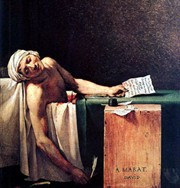
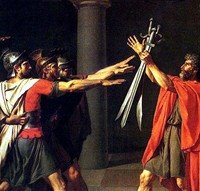
One of the most celebrated French painters of his day, Jacques-Louis David was the principal exponent of neoclassical art (flourished 1770-1830) - a style that rejected the light-heartedness of the Rococo school in favour of the austere spirit and ordered forms of classical art, which were more in keeping with the European Age of Enlightenment. Neoclassicism was both a reaction against the decadence of the French court and also a cultural response to the Roman art discovered at Herculaneum and Pompeii (1738-50), as exalted by the German historian and scholar Johann Winckelmann (1717-68). Close to Robespierre, and other revolutionary leaders of the new French Republic, who often used his monumental neoclassical painting as propaganda, J-L David later became official painter to the Emperor Napoleon. His most famous paintings include The Oath of the Horatii (1785, Louvre, Paris); The Death of Socrates (1787, Metropolitan Museum of Art, New York); The Lictors Returning the Bodies of his Sons to Brutus (1789, Louvre); Death of Marat (1793, Musees Royaux, Brussels) and the Sabine Woman (1794, Louvre, Paris). As well as being one of the best history painters of the late 18th century, J-L David is also considered to be one of the best portait artists in French art. He influenced a large number of his contemporaries including the romantic Delacroix (1798-1863) as well as the classicist Ingres (1780-1867). |
|
NEOCLASSICISM WORLD'S COSTLIEST ART
|
|
|
David was born to a wealthy Parisian family in 1748. When he was seven, his father was shot dead in a pistol duel, so he was brought up by his uncle, Jacques Buron. He showed a desire to paint at an early age, and his mother eventually sent him to her cousin, the artist Francois Boucher (1703-70) to study fine art painting. Painting was an important means of communication for David, particularly after he developed a stutter when his face was slashed during a sword fight. However Boucher did not get on with the boy, so in 1766 he sent him instead to Joseph Marie Vien (1716-1809), one of the leading French Neoclassical artists. In 1771, J-L David's entry for the Prix de Rome, The Combat of Minerva and Mars (Louvre), was awarded only the second prize; it was not until 1774, after a number of setbacks that almost drove him to suicide, that he finally won the first prize for his painting Eristratus Discovering the Cause of Antiochus' Illness (Ecole Nationale Superiere des Beaux-Arts, Paris). This allowed him to take up a 5-year study period in Rome under Vien, who had just been appointed Director of the French Academy there. |
|
|
The five years in Rome were decisive in the evolution of J-L David's art. Having left Paris determined not to be carried away by the remains of classical antiquity, he found himself overwhelmed, when he reached Rome, by the grandeur of its civilisation. He also became caught up in the great Neoclassical movement and was introduced to the new theories propagated by Anton Raphael Mengs (1728-79) and the archeologist Winckelmann. Abandoning painting for the time being in favour of drawing, David set out to study the monuments of ancient Rome as well as the works of the Old Masters, and one can follow the evolution of his aesthetics in his sketchbooks (Louvre; Fogg Art Museum, Cambridge, Massachusetts; National Museum, Stockholm). Few paintings from this period are known: the most important, St. Roch Interceding with the Virgin for the Plague-Stricken (1780, Musee des Beaux-Arts, Marseille), painted on his return from a visit to Naples, marks a break with the teaching of Boucher, and even with that of Vien. The realism of the figure in the foreground, together with the expression of the faces, shows that David had been studying The Plague-Stricken of Jaffa (Louvre) by Antoine-Jean Gros (1771-1835). The most ambitious of these paintings is the recently discovered Funeral of Patroclus (1778, National Gallery, Dublin), illustrating a passage from the Iliad, a canvas still full of echoes of the Baroque, but built upon quieter rhythms. In 1780 David returned to Paris where he quickly became known for his anti-Rococo neoclassical painting. He subordinated his use of colour to drawing, and this economy of style was very much in keeping with the preferred style of the French Academy, and the severity of the time (he was pro-republican and anti-royalist). The themes of his work expressed self-sacrifice, devotion to duty and austerity. In any event, the maturity and experience he had gained during his years in Rome are evident in his 1781 Salon exhibit, Belisarius Recognized by the Soldier (Musee des Beaux-Arts, Lille), and in Andromache Mourning Hector (1783, Pushkin Museum of Fine Art), entered for the Academy Salon two years later. His reputation was now growing, and he opened a studio that soon attracted pupils, among them Anne-Louis Girodet (1767-1824) and Germain Drouais (1763-88). In 1784, in response to a commission, he decided to paint the subject of The Oath of the Horatii (Louvre) and set off again for Rome, in order to carry out the project in a 'classical' atmosphere. Exhibited in Rome before being sent to the Paris Salon of 1785, the painting - in which line and atmosphere, together with a renewed classic humanism, are more important than colour and movement - was a huge success and was hailed as the manifesto of Neoclassicism. In 1787, faithful to the formula of the Horatii, a classical subject with only a few figures, David exhibited The Death of Socrates (Metropolitan Museum, NY), then The Lictors Returning the Bodies of his Sons to Brutus (1789, Louvre) and The Love of Paris and Helene (1788, Louvre). |
|
The French Revolution (1789-93) With the Revolution, David leaped from history into actuality. A passionate militant, he put his art and his person at the service of the revolutionaries. Successively deputy to the Convention, a member of the Committee of Public Safety, and convener of Revolutionary feasts and ceremonies, he was active in all these fields. When he took up his brush, it was to illustrate certain episodes of the time - tragic, The Death of Marat (1793, Museum of Modern Art, Brussels) [the art critic Simon Schama has said, "if there's ever a picture that would make you want to die for a cause, it is the Death of Marat"] or heroic, The Oath of the Tennis Court (1791, pen and brown ink, with white highlights, Musee National du Chateau de Versailles), a painting that was never finished) - with a force and truth that are to be found again in his intense, direct portraits of relations, friends or people he admired. Compare David's conventional and uplifting history paintings with the infinitely more revolutionary Third of May, 1808 (1814, Prado, Madrid) by his Spanish contemporary Goya (1746-1828). The frankness of observation and sureness of execution that already characterize the Portrait of Count Potocki (1780, National Museum, Warsaw) and the first portraits of the Buron or Sedaine families show how David, escaping from the aesthetic constraints of classicism, was able to channel his talents into portrait art. And his incomparable technique triumphed in the well-known portraits of Portrait of Antoine-Laurent and Marie-Anne Lavoisier (1788, Metropolitan Museum of Art, New York), the Marquise d'Orvilliers (1790, Louvre), Madame Trudaine (c.1791, Louvre), Madame de Pastoret (Chicago Art Institute) and Portrait of Emilie Seriziat and Her Son and Portrait of Pierre Seriziat (both 1795, Louvre), who stand out with a monumental simplicity against a neutral background. David became close friends with Maximilien Robespierre and in 1794, after the fall of Robespierre, David was accused of high treason and twice imprisoned in the Palais du Luxembourg, which had been turned into a prison. His wife divorced him (she was a royalist), but they were remarried in 1796 on his release. During this time, apart from the View of the Garden of the Luxembourg Palace, (1794, Louvre), the only landscape painting he ever painted, he conceived The Intervention of the Sabine Women (Louvre), which he finished later in 1799 and which displays an urge towards greater stylistic perfection in imitation of Greek art. The following year he undertook, though without finishing it, the Portrait de Madame Recamier (1800, Louvre), in which the sitter is depicted half stretched out on a sofa of classical style, her supple white tunic offering a delicate contrast with the lightly touched grey of the wall and floor. A meeting with Napoleon Bonaparte, whose features he recorded in a brilliant sketch (c.1797-8, Louvre) and in the heroic image in the Equestrian Portrait of Napoleon at the St-Bernard Pass (1800; versions at Malmaison, Versailles, and Berlin, Charlottenburg), led to David's appointment as the Emperor's chief painter in December 1804. Charged with commemorating the main scenes of the coronation celebrations, David planned four compositions, of which two were carried out: Consecration of the Emperor Napoleon I and Coronation of the Empress Josephine in the Cathedral of Notre-Dame de Paris on 2 December 1804 (1808, Louvre), and The Distribution of the Eagles (1810, Versailles). The two others, The Enthronement and The Arrival at the Hotel de Ville, are known only from drawings (Louvre; Lille Museum). But for all the glory and the international reputation that he now enjoyed, David failed to be appointed Director of the Paris Academy of Fine Arts as he had hoped, and gave up his official work and the official world. In 1813 he resumed work on the Leonidas at Thermopylae (1814, Louvre); commissioned in 1802, the painting had been interrupted on Napoleon's orders, although the Emperor was to admire it on his return from Elba in 1815. Certain official portraits of this time are among the most remarkable of all David's work: Portrait of Comte Francois de Nantes (1811, Paris); Portrait of Napoleon in His Study (1812, National Gallery of Art, Washington DC) and Madame David, (1813, National Gallery of Art, Washington DC). These paintings showed the development of his new 'empire' style which was noticeable for a warming in the colours of his palette.
Self-Imposed Exile in Brussels After the fall of the Republic, the new Bourbon King Louis XVIII, an admirer of David's work, granted him amnesty and even offered him the position of court painter. David declined and chose to go into exile in Belgium instead. Given an enthusiastic welcome by his old Belgian pupils, he opened a studio in Brussels and spent the last years of his life painting smaller-scale works on the theme of love, inspired by mythology and classical literature - Cupid and Psyche (1817, Cleveland Museum); Telemachus and Eucharis (1818, private collection); Mars Disarmed by Venus and the Graces (1824, Musee d'Art Moderne, Brussels). These works reveal a certain departure from his theories, but the neoclassical portraits painted at this time, in their sobriety and frankness, set him in the great line of French portrait painters from Jean Fouquet (c.1425-80) to Paul Cezanne (1839-1906) (Monsieur et Madame Mongez, 1812, Louvre; Sieyes, 1817, Fogg Art Museum, Cambridge, Massachusetts; Comte de Turenne, N.C.G. Copenhagen; Comtesse Daru, 1820, Frick Collection, New York), as does his reworking of The Coronation (1821, Versailles), and Portrait of Charlotte and Zenaide Bonaparte (1821, J. Paul Getty Museum, Malibu) with the help of his pupil and collaborator Georges Rouget. His last great work begun in 1822, Mars Disarmed by Venus and the Three Graces (1824, Musee d'Art Moderne, Brussels) was only just finished when he died on 2nd December 1825 (after being hit by a carriage).
Reputation As an Artist, Legacy In turn admired and decried, proclaimed by his supporters as the renewer of French painting and by Eugene Delacroix as 'the father of modern painting', David was also accused of fostering, through his theories, the worst kind of academic art or academicism, yet the influence of his direct and deliberate art, no less than his powerful vision, was profound. To the classicists, like Ingres and his pupils, he transmitted ideas, a language, a sense of formal beauty, and to the supporters of Romanticism, through Antoine-Jean Gros, the inspiration that led him to conceive enormous paintings or huge decorative pieces. His work, in consequence, still poses unresolved problems, for it exemplifies that 'remarkable mixture of realism and the ideal' that Delacroix was to speak of later. Works by the French neoclassicist painter Jacques Louis David can be seen in the best art museums around the world. |
|
• For information about the best artists, see: Homepage.
Visual
Artists, Greatest |