Ancient Art
History, Characteristics of Stone, Bronze,
Iron Age Cultures.
MAIN A-Z INDEX

|
Ancient Art
|
|
|
Ancient Art (2,500,000 BCE - 400 CE)Contents • Stone Age Further Resources • For an introduction to Stone Age
arts and crafts, see: Prehistoric Art. |
|
|
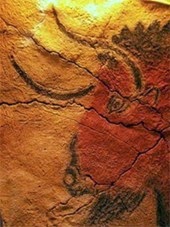
Stone Age Art (From c.2,500,000 BCE)Paleolithic Art (c.2,500,000 – 10,000 BCE) The earliest art of prehistory, created during the Lower Paleolithic Age, is the Bhimbetka Petroglyphs, found in the Auditorium cave in Central India and dated to at least 290,000 BCE. Next oldest is the Venus of Berekhat Ram (c.230,000 BCE) discovered on the Golan Heights, and the Venus of Tan-Tan (c.200,000), discovered in Morocco. Also, stone engravings have been found at the Blombos Cave in South Africa dating from 70,000 BCE. The first type of so-called "cave art", is the cave painting in Cantabria, as exemplified by the abstract El Castillo cave paintings dated to 39,000 BCE. For more, please see: Prehistoric Abstract Signs. Early mobiliary art includes the Swabian Lion Man of Hohlenstein-Stadel (38,000 BCE). After this comes the miniature female sculptures, known as the Venus Figurines, as exemplified by the ivory Venus of Hohle Fels (38,000-33,000 BCE), the Venus of Willendorf (25,000 BCE), and the Venus of Brassempouy (23,000 BCE) and the Venus of Kostenky (22,000 BCE). The most ancient pottery - currently Chinese pottery (for more details please see Xianrendong Cave Pottery) - also appeared from about 18,000 BCE. For more, see: Pottery Timeline. Up until recently, paleoarcheologists and art historians considered that neither Homo errectus nor the early sub-species of Homo sapiens (eg. Neanderthal man, who died out about 35,000 BCE) were capable of creating cave painting or other types of parietal art. Instead, they considered that the oldest art was created by "anatomically modern man" after 40,000 BCE, exemplified by the abstract art at El Castillo, the primitive engravings at the Abri Castanet (c.35,000 BC), the figurative Chauvet cave paintings (c.30,000 BCE) in the Ardeche, the polychrome Lascaux cave paintings (c.17,000 BCE), the Altamira cave paintings (15,000 BCE), and the extraordinary Addaura Cave engravings (11,000 BCE). However, this view is now changing - not least because microanalysis of the Venus of Berekhat Ram has shown that it was shaped by human hand, and because of the conclusive dating of the cupules at Bhimbetka, now the world's oldest rock art. For more, see: Paleolithic Art (2,500,000-10,000 BCE). |
|
Prehistoric Chronology • Aurignacian
Art
|
|
ANCIENT PAINTING |
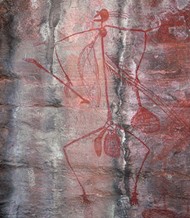
Mesolithic Art (c.10,000-4,000 BCE) Artworks created by Mesolithic hunter-gatherers include petroglyphs, stylized cave paintings, hand stencils - as in the Cave of Hands (Cueva de las Manos) (7,000 BCE) in Argentina - body adornments like bracelets as well as functional objects like paddles and weapons. These types of Mesolithic art have been located in many different areas around the world, including the Waterberg area in Africa, the Rock Shelters of Bhimbetka in India, Arnhem Land in Australia. Jomon pottery, an early exemplar of Japanese Art also emerged during the early Mesolithic. • For more details of primitive native
artworks, see: Tribal Art. Neolithic Art (c.4000–2000 BCE) Neolithic art, influenced by the development of agriculture, and animal husbandry, was responsible for more portable art and less rock/cave painting. Artworks become enhanced by the use of precious metals (eg. copper), and the design of new tools. Free standing sculpture, statues, pottery, primitive jewellery and decorated artifacts become more common during this time. The advent of hieroglyphic writing systems in Sumer heralds the arrival of pictorial methods of communication, while greater prosperity leads to more religious activity and religious art in temples and tombs. A great example of Neolithic art includes: the "Thinker of Cernavoda", a sculpture found in Romania. Another significant category of megalithic art, concerns megaliths made out of large stones such as the Passage Tomb at Newgrange (Dún Fhearghusa), the UN World Heritage site in County Meath. See also: American Indian art for a short guide to tribal culture at this time. For Neolithic cultures of the Far East, see Neolithic Art in China (7500-2000 BCE) and Xia Dynasty Culture (2100-1600 BCE). Bronze Age Art (c.3000-1200 BCE) The best examples of Bronze Age art appeared in the 'cradle of civilization' around the Mediterranean in the Near East, during the rise of Mesopotamia - see Sumerian Art and Mesopotamian art as well as Mesopotamian sculpture - Greece, Crete (Minoan civilization) and Egypt. The emergence of cities, the use of written languages and the development of more sophisticated tools led the creation of a wider range of ceramics. Other Bronze Age art included statues, sculptures and paintings of Gods. During this period, art began to assume a significant role in reflecting the community, its rulers and its relationship with the deities it worshipped. For other cultures of the Middle East, see: Assyrian art (c.1500-612 BCE) and Hittite art (c.1600-1180 BCE). Egyptian Art (from 3100 BCE) Ancient Egypt is most famous for its monumental Egyptian Architecture (c.3000 BCE - 160 CE), and its associated Egyptian sculpture. It is also the first civilization with a recognizable style of art. In paintings, artists depicted the head, legs and feet of their human subjects in profile, while portraying the eye, shoulders, arms and torso from the front. Other conventions dictated how Gods, Pharaohs and ordinary people should be portrayed, and regulated the size, colour and figurative positions of these images accordingly. Women were painted with fair skin, men with dark skin. Much of Egyptian art in tombs and temples (hieroglyphs, papyrus scrolls, murals, panel paintings and sculptures) reflects religious themes, especially those concerning the afterlife. In modern times, a number of outstanding Egyptian encaustic wax paintings, known as the Fayum Mummy portraits, dating from 50 CE, have been found preserved in coffins. These pictures offer a fascinating glimpse into the styles, customs and culture of the day. See also: Early Egyptian Architecture (3100-2181); Egyptian Middle Kingdom Architecture (2055-1650); Egyptian New Kingdom Architecture (1550-1069); Late Egyptian Architecture (1069 BCE - 200 CE). |
|
|
Minoan Art (c.1600 BCE) The first major strand of Aegean Art - Minoan civilization (named after King Minos) - grew up during the bronze age on the island of Crete. By 2100 BCE they had built up a prosperous maritime trade with countries around the Mediterranean from buying tin and combining it with copper from Cyprus, to make bronze - the key metal of the time. This prosperity led to the construction of palaces and court buildings at Knossos, Phaestus, Akrotiri, Kato Zakros and Mallia, along with other public buildings. Thus emerged a Minoan art and culture noted for its sculpture, metalwork, fresco painting, pottery, and stone engravings (particularly seal stones). In about 1500 BCE, following an unknown catastrophe the Minoan civilization collapsed, and around 1425 BCE the Minoans were conquered by the Mycenaeans.
|
|
|
The Iron Age saw a huge growth in artistic activity, especially in Greece and around the eastern Mediterranean. It coincided with the rise of Hellenic (Greek-influenced) culture. See Art of Classical Antiquity (1000 BCE - 450 CE). The period is typically classified into several smaller periods: the Dark Ages (c.1200-900 BCE), the Geometric Period (c.900-700 BCE), Oriental-Style Period (c.700-625 BCE), the Archaic Period (c.625-500 BCE), the Classical Period (c.500-323 BCE), and the Hellenistic Period (c.323-100 BCE). |
|
Mycenean Art (c.1400-1000 BCE) Mycenae was an ancient Greek city in the Peloponnese. But the term "Mycenaean" or "Mycenean" culture commonly denotes mainland Greek culture as a whole during the late Bronze Age (c.1650-1200 BCE). At first, Mycenean/Greek arts were dominated by Minoan culture. Minoan artists and painters visited Greece regularly. In contrast to the Minoans, Mycenean kings were warriors with a tradition of conquest. Mycenean painters and sculptors emphasized military and other mythological exploits, in a more formal 'geometric' style than that of the Minoans. Mycenean art encompassed ceramics, pottery, carved gemstones, jewellery, glass ornaments, as well as tomb and palace murals, frescoes and sculptures. Celtic Art (c.500 BCE - c.17 CE) By around 1100 BCE, the Celts, an Indo-European group of tribes had established themselves in a controlling position astride the main trade routes along the river systems of the Rhone, Seine, Rhine and Danube. Between 1100 and 700 BCE, they were the first non-Mediterranean people to develop iron which gave them the technological superiority to colonize their neighbours throughout France, Germany, Austria, Switzerland, Hungary, Slovakia. Two styles of Iron Age Celtic art emerged: Hallstatt and La Tene. The more advanced La Tene form of Celtic culture was characterized by its distinctive geometric designs and stylized bird and animal forms, as exemplified by the decorative designs on the stonework of the Turoe Stone, one of the earliest examples of visual art in Ireland. Celtic metalwork also achieved an extremely high standard of craftsmanship, as exemplified by the Irish Petrie Crown and Broighter Collar. La Tene style Celtic Designs were strongly influenced by the Mediterranean culture of the Greek and Etruscan civilizations and continued to flourish until the advent of the Roman Empire. |
|
Classical Greek Art (500-323 BCE) Hellenism (323-31 BCE) During the era of Hellenistic art, classical realism was replaced with greater solemnity and heroicism, an almost Baroque-like dramatization of subject matter. The principal art-forms were Hellenistic painting, Hellenistic free-standing sculpture and reliefs. Famous examples of Greek sculpture include: "Dying Gaul" (c.232 BCE) by Epigonus; the frieze "Altar of Zeus" at Pergamum(c.180 BCE); "Aphrodite, Pan and Eros" (c.100 BCE); the "Winged Victory of Samothrace" (c.1st/2nd century BCE), now in the Louvre; "Laocoon and His Sons" by Hagesandrus, Polydorus and Athenodorus (c.40-31 BCE). The famous marble statue known as the "Venus de Milo", now in the Louvre Museum, Paris, was completed around 100 BCE. During this period, new forms secular patrons of the visual arts emerged who influenced the choice of subject matter in sculpture, painting and mosaics. Meanwhile, the rise of Roman power caused many Greek artists to move to Italy to participate in the growing Roman art market. In Egypt, the most famous example of Hellenistic painting was the Fayum Mummy portraits, unearthed mainly west of the Nile in the Faiyum Basin.
Art of Ancient Rome (c.200 BCE - 400 CE) Roman architecture and engineering was always grandiose, but its paintings and sculptures remained largely imitative of Greek art. Greek styles, reworked with Roman clothes and accessories, were used to reinforce Rome's power and majesty. Early Roman art (c.200-27 BCE) was realistic and direct. Portraits of their leaders were detailed and unidealized, but they, along with sculptural reliefs, friezes and wall paintings, were used nevertheless to convey political messages through the poses and subject matter. Later Hellenistic Roman art (c.27 BCE - 200 CE) during the height of Empire, was more heroic, as in Trajan's Column (c.106-113 CE). Decorative arts flourished throughout the Roman area, largely through a proliferation of murals. Panel painting was regarded more highly, being executed in tempera or in encaustic pigments. Roman sculpture was commissioned mainly for its visual effect on the public. The underlying message of Roman greatness was rarely far from the surface. Late Roman art (200-400 CE) came under the influence of the Eastern Roman Empire in Constantinople, and also during this period we ssee the emergence of both Celtic Roman art and Christian Roman art. FOR MORE ABOUT ANCIENT ART, BROWSE |
|
• For more about painting and sculpture from Antiquity, see: Homepage.
ENCYCLOPEDIA OF ART |