Petroglyphs
Prehistoric Rock Art, Engravings, Carvings,
Stone Reliefs.
MAIN A-Z INDEX - A-Z of PREHISTORIC ART

|
Petroglyphs
|
|
|
Petroglyphs (290,000 - 4,000 BCE)Contents • What Are Petroglyphs?
Definition, Characteristics |
|
|
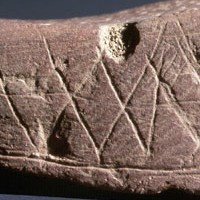
What Are Petroglyphs? - Definition, Characteristics In prehistoric art, the term "petroglyphs" (derived from the Greek word "petra" meaning stone, and "glyphein" meaning to carve) is used to describe any image created on a rock surface by scouring, scratching, engraving, chiseling, carving or any similar method. Note, however, that painted or drawn images on rocks are not classified as petroglyphs: instead, they are defined as pictographs. Rock engravings are by far the most ubiquitous type of Stone Age art, having been found in all parts of the prehistoric world, with the greatest density in parts of Saharan Africa, South Africa, Scandinavia, Siberia, and Australia. Typical of this form of ancient art are the Wonderwerk Cave Engravings, discovered in Northern Cape Province, South Africa. Consisting of geometric designs, ideomorphs as well as representations of Animals, they date from the Neolithic period, about 8,200 BCE. (To see how this type of ancient stonework fits into the development of visual art during the period of prehistory, see: Prehistoric Art Timeline.) |
|
|
|
|
What is the Difference Between Petroglyphs and Rock Art? Whereas a petroglyph is a narrow type of stonework, the term "rock art" is a much wider term which embraces three types of art: (1) Petroglyphs; (2) Pictographs, including cave painting or any other form of pictorial symbol; and (3) Megalithic Art, or petroforms, involving the arrangement of stones (eg. Stonehenge stone circle, Salisbury Plain, England).
What Are the Oldest Petroglyths? The oldest art in this particular category of prehistoric rock carving are the Bhimbetka Petroglyphs in the Auditorium cave situated at Bhimbetka in India. Excavations at a sister site (Daraki-Chattan) have confirmed that the petroglyphs were created between 290,000 and 700,000 BCE, during the Acheulian period of the Lower Paleolithic. Cupules are non-functional cup-shaped depressions found on a rock surface which are created by a number of human blows. The rock surface at cupule-sites usually shows microscopic signs of percussion, such as particles of crushed material, surface bruising, and occasionally signs of tool marks. They are most common type of petroglyph in the world.
What Was the Purpose, Function or Idea Behind Petroglyphs? It is impossible to generalize. A cupule, for instance, is a fundamentally different type of rock marking from (say) a relief sculpture or an animal engraving. As yet, no archeologist has provided a coherent explanation for the creation of cupules, while other types of rock engraving may serve as territorial maps or markers (geocontourglyph), or ritualistic, religious, totemic or linguistic markings. A recent study of the rock carvings produced by the San Bushmen of the Kalahari desert, was conducted by the Rock Art Research Institute (RARI) of the University of the Witwatersrand. It discovered a number of connections between this tribal art on the one hand, and San culture and religion (including healing and rain-making) on the other. For more about the cultural background to Stone Age carvings, and other parietal rock art, see: Paleolithic Art and Culture. Other important petroglyphs were the carvings and engravings found on megaliths at Gobekli Tepe, Newgrange and Stonehenge. |
|
|
|
|
What Are the Most Famous Petroglyphs? The best known rock engravings include: Bhimbetka Petroglyphs, at (290,000-700,000
BCE) Daraki-Chattan Petroglyphs (290,000-700,000
BCE) Blombos Cave Engravings (c.70,000
BCE)
Ferrassie Cave Cupules (c.60,000 BCE) Gorham's
Cave Engraving (c.37,000 BCE) Abri
Castanet Engravings (c.35,000 BCE) Burrup
Peninsula Rock Carvings (from 30,000 BCE but unconfirmed)
Grotte
des Deux-Ouvertures /Cave of Two Openings (c.26,500 BCE) Cosquer
Cave (c.25,000 BCE) Cussac Cave
Engravings (c.25,000 BCE) Gargas Cave
Hand Stencils (c.25,000 BCE) Roucadour
Cave Art (c.24,000 BCE) Abri du Poisson
Cave Salmon Carving (c.23,000 BCE) Coa
Valley Engravings, Portugal (22,000 BCE) Lascaux
Cave (c.17,000-13,000 BCE) Cave of La
Pasiega (c.16,000 BCE) Font
de Gaume Cave (c.14,000 BCE) La Marche Cave (c.13,000 BCE) Les
Combarelles Cave (c.12,000 BCE) Addaura Cave
Engravings (c.11,000 BCE) Wonderwerk Cave Engravings (c.8,200
BCE) Tassili-n-Ajjer Rock Art (c.8,000
BCE) Coldstream Burial Stone (c.6,000
BCE) Sydney Rock Engravings (c.5000 BCE) Dabous Giraffe Engravings (c.4,000
BCE) Newgrange Megalithic Passage Tomb
(c.3,300 BCE) Stonehenge Stone Circle (c.3100-1100
BCE) Knowth Megalithic Passage Tomb (c.2500
BCE) |
|
• For details of cave painting, engravings
and reliefs, see Parietal Art (c.40,000-10,000
BCE)
ENCYCLOPEDIA OF STONE AGE ART |