Ivory Carvings: Swabian Jura
Prehistoric Sculptures from Vogelherd,
Hohlenstein-Stadel & Hohle Fels Caves.
MAIN A-Z INDEX - A-Z of PREHISTORIC ART

|
Ivory Carvings: Swabian Jura
|
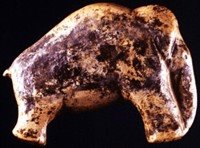 Ivory Carving of Mammoth, Vogelherd Cave, from about 33,000 BCE. A rare treasure of Aurignacian art from the Upper Paleolithic. |
Swabian Jura Ivory Carvings (c.30,000 BCE)Vogelherd Cave In 2006, archeologists from the Department of Early Prehistory and Quaternary Ecology at the German University of Tubingen unearthed the first completely intact mammoth ivory carving from the Upper Paleolithic era of the old Stone Age. Dated to 33,000 BCE, it is the oldest carving of an animal known to archeology, the second oldest example of European prehistoric sculpture after the famous Venus of Hohle Fels (c.38,000-33,000 BCE) - also discovered by archeologists from Tubingen - and one of the most outstanding examples of mobiliary art of the late Stone Age. |
|
PREHISTORIC SCULPTURES
|
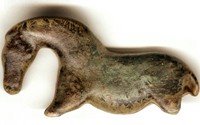
Other discoveries of prehistoric art included four other mammoth ivory animal sculptures, including a lion figurine, fragments of a second mammoth figurine and two unidentified carvings. All the artifacts were found at the site of the Vogelherd Cave in the Swabian Jura, in southern Germany. The Vogelherd mammoth ranks among the earliest art of prehistory. Stone Age Caves in the Jura The Swabian Jura, a plateau in the German state of Baden-Württemberg, is home to a large number of prehistoric caves and rock shelters (including Vogelherd, Hohlenstein-Stadel, Geißenklösterle and Hohle Fels) that have attracted the interest of Paleo-anthropologists and archeologists ever since the early 20th century. Several were successfully excavated in the early 1930s by the Tubingen archeologists Gustav Reik and Robert Wetzel - see, for instance: the Lion Man of Hohlenstein Stadel (c.38,000 BCE). During the late 1990s and early 2000s more ivory figurines of animals and birds, all dating from the Aurignacian culture of the Upper Paleolithic, were found at various sites in the region. The recent systematic investigation, which was run by Nick Conard and his colleagues Michael Lingnau and Maria Malina, began in 2005 and has already generated more than 7,000 sacks of sediment. It continues until 2009. Preliminary findings have already appeared in the journal Archäologische Ausgrabungen in Baden-Württemberg.
|
|
|
The Cave Art The woolly mammoth figurine - the first of the dozen or so Paleolithic Stone Age figurines discovered in Swabia to be recovered intact - measures 3.7 centimetres in length and weighs only 7.5 grams. Sculpted in exquisite detail using stone tools, it has a slim form, pointed tail, powerful legs and arched trunk. It is decorated with six short incised grooves, and the soles of the mammoth's feet exhibit a crosshatch pattern. The lion figurine is 5.6 centimetres in length with an extended body and neck. Its spine is decorated with a number of crosses. (Note: Lions, mammoths and other large predators dominate the cave art in the shelters of the Swabian Jura, as they do also in France at Chauvet (30,000 BCE), Pech-Merle (25,000 BCE), Cosquer (25,000 BCE), Lascaux (17-13,000 BCE) and Altamira (34-13,000 BCE). Dating Geological and radio-carbon dating tests show that the Swabian Jura figurines were created during the Aurignacian culture of the Upper Paleolithic period, associated with the replacement of Neanderthal Man by anatomically modern humans. They have been dated to at least 33,000 BCE, if not slightly earlier.
Cultural Significance Archeologists and art historians have always considered the creation of figurative art to be a key indicator in human evolution. These new finds reveal the outstanding artistry of the Stone Age inhabitants of the Swabian Jura and chronicle an aesthetically-appreciative culture that was far from primitive. Like the other archeological discoveries in 2003 of animal and therianthropic sculpture at the Hohle Fels cave, the Vogelherd cave figurines confirm that the area around the Upper Danube was an important centre of Stone Age art (including petroglyphs) and a site of great cultural innovation during the early period of the Upper Palaeolithic. Hohlenstein-Stadel Cave During the 1990s, the Hohlenstein-Stadel rock shelter in the Swabian Jura witnessed the discovery of another ancient figurine - The Lion Man of Hohlenstein-Stadel. Carved from mammoth ivory and standing 28 centimetres in height, this anthropomorphic sculpture is dated to the late Aurignacian culture, roughly 38,000 BCE. Exhibition Preliminary results from the Vogelherd excavation were presented at a special exhibition of ancient art at the Museum of Prehistory in Blaubeuren (June 2007 – January 2008). In 2009, the ivory carvings will be shown at the Stuttgart exhibition "Cultures and Art of the Ice Age." Further analysis and data can be seen in the article "Palaeolithic ivory sculptures from southwestern Germany and the origins of figurative art", by N. J. Conard, Nature 426, 830–832 (2003). For more examples of European prehistoric art from this period, see the famous "Venus Figurines", like the Venus of Willendorf (Austria) and the Brassempouy Venus (France). |
|
• For the origins of painting and sculpture, see: Homepage.
ENCYCLOPEDIA OF STONE AGE ART |