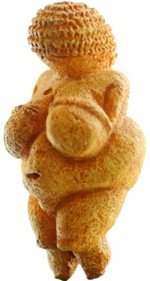
Venus of Willendorf
Description, Dating, Interpretation of
Austrian Prehistoric Figurine.
MAIN A-Z INDEX - A-Z of PREHISTORIC ART

|
Venus of Willendorf
|
|
PREHISTORIC ART
in IRELAND
CHRONOLOGY OF |
The Venus of Willendorf (25,000 BCE)Contents • Introduction One of the most famous items of prehistoric sculpture, the Venus of Willendorf was sculpted from oolitic limestone, and is one of three such figurines unearthed at Paleolithic archeological sites at Willendorf in Austria. The sites have yielded numerous artifacts dating to Gravettian culture (26-20,000 BCE). The Venus of Willendorf is one of many similar female carvings - known as "Venus Figurines" - which appeared across Europe during the period of Gravettian art (c.25-20,000 BCE). See also its older Austrian 'sister', found in nearby Stratzing, and known as the Venus of Galgenberg (c.30,000 BCE). Other similar examples of prehistoric art include: the German carving known as the Venus of Hohle Fels (35,500 BCE), the steatopygous Venus of Monpazier (c.25,000 BCE) and the French Venus of Brassempouy (c.23,000 BCE).
|
|
|
The carving was discovered in 1908 by Austrian archeologist Josef Szombathy during systematic investigations of the local Gravettian settlements in lower Austria, near Krems.
Description and Characteristics The figurine is roughly 11 centimetres in height and a maximum of 4 centimetres in width. Sculpted from yellowish limestone, tinted red by traces of ochre, the stumpy female figure features pendulous breasts, an obese middle and belly, and pronounced buttocks. In all, a realistic representation of a severely overweight woman. There is no facial detail - the head being almost completely covered by a braided pattern - and the feet appear to be broken off, while the belly button and vulva are clearly defined. The Venus of Willendorf has been classified as belonging to to the Gravettian or Upper Perigordian culture of the Upper Paleolithic period - the final period of the old Stone Age, and dated to approximately 25,000 BCE. It is part of the permanent collection of rock art in the Natural History Museum in Vienna.
|
|
|
What makes the Willendof statuette so compelling is its graphic portrayal of obesity. One feels that, despite the scarcity of food and the unlikely prevalence of overweight females, the sculptor must have worked from a model. If so, this "celebration" of what would have been rare corpulence, might be a factor in the work's interpretation. In other words, such a body shape might have been worth ritualization. The fact that no equivalent male figures have been unearthed need not undermine this theory. First because few male Stone Age figures of any description have been discovered, second because female bodies have traditionally been hallowed as fertility symbols, not unlike the Virgin Mary of modern Christianity. The Venus of Willendorf was created during the same period as several other famous Stone Age statuettes, including the bas-relief Venus of Laussel (France), the ceramic Venus of Dolni Vestonice (Czech Republic), the ivory Venus of Lespugue (France), the steatite Venus of Savignano (Italy), the stone Venus of Gagarino (Russia), as well as the Russian ivory figurines, known as the Avdeevo Venuses, the Venus of Kostenky, the Mal'ta Venuses and the Zaraysk Venuses. As yet, little is known about the origin or cultural significance of these early statuettes. For a later Russian carving from the Magdalenian period, see the Venus of Eliseevichi (14,000 BCE) from Bryansk Oblast, Russia.
|
|
• For the origins of painting and sculpture, see: Homepage.
ENCYCLOPEDIA OF STONE AGE ART |