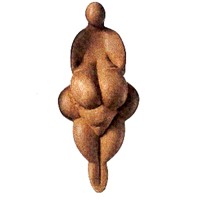
Venus of Lespugue
Prehistoric Semi-Abstract Ivory Carving:
Gravettian Fertility Symbol.
MAIN A-Z INDEX - A-Z of PREHISTORIC ART

|
Venus of Lespugue
|
|
|
Venus of Lespugue (c.23,000 BCE)Contents • Introduction |
|
EVOLUTION OF SCULPTURE
|
A famous example of Prehistoric art, this nude female statuette is one of many steatopygian Venus figurines sculpted during the Gravettian culture (26,000 - 20,000 BCE). It was discovered by the archeologist Rene de Saint-Perier (1877-1950) in 1922, in the cave of Les Rideaux, close to the village of Lespugue in Haute-Garonne near the Pyrenees. (No other cave art was found.) Approximately 6 inches in height, the ivory carving is noted for its abstraction, and for a series of unusual engravings below the buttocks, which may represent a type of textile skirt made of spun and twisted fibers, or possibly a type of ritualistic skin decorations. The sculpture is part of the collection of Paleolithic art in the Musee de l'Homme in Paris, France. |
|
|
|
|
The Venus of Lespugue shares a number of characteristics with similar works of mobiliary art created during the Upper Paleolithic. Great attention, for instance, has been paid to its feminine features, notably its enormous, pendulous breasts, protruding belly, and exaggerated hips and buttocks. At the same time, like most other Venuses, it has no facial features (though see Venus of Brassempouy) and no arms. The overall figure is lozengic in form, and tapers from a wide midriff towards the head and feet. Interpretation of the Venus of Lespugue The sculptor's clear focus on the figure's female reproductive organs and gender characteristics suggests that it might have been intended as a fertility symbol, although archeologists have so far failed to agree on a common interpretation of these obese female nudes. Forming their own special category of portable prehistoric sculpture, these small figurines - carved out of ivory, soft stone like limestone, serpentine or, more rarely, ceramic clay - have been found across Europe from the Pyrenees to Lake Baikal - though not, mysteriously in Spain, the centre of so much Paleolithic cave painting. A few - like the Venus of Hohle Fels (35,500 BCE), and the Venus of Galgenberg (30,000 BCE) - were carved during the era of Aurignacian art, but most were sculpted during the Gravettian period. The most famous Gravettian venuses include: the Venus of Dolni Vestonice (26,000 BCE), the Venus of Monpazier (25,000 BCE) - the Venus of Willendorf (c.25,000 BCE), the Venus of Savignano (24,000 BCE) and the bas-relief Venus of Laussel (c.23,000 BCE), the Venus of Kostenky (22,000 BCE), the Venus of Gagarino (20,000 BCE), the Avdeevo Venuses (20,000 BCE), the Mal'ta Venuses (20,000 BCE) and the Zaraysk Venuses (20,000 BCE). A few figurines were carved during the Magdalenian era, like the Venus of Eliseevichi (14,000 BCE), the Venus of Engen (13,000 BCE) and the Venus of Monruz-Neuchatel (10,000 BCE). Please Note |
|
• For more about prehistoric sculpture,
see: Stone Age art.
ENCYCLOPEDIA OF STONE AGE ART |