Pech-Merle Cave Paintings
Cabrerets, Lot. Prehistoric Parietal Art
- "Dappled Horses".
MAIN A-Z INDEX - A-Z of PREHISTORIC ART

|
Pech-Merle Cave Paintings
|
|
|
Pech-Merle Cave Paintings (c.25,000 BCE)Contents • Summary |
|
|
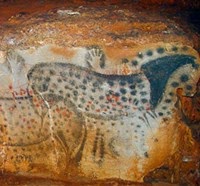
An important site of Franco-Cantabrian cave art, Pech-Merle is situated some 20 miles east of Cahors, in the Midi-Pyrenees region of France, and contains some of the most spectacular examples of prehistoric art in the world. Dating to 25,000 BCE, Pech-Merle's parietal art ranks with the Abri Castanet Engravings (35,000 BCE), the Chauvet Cave Paintings (30,000 BCE) and the engraved drawings at Grotte des Deux-Ouvertures (c.26,500 BCE) as the oldest art in France. It is particularly famous for its polychrome cave painting known as "The Dappled/Spotted Horses of Pech-Merle" which is accompanied by numerous hand stencils. Other highlights include "The Black Frieze" and the "Wounded Man" with its abstract signs of the Aviform or Placard type. Archeologists believe that the cave's rock art was completed in three phases: the first two occurred during the eras of Gravettian art and Solutrean art, between about 25,000 and 17,000 BCE; the third phase occurred about 13,000 BCE, during the later era of Magdalenian art, exemplified by the wonderful Altamira Cave paintings in Spain. To see how Pech-Merle's cave art fits in with the evolution of Stone Age art, see: Prehistoric Art Timeline (from 2.5 million BCE). Location, Discovery, Description Pech Merle cave is located near the village of de Cabrerets, in the Lot. Much of its upper level has been known to locals since the turn of the century. The painted chambers, which are to be found in the lower network of the cave were first discovered in 1922 by teenagers Andre David and Henri Dutertre, and initially examined by Father Amedee Lemozi, amateur archeologist and curate of Cabrerets, although the cave's famous Combel Gallery wasn't uncovered until 1949, when a passage was cleared through the rubble blocking it. The rubble, fortuitously, had preserved the gallery's contents in an airtight condition. Overall, the cave is spacious and dry, runs for about two kilometres and contains about 300 metres of galleries, with passages averaging about 10 metres in width and 5-10 metres in height. Chambers include: the "Hall of the Discs", the "Bear's Gallery", the "Hall of the Paintings", and the "Combel Gallery". In addition to its unique Stone Age art, it contains tools, food remains, and prehistoric footprints of children, as well as other signs of human habitation, although this is thought to have been intermittent and insubstantial. The cave has been open to the public since 1926. There are twelve other caves containing Paleolithic art within a few miles radius of the cave, although none of these are open to the public.
|
|
|
|
|
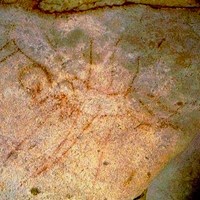
The cave art at Pech Merle consists of some 570 separate images. Unusually, and unlike Chauvet, Lascaux and Altamira, there are more abstract pictographs here, than animal pictures. Only about 60 animal images have been identified: 21 woolly mammoths, 12 horses, 7 bison, 6 aurochs, 6 reindeer, 2 ibex, 1 lion, 1 bear and 3 indecipherable creatures. In addition, there are 12 images of humans - 8 relatively naturalistic, and 4 schematic. The abstract art includes: a number of aviforms or Placard-type signs - including two next to the picture of the "Wounded Man". These signs occur in three paintings at Pech-Merle, eleven paintings at Cougnac Cave (c.23,000 BCE), and in seven engravings at Le Placard Cave (17,500 BCE). There are also a large number of black and red dots, and other abstract symbols. As well as paintings and pictographic imagery, there are numerous engravings - similar to the contemporaneous Cussac Cave Engravings (c.25,000 BCE) - and some prehistoric sculpture, including a bison carved in natural relief.
"Dappled Horses of Pech-Merle" and other highlights The great masterpiece of the early phase of art at Pech Merle (Gravettian) is the dappled or spotted horse panel - four metres in length, carbon-dated to roughly 25,000 BCE. It features two horses back-to-back and partly superimposed, as well as numerous red and black hand stencils and other abstract imagery. This period of activity also features the series of dots, circles, hand stencils and crude finger drawing on the large "hieroglyph ceiling." (For a comparison, please see the El Castillo cave paintings in Cantabria, which include a number of hand stencils and abstract symbols.) The main highlights of the second phase (Solutrean) are the painting of the "Wounded Man", and the cave's 40 black drawings (c.20,000 BCE), notably the two dozen or so grouped on the famous "Black Frieze" or Chapel of the Mammoths. This assemblage includes images of 11 mammoths, 5 bison, 4 horses, 4 aurochs and a quantity of abstract markings. Colour pigments used were predominantly black manganese oxide and red ochre. (For details of the colour pigments in Stone Age cave painting, see: Prehistoric Colour Palette.) The final phase of parietal art at Pech-Merle,
undertaken during the Magdalenian period, involved a number of rock
engravings, including the famous engraved drawing of a bear in The
Bear's Passage, dating to about 11,000 BCE. There are a number of other painted caves and rock shelters in the Lot-Cele area dating back to the period of Upper Paleolithic art, including: • Cuzoul des Brasconies (260
metres in length) • Grotte Carriot (200 metres
in length) • Grotte Christian (200 metres
in length) • Cave of the Counterfeiters
(150 metres in length) • Grotte du Cantal (160 metres
in length) • Cuzoul de Melanie (25 metres
in length) • Grotte Marcenac (130 metres
in length) • Cave of Sainte Eulalie (several
kilometres in length) • Cave Papetier (70 metres
in length) • Grotte du Moulin (40 metres
in length) • Grotte de la Bigourdane (30
metres in length) • Grotte de Pergouset (150
metres in length) • Lascaux
Cave Paintings (from 17,000 BCE) • Roc-de-Sers
Cave (17,000 BCE) • Font
de Gaume Cave (c.14,000 BCE) • Rouffignac
Cave (14,000 BCE) • Trois
Freres Cave (13,000 BCE) • Niaux Cave
(12,000 BCE) • Roc-aux-Sorciers
(c.12,000 BCE) • Les
Combarelles Cave (11,000 BCE) |
|
|
|
• For more details of cave painting in France, see: Homepage.
ENCYCLOPEDIA OF STONE AGE ART |