|
|
The Nabis
The term 'Nabi' means prophet in Hebrew. The group was named by the poet
Henri Cazalis who drew a parallel between the way the painters aimed to
revitalise painting as prophets of modern art and the way the ancient
prophets had rejuvenated Israel. Paul Serusier was the main proponent
of the group, but Bonnard was involved from the start, although he later
drifted in other directions. The Nabis worked in a variety of media including
oil on canvas and cardboard, wall decoration, prints, illustrations, posters,
textile and furniture. Influenced by Symbolism,
Japanese prints and Oriental design, the group's works were seen as avant-garde
for their time. Their paintings were influenced by Impressionist
painters - so although they shared the flatness of space of Art
Nouveau, they were still driven by the use of colour which they employed
in an unrealistic manner, demonstrating influences of the Post-Impressionists
Paul Gaugin and Van
Gogh. Bonnard continued to create a range of decorative
art, including posters and lithographs, his style in this medium was
primarily Art Nouveau. In the early 20th century, as art moved from traditional
representation towards Abstraction, Cubism and so on, the Nabis, whose
roots remained in Impressionism, quickly came to be viewed as conservative.
In later years, they totally abandoned experimentation in the applied
and decorative arts.
Intimism and Impressionism
From 1900 onwards, Bonnard's palette became richer in colour and his brushstrokes
became thicker, impasto.
He shared this method with Vuillard. This more Impressionist technique
and choice of subject matter (interiors, women bathing, family scenes
at the table) became known as Intimism. Bonnard's landscape
painting became brilliant in colour and brightly lit, painterly features
that were especially influential on the next generations of European painters.
His wife Marthe was the model for many of his female studies, in which
she never seems to age - he admitted to painting from memory in later
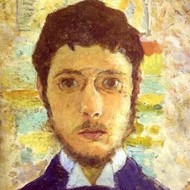
years. Bonnard also created a series of self-portraits,
which recorded the perplexities he felt about life. Bonnard rarely painted
directly from life, but rather made sketches or took photographs of his
subjects, turning only later to the studio and his canvas. Examples from
this period include: Indolence (1899, private collection); The
Terrasse Family (1900, Musee d'Orsay, Paris) and Woman in Black
Stockings (1900, private collection).
Mature Paintings
Living outside of Paris, Bonnard had little interest in modern
art movements like Fauvism, Cubism, and Futurism, all of which moved
too far along the road towards abstract
art for his liking. During the First World War, he exhibited little,
and it appears that the conflict had no impact on his art. He continued
to paint colourful, happy scenes, associated with a warm happy personal
life. In 1918 Bonnard was appointed honorary president of the Society
of Young French Painters. He was also a personal friend of the parents
and family of Count Balthazar Klossowski de Rola, better known as Balthus
(1908-2001). In 1926 he moved to the Cote d'Azur, where he remained until
he died in 1947. He continued to paint prolifically, his most notable
paintings in later years, all in private collections include: Fruit
Basket (1929-1930); Landing Stage (c.1934); Nude in the
Bathtub (1935) and Landscape of Cote d'Azur (1943). A particular
favourite was his Basket and Plate of Fruit on a Red-Checkered Tablecloth
(c. 1939, Art Institute of Chicago).
For an avid collector of Bonnard, see
Duncan Phillips (1886-1966),
who purchased 17 canvases for the Phillips
Collection.
Exhibitions
Bonnard had been holding solo exhibitions in Paris from 1904 onwards.
In 1924, he received his first retrospective exhibition. Four years later,
in 1928, he had his first one-man exhibition in New York, and from then
on his paintings became known on both sides of the Atlantic. In 1948 the
Museum of Modern Art held a posthumous retrospective of his works, although
it was originally intended to celebrate his 80th birthday. By this time
however, Bonnard's style of oil painting
had fallen out of favour with the post-war world, which found his luxurious
colours not fitting with the times. His great friend Henri
Matisse, formerly the leader of the fauvism
movement, defended Bonnard's contribution to painting on many occasions.
Happily, since that time, Bonnard has been reinstated as one of the greatest
colourists of the 20th century, and his paintings can be seen in many
of the best art museums throughout the
world. In 1988 the Tate Modern in London and the Museum of Modern Art,
New York held major retrospectives of his work. Today, his paintings sell
for up to $8 million dollars.
|