Vincent Van Gogh
Biography/Paintings Of Dutch Expressionist
Painter.
MAIN A-Z INDEX - A-Z of ARTISTS

|
Vincent Van Gogh
|
|
|
Vincent Van Gogh (1853-1890)Contents • Biography NOTE: For analysis of works by Dutch expressionist painters like Van Gogh, please see: Analysis of Modern Paintings (1800-2000). |
|
WORLDS TOP ARTISTS MODERNISM |
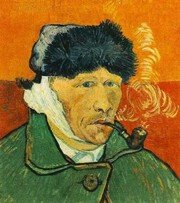
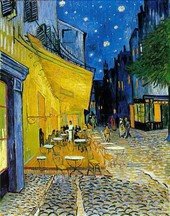
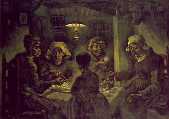
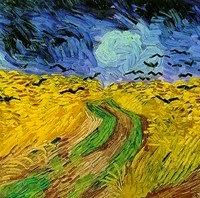
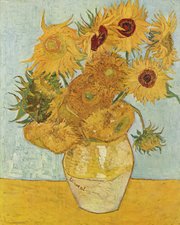
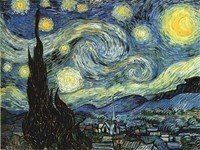
One of the most influential figures of the Post-Impressionism movement in France, Vincent Van Gogh is also seen as a seminal pioneer of 20th century Expressionism. His use of colour, rough brushwork and primitivist composition, anticipated Fauvism (1905) as well as German Expressionism (1905-13). Although he didn't start painting until the final 10 years of his life and failed to sell a single work during his lifetime, his paintings and drawings are now some of the world's best known works of modern art. In 1990, his Portrait of Dr. Gachet sold for $82.5 million, while in 1998 his Portrait of The Artist Without A Beard sold for $71.5 million. As a result, Van Gogh is now - along with Picasso and Warhol - one of the greatest modern artists. Why is Vincent Van Gogh such a popular and successful artist? First, he lived a short but fascinating life which ended in suicide; second, many of his works are autobiographical, a fact which lends extra significance to his paintings; third, his style of painting - vivid colour slapped onto his canvases with broad brushstrokes of thick impasto paint - was genuinely revolutionary, and inspired generations of 20th century painters. In particular, his highly animated style of gestural painting began a tradition which was later developed by members of the New York School. His greatest expressionist paintings include: The Potato-Eaters (1885, Van Gogh Museum, Amsterdam), Twelve Sunflowers in a Vase (1888, Neue Pinakothek, Munich), Drawbridge with Carriage (1888, Kroller-Muller Museum, Otterlo), Cafe Terrace at Night (1888, KMM, Otterlo), Van Gogh's Bedroom in Arles (1888, Musee d'Orsay), Self-Portrait with Bandaged Ear (1889, Courtauld Institute Galleries, London), Starry Night (1889, Museum of Modern Art, New York), and Wheat Field with Crows (1890, VGM, Amsterdam). The largest single collection of his work is at the Van Gogh Museum in Amsterdam. |
|
WHAT IS ART? |
|
|
Born into a very religious family - his father was a Protestant minister - Van Gogh displayed a lively talent for drawing as early as 9 years old, but it wasn't until much later (at the age of 27) that he eventually pursued his true vocation as an artist. He actually began his working life as an employee of the Goupil Art Gallery (at branches in The Hague, London and Paris). In 1878, in pursuit of his first vocation to become a priest, he started studying theology, but did not graduate due to his overly mystical determination to follow in "Christ's footsteps". However, his urge to save souls and help the poor, led him to work as an evangelist in one of the poorest mining areas in Belgium, from which he was driven out in 1880, the year he decided to become a painter. He began his career as an artist with the moral and financial support of his brother Theo, with whom he maintained a continuous correspondence throughout his life. The main sources of inspiration for his art included Biblical stories and the works of Emile Zola, Victor Hugo and Charles Dickens, as well as paintings by Honore Daumier (1808-79), and, above all, the Realism of the pious Jean-Francois Millet (1814-75). |
|
|
|
|
Van Gogh's art career falls into two main periods - broadly speaking corresponding to his periods of residence in The Netherlands and France. A short but important period spent in Antwerp acted as a link between Holland and France. Meantime, the French period falls into four parts: Paris, Arles, St Remy and Auvers-sur-Oise. The Netherlands (Spring 1881 - November 1885) Van Gogh's Dutch period (when he stayed in Etten, The Hague, Drenthe and Nuenen) reflects his experiences in the Borinage, the Belgian coal mining area close to the French border. He determined to perfect his drawing, studying wood-engravings and lithographs in the copies of the Illustrated London News which he had kept from his earlier stay in London (1863-5). He also explored watercolour painting (Rooftops, 1882) and arrived at oil-painting only after several years of patient effort. In The Hague, where he worked briefly with Breitner on studies for street scenes, he was given his first and only commission: twelve pen-and-ink drawings of views of the town. It came from his uncle, a picture dealer in Amsterdam. It was also in The Hague that he executed a black-lead drawing of Sorrow (April, 1882) an allegorical figure for which Sien, the pregnant prostitute with whom he was cohabiting, was the model. The theme of despair, the purely graphic style, and the feeling of acute tension that make this a masterly example of proto-Symbolism, are comparable to works by Gustav Klimt (1862-1918) and Egon Schiele (1890-1918). Van Gogh mastered the technique of drawing at Nuenen where his subjects - ordinary men and women such as peasants and weavers, usually at work - were depicted with an instinctive sympathy and were never exaggerated (Peasant Gleaning, 1885, Kroller-Muller Museum, Otterlo). His paintings were characterized by dramatic chiaroscuro and impasto, as well as an expressive foreshortening recalling certain aspects of Hals and Rembrandt; "I'm sorry that so many of today's painters deprive us of bistre and bitumen, with which so many fine pictures have been painted," he replied to his brother, who, from Paris, where he had been working since 1880, tried to persuade Vincent to lighten his palette as Impressionist painters were doing. The culmination of the Dutch period was The Potato-Eaters (1885, Van Gogh Museum, Amsterdam). Although not one of Van Gogh's best works, it is important for its historical significance and for the understanding of his art. Later, in the asylum at St Remy, Van Gogh remembered it with nostalgia when recalling his time in the north. "I have tried to make it clear how these people eating their potatoes under the lamplight, have dug the earth with those very hands they put in the dish, and so the painting speaks of manual labour and how they have honestly earned their food."
Antwerp (November 1885 - February 1886) From the end of November 1885 until the end of February 1886 Van Gogh was in Antwerp. It was an important period in his career, for it marked the development of his interest in colour under the dual influence of Rubens, whom he discovered in the museums, and Japonism - notably the Japanese Ukiyo-e prints that he had collected (he later owned about 200). In addition, it was in Antwerp that he began his cycle of self-portraits when he painted the astonishing Skull with Cigarette (1886, Van Gogh Museum, Amsterdam), a rare piece of black humour, reminiscent of the complex Belgian symbolist painter James Ensor (1860-1949). |
|
|
Paris (February 1886 - February 1888) But it was in Paris - where he lived with his brother Theo from February 1886 to February 1888 - that his vision was transformed. During his 2-year stay in the city, Impressionism was still high fashion within artistic circles, with Neo-Impressionism - the creation of Georges Seurat and Paul Signac - being the cutting edge variant. After a short time working under Cormon
in his studio, where he met and became friends with Toulouse-Lautrec
(1864-1901), his brother Theo introduced him to the founders of Impressionism,
including Monet (1840-1926), Renoir (1841-1919),
Sisley (1839-1899), and Degas (1834-1917), as well as the Neo-Impressionists
Georges Seurat (1859-1891) and Paul
Signac (1863-1935). Van Gogh joined forces with Camille
Pissarro (1830-1903) and Emile Bernard
(1868-1941) in becoming a regular visitor to Julien Tanguy's shop. During
1886 his palette lightened, and this became especially noticeable in his
flower paintings (Geranium, 1886). From a study of his Japanese
art (sometimes most faithfully copied on canvas) Van Gogh absorbed
a freer type of composition and the use of planes of flat colour. He also
explored Seurat's Pointillism
(an offshoot of Divisionism),
a form of Post-Impressionist
painting quite at odds with his own approach. (See: Self-Portrait
with Felt Hat, 1888, Van Gogh Museum, Amsterdam). Arles (February 1888 - April 1899) Long discussions in Paris with Gauguin and Bernard, two of the most innovative Post-Impressionist painters, however, convinced Van Gogh that he should abandon Impressionism and related styles. And so, in February 1888, after completing more than 200 paintings, Van Gogh left Paris for Arles, hoping to find in the Midi (which Lautrec had recommended to him) more light and colour.
Realizing that the development of his art
must henceforth follow the path of colour, he reacted very quickly against
Impressionism and it's allusive character (Pont de l'Anglois, 1888,
Kroller-Muller Museum, Otterlo). It was this concentration on line and
colour that had interested him in the Japanese prints (Plaine de la
Crau, 1888, Van Gogh Museum, Amsterdam) and in Gauguin
(1848-1903), whom he admired, and who, at his invitation, came to stay
with him in Arles (20th October 1888). |
|
|
Saint-Remy Asylum (May 1889 - April 1890) La Berceuse was painted soon after
Van Gogh had left the hospital in Arles after an enforced stay in March
1889. While he was there, he had been visited by Signac, but had suffered
from the hostility of other patients. In May 1889, after further symptoms
of mental disturbance, Van Gogh asked to be temporarily admitted to the
asylum at Saint-Remy-de-Provence in order to be under medical supervision
- painting was, he believed, his only way of keeping sane. He remained
as a voluntary patient at the asylum for a year, from May 1889 to May
1890, during which time he was attacked by several terrible bouts of madness,
which left him utterly prostrate. Final Months at Auvers-Sur-Oise (May-July 1890) These characteristics are also typical of the landscape painting that Van Gogh produced at Auvers-sur-Oise (The Church at Auvers, Thatched Cottages at Cordeville, Musee d'Orsay) the village where he spent the last three months of his life (May-July 1890). But these pictures, harsh and uneven in style, were the first signs of a growing anguish before the threat of new breakdowns.
In May 1890, homesickness drove him to stay with Dr. Paul Gachet, a doctor-artist living in Auvers-sur-Oise near Paris, who had been recommended to him by Pissarro. Later Van Gogh executed two versions of Portrait Of Dr Gachet both of which highlight the physician's melancholic disposition. In both he is shown sitting at a table, supporting his head with his right arm. Both works, now considered to be two of his best expressionist portraits, were completed by Van Gogh during his short stay with Doctor Gachet in Auvers-sur-Oise close to Paris, while undergoing treatment for his mental condition. Gachet was a keen painter himself and Van Gogh was delighted to be able to paint someone who understood his work. Both portraits were executed in June 1890 shortly before Van Gogh's suicide. The first version became famous in May 1990, when it was bought at a Christie's auction in New York for $82.5 million - a world record for a painting at the time. According to subsequent accounts, the picture was resold to a private collector. (For more information, see: Most Expensive Paings: Top 10.) The second version of the portrait is in the possession of the Musee d'Orsay in Paris.
Tragically, Dr Gachet's treatment was unsuccessful. His patient's depression deepened, and thus on 27 July 1890, at the age of 37, Vincent Van Gogh walked into a field and shot himself in the chest with a revolver. He died two days later. He left behind a vast collection of some 900 paintings and 1100 drawings and sketches, the majority painted in his final years. Van Gogh experienced enormous suffering at the hands of a world which he loved but which did not love him. In response to this rejection, Van Gogh used painting to create his own world - a world full of colour and movement, which contains all his emotions, making him one of the great expressionist painters of the 19th century. For details of the reaction to his work in the Netherlands, see: Post-Impressionism in Holland (1880-1920). His passionate, autobiographical art exerted a complex influence on his contemporaries and followers. To the Fauves he showed how composition could be achieved through colour and to the Expressionists, more occupied with moral significance, the symbolic part that colour could have. The paintings of his French period played a greater part in the evolution of modern art, while his Dutch paintings aroused less interest until the First World War, when the Belgian-Dutch Expressionist school found inspiration in the harsh virtues of an existence lived close to the soil. But note his profound influence on the Worpswede modernist Paula Modersohn-Becker (1876-1907). Van Gogh's true descendants may well be found here, particularly in the later works of the Belgian expressionist Constant Permeke (1886-1952), painted when he lived in Jabbeke. In Van Gogh's last pictures, such as the Cornfield with Crows and Trees, Roots and Branches (both Van Gogh Museum, Amsterdam), the feverish haste of the execution and the closeness of the viewpoint, entailing some loss of identity for the motif, herald some contemporary movements, notably Abstract Expressionism. As well as his oil painting, Van Gogh's graphic art - watercolours and drawings in many different techniques (Indian ink, graphite pencil, black pencil, charcoal and charcoal soaked in oil) - was also outstanding: see, for instance, the intensity of Cornfield with Cypresses (1889, Van Gogh Museum, Amsterdam).
Van Gogh's pictures hang in many of the world's best art museums. There are particularly fine collections in Amsterdam (Stedelijk Museum and the Van Gogh Museum, opened in 1972) and at Otterlo (Kroller-Muller Museum) where the public collections make up almost half of his entire output. In Paris, the Musee d'Orsay has about 20 paintings from the last years of the artist's life. Most imporant American art museums have some of Van Gogh's greatest works. They include: the Museum of Fine Arts Boston, the Chicago Art Institute, Fogg Art Museum Cambridge, Detroit Institute of Arts, Barnes Foundation Merion, New Yale University Art Gallery, Metropolitan Museum and MoMA New York, Philadelphia Museum of Art, Toledo Museum of Art, the Phillips Collection and the National Gallery of Art in Washington DC. |
|
|
Selected Paintings of Vincent Van Gogh Here is a short selection of his most famous works and the museums in which they appear. (Note: VGM refers to the Van Gogh Museum in Amsterdam.) HOLLAND/ANTWERP - Beach with Figures and Sea with a Ship
(1882) VGM. PARIS - Montmartre. Paris (1886) Art
Institute of Chicago. ARLES/SAINT-REMY - All-Night Cafe at Arles (1888) Yale University
Art Gallery. AUVERS-SUR-OISE - Portrait of Dr. Gachet Seated at a Table
(1890) Private Collection. |
|
• For more biographies of great Dutch
painters, see Famous Painters.
ENCYCLOPEDIA OF VISUAL ARTISTS |