Paul Signac
Biography of Neo-Impressionist Painter.
MAIN A-Z INDEX - A-Z of ARTISTS

|
Paul Signac
|
|
|
Paul Signac (1863-1935)Contents • Biography NOTE: For analysis of works by Pointillist
painters like Paul Signac, |
|
WORLD'S GREATEST ART |
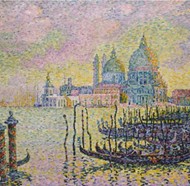
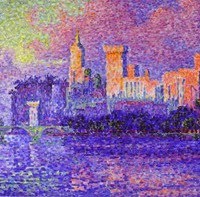
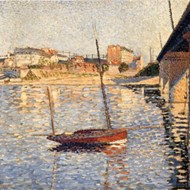
The Post-Impressionist painter, Paul Signac took over the leadership of the Neo-Impressionism art movement after the death of Georges Seurat (1859-1891). Signac focused primarily on landscape painting and seascapes in vivid bright colours. He was introduced to the colourist theories of Divisionism and Pointillism through Seurat, but went on to develop the style further. A leading theorist on the subject of colour in painting, his experiments with differing ways of applying paint influenced a number of schools of art, notably Fauvism, and Les Nabis, and specifically the work of Henri Matisse (1869-1954) and Andre Derain (1880-1954). Signac experimented with various media including oil, watercolour, etchings and lithographs. An important influence on Italian Divisionism, his most recognised contributions to Post-Impressionist painting include: The Papal Palace, Avignon (1900, Musee d'Orsay) and Port of Marseilles (1905, Metropolitan Museum of Art, New York). He is one of the great Post-Impressionist painters. |
|
WHAT IS VISUAL ART? |
|
COLOURS USED IN
PAINTING WORLDS TOP ARTISTS |
Impressionism |
|
|
Georges
Seurat and Neo-Impressionism Pointillism Between the period 1891 and 1893, Signac was also briefly a member of the French arm of Les Vingt group. This was a group of artists who exhibited together and shared an interest in Symbolism. Signac admired JMW Turner (1775-1851) and the Dutch artist Jongkind (1819-1891), about whom he published a monograph in 1927. By the 1920s the idea of Pointillism had long ceased to be avant-garde, but Signac steadfastly pursued the development of Seurat's colour theories. He published a book From Delacroix to Neo-Impressionism, which summarised these theories, and did much to influence the next generation of modern artists, many of whom he encouraged by buying their paintings - he was the first to buy a painting by the colourist Henri Matisse, leader of the Fauvist painters. Signac became President of the Salon des Independants from 1908, and used his position to encourage new movements by organising exhibitions of the Fauves, Nabis and Cubists. He died in Paris in 1935. Paintings by Paul Signac can be seen in many of the best art museums throughout the world. |
|
|
|
• For more biographies of Neo-Impressionist
artists, see: Famous Painters.
ENCYCLOPEDIA OF VISUAL ARTISTS |