Neo-Impressionism
Characteristics of Pointillism and Divisionism.
MAIN A-Z INDEX - A-Z of ART MOVEMENTS

|
Neo-Impressionism
|
|
|
Neo-Impressionism (1880s)Contents • What is Neo-Impressionism?
Pointillism? Divisionism? |
|
WORLD'S BEST ARTISTS |
What is Neo-Impressionism? - Characteristics The term Neo-Impressionism was first used in 1886 by the French art critic Felix Feneon to describe a style of 19th-century Post-Impressionist painting, pioneered by Georges Seurat (1859-1891). This style of Post-Impressionism used a new technique of "colour-mixing" known as Pointillism (a specific form of Divisionism). In simple terms, instead of mixing different colours on a palette and then applying them to the canvas, Neo-Impressionist artists applied different primary colours to the canvas - in groups of tiny dots (points) - and then allowed the viewer's eye to do the "mixing." This Pointillist painting method was used to boost the luminosity of the colour pigments. From a distance, the dots of separate pigment came together as a whole in the viewer's eye, and glowed with maximum brilliance. Seurat himself called the technique Chromoluminarism (colour luminousness) rather than Pointillism or Divisionism. (Note: Although used interchangeably, Divisionism refers to the general method of applying small strokes or dabs of separate primary colours, while pointillism refers to the size/type of dab, in this case, dots.) |
|
COLOUR
THEORIES EVOLUTION
OF VISUAL ART
|
|
|
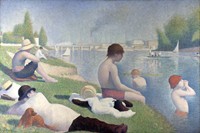
The tragically shortlived Georges Seurat (1859-1891) was the leader and by far the greatest exponent of Pointillism. During the early 1880s, Seurat had studied several treatises on colour theory by French chemists Eugene Chevreul and Charles Henry, and had developed a new pictorial technique based on "separation of colour" or "Divisionism", which offered greater vibrancy of colour. In 1884, at the first Salon des Independants - an open art show without any jury or selection committee, run as an alternative to the Official Paris Salon - Seurat met Paul Signac (1863-1935), who became the group's principal theorist and next leader after Seurat's death in 1891. He also met several other Impressionist painters, including Camille Pissarro (1830-1903), Albert Dubois-Pillet (1846-1890), Henri-Edmond Cross (1856-1910) and Charles Angrand (1856-1926), all of whom duly formed the first Neo-Impressionist circle. Two years later, in 1886, at the final Impressionist Exhibition and at the Salon des Independants, Seurat attracted more followers such as Maximilien Luce (1858-1941), Leo Gausson (1860-1944), Louis Hayet (1864-1940) when he first showed his masterpiece Sunday Afternoon on the Island of La Grande Jatte (1884-1886, Art Institute of Chicago). The painting was also exhibited at the Salon des Vingt in Brussels, the following February, attracting Belgian artists like Theo Van Rysselberghe, Henry Van de Velde, and others to the new movement now coalescing around Seurat. After Belgium, Neo-Impressionism spread to the Netherlands (for details, see: Post-Impressionism in Holland), Germany, Austria, Switzerland, and Italy. Italian Divisionism, whose members included Vittore Grubicy De Dragon (1851-1920), Giovanni Segantini (1858-1899), Angelo Morbelli (1853-1919), Giuseppe Pellizza da Volpedo (1868-1907), Plinio Nomellini (1866-1943), Emilio Longoni (1859-1932), Gaetano Previati (1852-1920), and Giovanni Sottocornola (1855-1917), was especially strong. The young Carlo Carra (1881-1966), a student at Brera Academy of Fine Arts during the late 1900s, was also drawn to Neo-Impressionist painting. Many of these painters were dissatisfied with Claude Monet's Impressionism with its creed of replicating nature - for more, see: Characteristics of Impressionist Painting - and sought new ways of creating interest on the picture surface. Pointillism's scientific basis also proved appealing, despite the somewhat contrived and mechanical nature of the required brushwork. The Colour Theory of Neo-Impressionism Divisionism was based on "optical mixing", involving the mixing of coloured light by the viewer's eye. Regular painting, by contrast, was based on the physical-mixing of pigments by the artist. According to the colour theory of Eugene Chevreul, author of the authoritative textbook De la Loi Du Contraste Simultanee Des Couleurs (On the Law of Simultaneous Contrast of Colours) (1839), optically-mixed colours tended to be more intense and luminous than physically-mixed colours. The later study Modern Chromatics, with Applications to Art and Industry, written by the American Ogden Rood further confirmed the different behaviours exhibited by coloured light versus coloured pigment. It was to increase the luminosity of their paintings, that the Pointillists devised their system of pure-colour juxtaposition - a system which, in order to create the desired effect, required the meticulous sizing and arrangement of small dot-like dabs of pure colour on the canvas. In Seurat's hands, this technique succeeded in producing clarity of form together with a vibrating intensity of light. But in the case of lesser artists, it produced works that looked rigid and contrived. As a result, the public never took to the style in any great numbers, despite a succession of outstanding pictures from Seurat himself, including: Bathing at Asnieres (1883-4, National Gallery, London), Evening, Honfleur (1886, Museum of Modern Art, New York City) and The Circus (1890-91) Musee d'Orsay, Paris. As an organized movement Neo-Impressionism lasted only a few years (1886-1891), but it had a major impact on several major artists who followed, including Paul Gauguin (1848-1903) the pioneer of Synthetism and Cloisonism, the expressionist Vincent Van Gogh (1853-90), the Fauvist Henri Matisse (1869-1954), and the contemporary American photorealist portrait painter Chuck Close (b.1940). Neo-Impressionism: Chronology of Development • 1839: Publication of The Principles of Harmony and Contrast of Colours by Eugene Chevreul, a volume much referred to by the Neo-Impressionist painters. • 1879: Ogden Rood publishes Modern Chromatics, which discusses 'optical mixture'. • 1880: Phenomena of Vision, by David Sutter, lays down 67 rules concerning the relations between painting and science. • 1884: Creation of the Salon des Independents. Bathers at Asnieres, Seurat. Charles Henry publishes his Introduction to a Scientific Aesthetics in La Revue Contemporaine. • 1885: Pissarro meets Signac and Seurat and for a while joins the Neo-Impressionist movement. • 1886: At the last Impressionist Exhibition, Rue Laffitte, Seurat presents his painting Sunday on la Grande Jatte, considered the founding work of divisionism. In September 86 Felix Feneon baptises the nascent movement "Neo-Impressionist" in an article published in the Brussels-based journal L'Art Moderne. • 1888: Seurat exhibits Sunday on La Grande Jatte at the Salon of Les Vingt in Brussels. Van Rysselberghe is among those who join the movement. • 1890: Seurat publishes Esthetique, synthesising scientific theories on colour, providing a theoretical foundation for Neo-Impressionist painting. • 1891: 29 March: Georges Seurat dies in Paris. Signac takes over at the head of the group, which undergoes a significant stylistic change. • 1892: In Saint-Tropez, Signac produces his first watercolour painting. • 1893: Opening of the Boutique Neo in Rue Laffitte, a permanent exhibition space for the Neo-Impressionists. Lack of critical and public success leads to its closure in 1895. • 1895: Foundation of the libertarian review Les Temps Nouveaux, in which the Neo-Impressionists publish articles, drawings and prints. • 1898: The first German exhibition by the Neo-Impressionist group is a great success. • 1899: Signac publishes his artistic manifesto entitled From Eugene Delacroix to Neo-Impressionism, rehabilitating Seurat's innovative method and explaining the pointillist procedure of breaking down colours. • 1904: Matisse composes Luxe, Calme et Volupte, reflecting the respective influences of Signac and Cross. • 1905: The Fauvism movement - derisively christened by the influential French art critic Louis Vauxcelles - is launched by Matisse in Paris. • 1908: Signac becomes president of the Societe des Artistes Independents, a position he holds until 1934.
List of Famous Neo-Impressionist Painters Georges Seurat (1859-1891) List of Selected
Neo-Impressionist Paintings Paintings By Paul Signac (1863-1935) Paintings By Camille Pissarro (1830-1903) Painting By Henri-Edmond Cross (1856-1910) Painting By Theo Van Rysselberghe (1862-1926) Paintings By Henri Matisse (1869-1954) |
|
• For information about visual arts, see: Homepage.
ENCYCLOPEDIA OF ART HISTORY |