Georges Seurat
Biography of Neo-Impressionist Artist, Founder
of Pointillism.
MAIN A-Z INDEX - A-Z of ARTISTS

|
Georges Seurat
|
|
|
Georges Seurat (1859-1891)Contents • Biography For analysis of works by Neo-Impressionist
painters like Seurat, |
|
EVOLUTION
OF VISUAL ART |
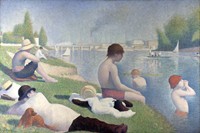
One of the most famous Post-Impressionist painters of the 1880s in France, the short-lived French artist Georges Seurat is noted for his invention of the colourist technique known as Pointillism, a form of Divisionism, in which colours are placed side-by-side on the canvas and 'mixed' by the eye, rather than being mixed beforehand by the painter. In so doing, he pioneered the new style of Neo-Impressionism (a name invented by Felix Feneon). As a response to Claude Monet's Impressionism, Neo-Impressionism lasted only a few short years (1886-1891), but - thanks to Seurat and his contemporary Paul Signac (1863-1935) - it had a major influence on Italian Divisionism (c.1890-1907) and on several other styles of Post-Impressionist painting, notably the Synthetism/Cloisonism of Paul Gauguin (1848-1903); the expressionism of Vincent Van Gogh (1853-90); the Fauvism of Henri Matisse (1869-1954); and the portraiture of the photorealist Chuck Close (b.1940). Seurat's best known masterpieces of Post-Impressionism are Bathers at Asnieres (1883-4, National Gallery, London) and A Sunday Afternoon on the Island of La Grande Jatte (1884-6, Art Institute of Chicago). A shy reclusive man, but one of the great modern artists, Seurat died in his prime at the age of 31. |
|
WORLDS TOP ARTISTS |
|
WORLD'S GREATEST ART WHAT IS VISUAL ART? TOP AUCTION RECORDS
|
Born in Paris, to a wealthy family - his father was a legal official with the government - he first studied drawing with the sculptor Justin Lequien at night school and was accepted into the Ecole des Beaux-Arts in 1878. After two years, he completed a year of service in the military and then returned to Paris. He moved into his own studio and spent the next two years mastering the technique of black and white drawing. He studied the science behind the theory of colour and his knowledge of colour perception grew. The technique of Neo-Impressionism that he was developing - today known as Pointillism - operated like thousands of coloured pixels on a television screen. These little dabs of pure paints, laboriously and slowly applied, allowed the viewer to optically mix the image themselves. He also used the recently discovered theory of complementary colours, which gave his painting a sort of luminous yet harmonious intensity. For more details, see: Pointillism. |
|
|
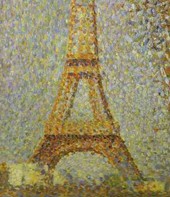
In 1883 he worked on his first major painting, a huge canvas called Bathers at Asnieres, 1883 (National Gallery, London). The painting was rejected by the official Salon, so in response, Seurat, along with artists Henri-Edmond Cross, Maximilian Luce, Odilon Redon and Paul Signac founded a new forum known as the Salon des Independants. The first exhibition was a financial disaster, but Seurat's new painting technique was the talk of the town - it was the hottest thing in French painting since Impressionism. Others tried to copy him, but he guarded the theory of his new style of Neo-Impressionism jealously. Sunday Afternoon on the Island of La Grande Jatte His next major oil painting was La Grande Jatte. He planned his works well in advance, making hundreds of preparatory sketches, planning the composition right down to the smallest detail. For La Grande Jatte, he visited the park every morning at the same time for months, sketching the visitors and then applying his new observations to the canvas in the afternoons. When you look at the people in his paintings, they appear isolated and mute, and this theme of isolation runs throughout his work. Other Neo-Impressionist Paintings Other important Neo-Impressionist paintings by Georges Seurat include: The Forest at Pontaubert (1881, Metropolitan Museum of Art, NYC); View of the Seine (1882-83, Metropolitan Museum of Art, NYC); The Gardener (1882-3, Metropolitan Museum of Art, NYC); Saint-Vincent Street, Montmartre (c.1884, Fitzwilliam Museum, Cambridge); View of Fort Samson, Grandcamp (1885, Hermitage, St. Petersburg); Le Bec du Hoc, Grandcamp (1885, Tate Collection, London); La Seine a Courbevoie (c.1885, Private Collection); Models (1886, Barnes Foundation, Lincoln University); Evening, Honfleur (1886, Museum of Modern Art, NYC); Bridge at Courbevoie (1886-7, Courtauld Institute Galleries, London); The Lighthouse at Honfleur (1886, National Gallery of Art, Washington DC); Gray Weather, Grande Jatte (1888, Philadelphia Museum of Art); Port-en-Bessin (1888, The Minneapolis Institute of Arts); Young Woman Powdering Herself (c.1888, Courtauld Institute Galleries, London); The Eiffel Tower (c.1889, Fine Art Museum of San Francisco); The Circus (1890-91, Musee d'Orsay, Paris).
A variation of Divisionism, Seurat's theory and practice of colour in painting was based around the assumption that colour pigments could be used to create emotion, in the same way that musicians used various tempos and notes to create emotion in music. For example, he said that joy could be achieved by the use of luminous hues, the predominance of warm colours and the use of lines directed upwards. And on the other hand, sadness could be achieved by using dark cold colours, and with lines pointing downwards. And harmony could be established with a balance of warm and cold colours, and the use of horizontal lines. His work helped to advance the theory of Impressionism and opened the way for new possibilities. This was a major achievement for so young a painter. He was already a complete artist by the time he turned 25. Although Pointillism is a relatively rigid process, a weakness which retarded further development of the technique, Seurat's work had a significant influence on his followers like Camille Pissarro (1830-1903), Paul Signac (1863-1935), Henri-Edmond Cross (1856-1910), as well as Post-Impressionist painters like Van Gogh (1853-90), Paul Gauguin (1848-1903), Henri Matisse (1869-1954) and Andre Derain (1880-1954). Several several schools of art were also affected by Seurat's colour theories, notably Fauvism, and Les Nabis. Paintings by Georges Seurat hang in some of the best art museums across the world, notably the Musee d'Orsay and other museums in Paris. |
|
• For biographies of other Neo-Impressionist
artists, see: Famous Painters.
ENCYCLOPEDIA OF VISUAL ARTISTS |