|
WORLDS TOP ARTISTS
For top creative practitioners, see:
Best Artists of All Time.
For the greatest view painters, see:
Best Landcape Artists.
For the greatest still life art, see:
Best Still Life Painters.
For the greatest portraitists
see: Best Portrait Artists.
For the greatest genre-painting, see:
Best Genre Painters.
For the top allegorical painting,
see: Best History Painters.
JEWISH ART
For an outstanding collection of
Judaica, crafts and artifacts,
see: Jewish Art Museum.
|
Other wealthy donators helped to grow
the galleries collection including the industrialist Dr Ludwig Mond who
gave 42 Italian renaissance paintings and Sir Hugh Lane (who died on the
Lusitania in 1915) who left 39 paintings in his will. There was some controversary
over the latter donation as he made an unwitnessed amendment to his will
before dying, that the works should go to Ireland. It wasn't until 1959
that this dispute was settled and the Hugh Lane collection is now on permanent
loan to the Hugh Lane Gallery in Dublin. In recent years there have been
two major fund-raising campaigns. In 2004, £35m was raised to buy
Raphael’s Madonna of the Pinks and, in 2008, £50m was
raised to buy Titian's Diana and Actaeon. The National Gallery
is now largely priced out of the market for major works by Old Masters
and can only make acquisitions with the help of public appeals.
Permanent Collection
The collection of the National Gallery
London can be divided into the following styles and periods of art.
Dutch School
The Dutch school features mainly Dutch
Realist genre painting of the 17th century, including some of the
greatest genre paintings
by Pieter de Hooch (1629-84), Rembrandt (1620-91), Aelbert Cuyp (1620-91),
Aernout van der Neer (1603-77), Jan Steen (1626–79) and Johannes
Vermeer (1632-75).
English School
The English School is most recognised by romantic painter John
Constable (1776-1837) - his painting The Hay Wain (1821) is
a national treasure.
The Gallery has 11 paintings by portrait and landscape painter Thomas
Gainsborough (1727-88) including his famous Mr and Mrs Andrews
(c.1750).
There are 8 paintings by artist, printmaker and cartoonist William
Hogarth (1697-1764) including his Marriage a la Mode: The Marriage
Settlement (c.1743).
There are also a number of fine paintings from other English artists such
as John Hoppner, Thomas Lawrence, Joshua
Reynolds, George Stubbs, Joseph Wright of Derby and Richard
Wilson., as well as the decorative artists/sculptors Alfred
Stevens and George
Frederick Watts.
• For more about figure work, see:
English Figurative
Painting.
• For details of scenic art, see: English
Landscape Painting.
See also our article: How
To Appreciate Paintings.
Flemish School
The gallery owns 3 paintings by the Flemish artist Jan Brueghel the Elder
(1568-1625) including The Interior of a Gothic Church looking East
(1604).
The Flemish school is also represented by paintings from Pieter Bruegel
the Elder, Petrus Christus, Jan van Eyck, Jan Mabuse, Quentin Matsys,
Hans Memling, Peter Paul Rubens, David Teniers the Younger and Anthony
van Dyck.
French School
Different movements in the French school are well represented in the gallery
collection.
There are 19 paintings by Impressionist Claude Monet (1840-26), including
examples of his monumental Waterlily series; several by Manet (1832-83),
Camille Pissarro (1830 –1903), Paul Cezanne (1839–1906), Pierre
Auguste Renoir (1841–1919), Edgar Degas (1834–1917) and Jean-Baptiste
Camille Corot (1796–1875).
Also on view are still life master Jean-Baptiste-Simeon Chardin (1699-1779),
neoclassicist Jacques-Louis David (1748-1825), Romantic painters and lithographers
Theodore Gericault (1791-1824) and Eugene Delacroix (1798–1863),
classical artist Nicolas Poussin (1594-1655) and Rococo painters Francois
Boucher (1703-70) and Jean-Antoine Watteau (1684-1721).
German School
The German school is represented by some of the greatest
portrait paintings by Hans Holbein the Younger (1497–1543), as
well as works by German Renaissance painter, printmaker and theorist Albrecht
Durer (1471-1528), engraver and portraitist Lucas Cranach the Elder (1472-1553)
and neoclassical painter Johann Zoffany (1733–1810).
Italian School
Renaissance fine art is amply
represented at the gallery with paintings from the Proto-Renaissance
by Giotto di Bondone and Duccio di Buoninsegna; from the Early Renaissance
by Fra Angelico, Sandro Botticelli, Piero della Francesca, Masaccio, Andrea
Mantegna, and Paolo Uccello; from the High Renaissance by Leonardo
da Vinci, Raphael, Michelangelo, Giovanni Bellini and Titian, the leading
painter of the 16th-century Venetian school; from the Mannerist
period by Parmigianino,
Caravaggio and Tintoretto. There are also Rococo works by the great fresco
painter Giovanni Battista Tiepolo.
Spanish School
The Spanish school is represented by artists Francisco Goya (1746–1828),
Baroque painters Bartolome-Esteban Murillo (1617-1682) and Diego Velazquez
1599–1660), painter and sculptor Pablo Picasso (1881–1973) and
Francisco Zurbaran (1598–1664) who was nicknamed the Spanish Caravaggio.
Female Artists in the National Gallery Collection
Female painters are well represented at the gallery, and include the following
artists and paintings:
- Catharina van Hemessen (1527-1566), Portrait of a Man (1552)
- Judith Leyster (1609-60), A Boy and a Girl with a Cat and an Eel
(c.1635)
- Marie Blancour, A Bowl of Flowers (c.1650)
- Rachel Ruysch, (1664-1750), Flowers in a Vase (1690)
- Rosalba Giovanna Carriera (1675-1757), Portrait of a Man (c.18th
Century)
- Elizabeth Louise Veigee Le Brun (1755-1842) Self Portrait, Straw
Hat (1782)
- Rosa Bonheur (1822-99), The Horse Fair (1855)
- Berthe Morisot (1841-95), Summer's Day (c.1879)
Top 30 Paintings in the National Gallery Collection
• The Hay Wain, John Constable
• Mr and Mrs Andrews, Thomas Gainsborough
• Arnolfini
Portrait, Jan Van Eyck
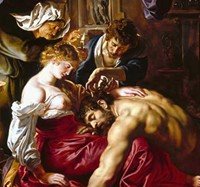
• Samson and Delilah, Peter Paul Rubens
• Virgin
of the Rocks, Leonardo da Vinci
• Venus and Mars, Sandro Botticelli
• Supper at
Emmaus, Caravaggio
• The
Ambassadors, Hans Holbein the Younger
• Equestrian Portrait of Charles I, Anthony Van Dyck
• A Young Woman standing at a Virginal, Jan Vermeer
• Sunflowers, Vincent Van Gogh
• Bathers
at Asnières, Georges Seurat
• The Fighting Temeraire, Joseph
Mallord William Turner
• Bathers at La Grenouillère, Claude Monet
• The
Large Bathers (Les Grandes Baigneuses), Paul Cezanne
• The Madonna of the Pinks, Raphael
• The Baptism of Christ, Piero della Francesca
• Bacchus
and Ariadne, Titian
• Judgement
of Paris, Rubens
• The Stonemason's Yard, Canaletto
• Whistlejacket, George Stubbs
• An
Experiment on a Bird in the Air Pump, Joseph Wright of Derby
• The Wilton Diptych, artist unknown
• Seaport with the Embarkation of Saint Ursula, Claude Lorrain
• The Rokeby Venus,
Diego Velazquez
• Madame de Pompadour at her Tambour Frame, Francois-Hubert
Drouais
• Madame Moitessier, Jean-Auguste-Dominique Ingres
• The Battle
of San Romano, by the Florentine Paolo Uccello
• The Doge Leonardo Loredan, Giovanni Bellini
Contact Details
The National Gallery
Trafalgar Square
London
WC2N 5DN
Website: www.nationalgallery.org.uk
Email: information@ng-london.org.uk
Phone: +44 (207) 747-2885
|