Juan Gris
Biography, Paintings of Spanish Cubist Artist.
MAIN A-Z INDEX - A-Z of ARTISTS

|
Juan Gris
|
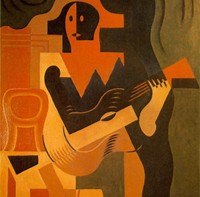
Harlequin With Guitar (1919).
|
Juan Gris (1887-1927)Contents • Biography |
|
Portrait Of Picasso (1912) BEST
ABSTRACT ART |
An important figure in Spanish painting before and after the First World War, the artist Juan Gris is considered the Third Member of Cubism, after Pablo Picasso and George Braque, although he remains greatly overshadowed by his more famous colleagues. Gris worked his way through analytical and synthetic Cubism, to create his own unique and colourful style, but it was his highly intellectual approach to his work that established him as the greatest theorist among the Cubist painters. This alone secures his place as a leading figure in the history of art in the early 20th century. Also significantly influenced by Fauvism art, his best known work is Portrait of Picasso (1912, Art Institute of Chicago). Gris is regarded as one of the great abstract painters of the early 20th century. Noted in particular for his Cubist-style still life painting, his best known 20th-century paintings include: Portrait of Picasso (1912, Art Institute of Chicago), Violin And Checkerboard (1913, Private Collection), The Sunblind (1914, Tate Collection, London), Portrait of Josette (1916, Reina Sofia Museum, Madrid), Violin (1916, Kunstmuseum, Basel), Harlequin with Guitar (1919, Private Collection), The View Across the Bay (1921, National Museum of Modern Art, Paris). A number of his paintings and prints are available online in the form of poster art. |
|
Violin And Checkerboard (1913). WORLDS TOP ARTISTS |
|
|
Born in Madrid, his original name was Jose Victoriano Carmelo Carlos Gonzalez-Perez. He studied mechanical drawing at the Escuela de Artes y Manufacturas in 1902 for two years, and in 1904 studied fine art painting under the academic artist Jose Maria Carbonero. In 1906 he moved to Paris, where he adopted the pseudonym Juan Gris. He was to remain in Paris for the rest of his life. Soon after arriving he became friends with his neighbour Picasso, and was introduced to other modern artists, including the Fauvist Henri Matisse, the Cubists Fernand Leger and Georges Braque, and the Expressionist painter Amedeo Modigliani (who painted his portrait in 1915). |
|
|
|
Cubism: Analytical and Synthetic He was impressed by Picasso, and worked with both him and Braque on the development of Cubism. To begin with, the painting's subject was fractured into separate pieces, forcing the spectator to put them together as if they were pieces of a jigsaw - a style known as Analytical Cubism. After this, instead of breaking things down, Cubists began adding extraneous materials to the canvas, and making everything more colourful. This development was called Synthetic Cubism. By 1912, Gris had developed his own personal style of Cubist art (impressing dealers like Leonce Rosenberg who already owned several of his paintings), which used brighter colours than his associates and owed something to Matisse and the Fauvists. Works from this period include: Three Lamps, 1910 (Kunstmuseum Bern); Bottles and Knife, 1911; Still-life with Oil Lamp, 1911 (both (Rijksmuseum Kroeller-Mueller, Otterlo); Portrait of Picasso; Still Life with Flowers, 1912 (The Museum of Modern Art, New York); Glass of Beer and Playing Cards, 1913 (Columbus Museum of Art, Ohio). A member of the Parisian artist group, known as the Ecole de Paris, in 1912 he showed for the first time at the Salon des Independants and the Salon de la Section d'Or in Paris, at the Sturm Gallery in Berlin (founded by Herwarth Walden), and the Galeries Dalmau in Barcelona. The same year Daniel-Henry Kahnweiler, one of the premier French art dealers of the 20th century, agreed to be Gris's dealer. Gris also came into contact with the Cubist sculptor Jacques Lipchitz and Jean Metzinger (a member of the Section d'Or group of artists). After 1913 he switched to Synthetic Cubism, and became an important contributor to the development of the style. His oil painting became brighter, with a more vivid colour palette, and he integrated paper colle and collage into his compositions. Paintings from this time include Landscape with Houses at Ceret, 1913 (Galeria Theo, Madrid); Landscape at Ceret, 1913 (Moderna Museet, Stockholm); Guitar on a Chair, 1913 (Private Collection); The Siphon, 1913 (Rose Art Museum, Massachusetts); Violin and Checkerboard, 1913 (Stephen a. Simon and Bonnie Simon Collection); Pears and Grapes on a Table, 1913 (Burton Tremaine Collection, Meriden, CT); Bottle and Glass on a Table, 1913 (Galerie Jan Krugier, Geneva); Fruit Dish and Carafe, 1914 (Rijksmuseum Kroller-Muller, Otterlo); Breakfast, 1914 (The Museum of Modern Art); A Man in a Cafe, 1914 (Acquavella Galleries, Inc., New York); Guitar on a Table, 1915 (Rijksmuseum Kroller-Muller); Water-bottle, Bottle, and Fruit-dish, 1915 (Private Collection); Harlequin at a Table, 1919 (Private Collection); The Open Window, 1921 (Meyer Collection, Zurich). |
|
|
In 1924 he was asked to design the costumes and ballet set for the famous Ballets Russes, founded by Sergei Diaghilev (1872-1929). In 1924 he delivered definitive lectures on the possibilities of painting at the Sorbonne. Major exhibitions of his works took place at the Galerie Flechtheim in Berlin and the Galerie Simon in Paris in 1923, and at the Galerie Flechtheim in Düsseldorf in 1925. One of his last completed paintings was Guitar and Music Paper, 1926-27 (Saidenberg Gallery, New York). During the war years his art dealer had left the country, and when he returned in 1918 he said, 'I had left behind a young painter whose works I liked. I had returned to find a master'. However, due to ill health, it is generally agreed that Gris work declined in the 1920s. Juan Gris died prematurely in 1927, he was only 39 years old. He was survived by his wife and son. One of the great 20th century painters in the Cubist style, the popularity and recognition of his work has increased over the years, and in 2005 one of his paintings sold for the phenomenal amount of $69 million. (See also: Most Expensive Paintings.) Paintings by Juan Gris hang in the best art museums across the world, including the Reina Sofia, Madrid. |
|
• For more biographies of modern Spanish
artists, see: Famous Painters.
ENCYCLOPEDIA OF VISUAL ARTISTS |