Ilya Repin
Biography of Russian Realist Genre-Painter,
Portraitist.
MAIN A-Z INDEX - A-Z of ARTISTS

|
Ilya Repin
|
|
|
Ilya Repin (1844-1930)Contents • Biography |
|
|
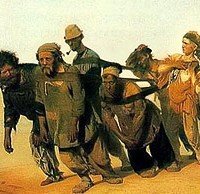
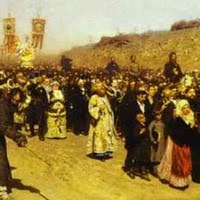
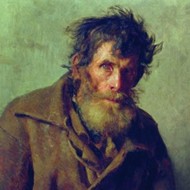
Arguably the greatest of all Russian artists of the 19th century, Ilya Efimovich Repin was noted for (1) the sympathetic realism of his genre-painting of contemporary life in Russia, exemplified by Barge Haulers on the Volga (1873), and Unexpected Return (1884), and his extraordinary Krestny Khod (Religious Procession) in Kursk Gubernia (1883); (2) his portrait art which featured country folk, both Ukrainian and Russian, as well as members of the Imperial Russian elite, the intelligentsia, and the aristocracy, including Tsar Nicholas II - as illustrated by Portrait of Maxim Gorky (1899) (3) his history painting, exemplified by his picture Ivan the Terrible and his son Ivan 1581 (1885), and The Reply of the Zaporozhian Cossacks to Sultan Mahmoud IV (1880-1891). He was also an accomplished still life painter. During his painting career, Repin was associated with the Society for Itinerant Art Exhibitions (peredvizhniki), also known as the Wanderers, a group of modern artists who dominated art at the end of the century. Repin is justly regarded as one of the great figures in Russian Painting of the 19th century. |
|
WORLDS TOP ARTISTS |
|
RUSSIAN ARTISTS |
Repin was born in the small Ukrainian town of Chuhuiv, the son of a military settler. As a youth he trained as an icon painter with a local artist named Bunakov. At the age of 19 he was lucky enough to enrol at the Imperial Academy of Arts in St. Petersburg. As it happened, his arrival in the Russian capital coincided with the self-styled "Rebellion of the Fourteen", when a group of young artists, led by Ivan Kramskoy (1837-1887), quit the Academy after refusing to employ mythological subjects in their diploma works, insisting instead that art should be closer to real life, and established the Society of the Peredvizhniki to promulgate their own aesthetic ideals. Later, Repin would join the society and become close friends with some of its members. Repin graduated from the Academy in 1871, winning the Major Gold Medal for his diploma work Raising of Jairus' Daughter (1871; State Russian Museum, St. Petersburg) - one of the greatest religious paintings of the day. |
|
|
He immediately followed this with his masterpiece Barge Haulers on the Volga (1870-1873; State Russian Museum, St. Petersburg), which gained him immediate recognition as one of the leading young Russian/Ukrainian painters. In 1873, Repin used the stipend he won with his Gold Medal Award to study fine art painting abroad. He travelled through Italy before settling in Paris until 1876. It was here that he witnessed the first of the Impressionist Exhibitions, but, judging by the works he painted during this period and by comments in his letters home, he was not particularly impressed by this new form of modern art. His background and culture was grounded in the Ukrainian countryside, and his art was already strongly seeped in Russian Realism. That said, he was a perceptive enough artist to absorb the painterly qualities of French Impressionism, notably its depiction of light and use of colour. |
|
|
On his return to Russia in 1876, Repin settled in Moscow, becoming a regular visitor to Abramtsevo, the country estate of Savva Mamontov (1841-1918), one of the most famous Russian patrons of art of the late 19th Century. The next 10-12 years was his most active period as an artist, a period that witnessed the creation of most of his famous works. He began in 1877, with a series of religious processions (krestny khod), such as Krestny Khod in Kursk Gubernia (1880-1883; Tretyakov Gallery, Moscow) - a composition based on the dramatic effect of the differing social rank and attitude of the members of the procession, all seemingly united by the miracle-working icon carried at its head. The painting may be interpreted as depicting the slow but relentless forward movement of the multi-cultural Russian state, led by a supposedly divine Czar to an uncertain destination. Just prior to the assassination of Tsar Alexander II in 1881, Repin began work on a series of genre pictures depicting the Russian revolutionary movement, several of which were bought by the art collector Pavel Tretyakov. Examples include: Arrest of a Propagandist (1880-1892; The Tretyakov Gallery, Moscow), The Revolutionary Meeting (1883; Tretyakov Gallery, Moscow), as well as his masterpieces They did not Expect Him, or Unexpected Return (1884; Tretyakov Gallery, Moscow), which depicts the father of a household returning from prison, and Refusal of the Confession (1879-1885; The Tretyakov Gallery, Moscow), which shows a dying man refusing a priest's offer of the Last Rites. During the 1880s, Repin also began painting portraits and these works form an essential part of his artistic legacy. He didn't just paint faces, rather he painted people fully, revealing his models in their natural state, to show how they communicated. Examples of Repin's best portraits include: Portrait of the Author Alexey Pisemsky (1880), Portrait of the Composer Modest Musorgsky (1881), Portrait of the Surgeon Nikolay Pirogov (1881), Portrait of the Poet Afanasy Fet (1882), Portrait of the Art Critic Vladimir Stasov (1883), and Portrait of Leo Tolstoy (1887), all typically distinguished by Repin's economy and sharpness of execution. He also painted, the art connoisseur and collector Pavel Mikhailovich Tretyakov (1832-98), and the Ukrainian poet and painter, Taras Shevchenko. Repin was too taken up with genre works and portraiture to pay much attention to history painting. Even so, he succeeded in producing one of the great masterpieces of this particular painting genre - Ivan the Terrible and his son Ivan (1895; Tretyakov Gallery, Moscow). Its intense expressionistic portrayal of the horrified Ivan embracing his dying son, whom he has just struck and mortally wounded in an uncontrolled fit of rage, leaves an unforgettable impression. Another major work is The Reply of the Zaporozhian Cossacks to Sultan Mahmoud IV (1880-1891; State Russian Museum, St. Petersburg). Begun in the late 1870s, it was only finished in 1891, and, somewhat ironically, was immediately bought by the Tsar, who paid 35,000 rubles for the painting, a huge sum at the time. In 1903, Repin was commissioned by the Russian government to paint his most grandiose design, a monumental canvas depicting a ceremonial session of the State Council of Imperial Russia. Other than this, he painted a number of innovative religious works and more portraits, but no new masterpieces. By the time of the Bolshevik Revolution in 1917, he had retired to his estate located just to the north of Saint Petersburg in Kuokkala, Grand Duchy of Finland, which immediately declared its independence. Although he received numerous invitations to return to his homeland, he excused himself by saying he was too old to make the journey. Not long after completing The Hopak, a joyful picture on a Ukrainian Cossack theme, he died on his estate at the age of 86. After his death a short-lived Repin cult emerged in the Soviet Union during which he was praised as a model "progressive" and "realist" to be copied by Socialist Realist painters in the USSR. Repin was undoubtedly one of the best genre painters produced by Russia, and also ranks among the best portrait artists of the country. He produced a wide range of realistic paintings frequently imbued with great psychological depth and great perception of the tensions underlying the existing social order in Russia. He remains one of the greatest genre-painters in the history of Ukrainian and Russian art. Paintings by Repin hang in all the best art museums of Russia, notably the Tretyakov Gallery Moscow. Repin produced some of the greatest modern paintings of his day. Here is a short list of his better known works and the collections to which they belong. - Preparation for the Examination. 1864.
Russian Museum, St. Petersburg. 3-D Art in Russia By comparison, read about the beautiful jewellery art of Repin's contemporary in St Petersburg - Carl Fabergé (1846-1920). See also: Fabergé Easter Eggs. |
|
|
|
• For more biographies of Russian
artists, see: Famous Painters.
Visual
Artists, Greatest |