The Wanderers: Russian Art Movement
Peredvizhniki or Itinerants: Russian
Landscape Painters.
MAIN A-Z INDEX - A-Z of PAINTING

|
The Wanderers: Russian Art Movement
|
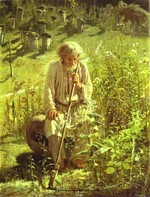 The Bee-Keeper (1872) by Ivan Kramskoy. (Tretyakov Gallery) Beautiful example of 19th Century Russian Painting. |
Wanderers Russian Art Movement (1863-1910)
|
|
WORLDS TOP LANDSCAPES |
|
CATEGORIES OF ART
|
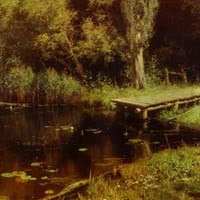
Tretyakov Collection The Wanderers received a variety of support from other Russian artists, as well as the art critic Vladimir Stasov, who promoted their painting and artistic program. The art-collector Pavel Tretyakov bought many of their best works, which later formed the basis of the Tretyakov Gallery which opened in Moscow, in 1892. In addition to Repin and Kramskoy, famous Itinerant painters included the portraitists Nikolai Gay (1831-94), Vasily Petrov (1834-82), and Nikolai Yaroshenko (1846-98); and the history painter Vasily Surikov (1848-1916). However, landscape and rural genre-paintings were the major part of the Itinerants' agenda. Landscape artists included: Feodor Vasilyev (1850–1873); Ivan Shishkin (1832-98) nicknamed the "Tsar of the forest" - see his magnificent Oak Grove (1887, Museum of Russian Art, Kiev); the luminous landscape painters Arkhip Kuindzhi (1842-1910) and Nikolai Dubovskoy (1859-1918); and the light/colour expert Isaac Levitan (1860-1900) - see his Secluded Monastery (1890, Tretyakov Gallery). The cultural work of the Wanderers was used by Lenin and other Bolshevik agitators to stimulate support for their radical ideas. However, once in power, Lenin replaced the Wanderer Group with a new Association of Artists of Revolutionary Russia (AARR), which became popular with traditional painters rebelling against the European Cubist and Surrealist-inspired abstract movements of the early twentieth century. Eventually, the Wanderers/AARR formed the basis for the Russian Socialist-Realist art movements of the 1930s, which dominated Soviet visual arts for decades. Ilya Repin The most famous member of the Wanderers was Ilya Repin (1844-1930), whose works encompassed landscapes (eg. River Bank; Autumn Bouquet), portraits (eg. Mahmoud IV of Turkey), dramatic history painting (eg. Ivan the Terrible and His Son Ivan), and rural genre-scenes (eg. Bargemen on the Volga). Figure painting remained his focus, and even his landscapes are populated with people. • For landscape painting in America,
see Hudson
River School (1825-75) and its off-shoot Luminism
(1850-75). |
|
• For more about the different types
of painting (portraits, landscapes, still-lifes etc) see: Painting
Genres.
ENCYCLOPEDIA OF ART |