Mikhail Vrubel
Biography of Russian Symbolist Painter.
MAIN A-Z INDEX - A-Z of ARTISTS

|
Mikhail Vrubel
|
|
|
Mikhail Vrubel (1856-1910)Contents • Biography |
|
RUSSIAN ART MUSEUMS |
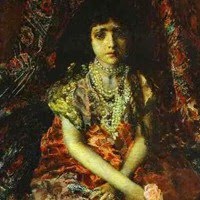
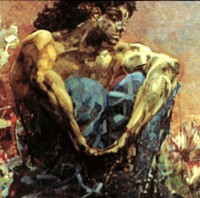
Arguably the most innovative and versatile figure in Russian art of the late 19th century, and one of the best modern artists in Europe, the painter and designer Mikhail Vrubel is regarded as the finest exponent of Symbolism in his country. Known for his portraiture, as well as his symbolic expressionist paintings, his fragmented brushwork calls to mind the jigsaw patterns of medieval mosaic art. One of the leading Russian artists involved in the Art Nouveau decorative movement, he became increasingly absorbed in his pictorial representation of Mikhail Lermontov's poem "The Demon", an activity that sadly paralleled his increasing ill-health and descent into insanity. Despite this, Vrubel's reputation was assured by the time of his death, and although scholars remain divided as to whether he was closer to late Byzantine art or Art Nouveau, his influence on other early 20th century Russian artists should not be underestimated. His most famous works include The Seated Demon (1890, Tretyakov Gallery, Moscow), Portrait of Konstantin Artsybushev (1897, Tretyakov Gallery, Moscow), and Girl against a Persian Carpet (1886, Museum of Russian Art, Kiev, Ukraine). Vrubel was also a highly talented sculptor. Please see also: Russian Sculpture (c.1740-1940). |
| RUSSIAN
PAINTERS Ivan Shishkin (1832-98) Unique forest landscape artist. Vasily Perov (1833-82) Pioneer critical realist genre painter. Ivan Kramskoy (1837-1887) Russia's greatest portraitist. Konstantin Savitsky (1844-1905) Critical realism; genre painter. Vasily Polenov (1844-1927) Landscape and biblical painter. Ilya Repin (1844-1930) The greatest Russian painter. Vasily Surikov (1848-1916) Russia's greatest history painter. Isaac Levitan (1860-1900) Realist/Impressionist landscape artist. Abram Arkhipov (1862-1930) Genre painter in critical realist style. Alexei von Jawlensky (1864-1941) Greatest Russian colourist. Wassily Kandinsky (1866-1944) Expressionist, abstract art. |
|
WORLDS TOP ARTISTS WORLD'S GREATEST ART WHAT IS VISUAL ART?
|
Early Life and
Training Christian Art: Mosaics, Murals In 1884, Vrubel was invited to collaborate in the restoration of Old Russian murals and mosaics in the 12th century Church of St. Cyril in Kiev, (later, much admired by the Russian abstract painter Lyubov Popova), a task which led him to spend several months studying religious art in Venice, where he was particularly drawn to the medieval mosaics in the Church of San Marco, as well as Early Renaissance art by Giovanni Bellini (1430/5-1516) and Giovanni Battista Cima da Conegliano (1460-1516). |
|
|
Returning to Kiev, Vrubel submitted a number of watercolour gospel scenes like The Lamentation (1887) and The Resurrection (1887) for the newly built Cathedral of St. Vladimir, only to have them rejected. He also started work on the task of pictorializing Lermontov's romantic Caucasian poem The Demon, although no images from this time have survived. Among his works which have survived in the Museum of Russian Art, Kiev, are: The Oriental Tale (1886), based on The Arabian Nights; and the decorative Portrait of a Girl against a Persian Carpet (1886), an inspired exploration of pattern and colour - both in The Museum of Russian Art, Kiev, Ukraine. In 1889, Vrubel moved to Moscow where he was commissioned to illustrate a special edition of the poems of Lermontov, to commemorate the fiftieth anniversary of the poet's death (in a duel). The completed illustrations (black watercolours on cardboard) included: Tamara and Demon (1890-91), Tamara Dancing (1890-91), Tamara Lying in State (1890-91) (all Tretyakov Gallery, Moscow), as well as Head of Demon (1890-91, The Museum of Russian Art, Kiev, Ukraine) and Demon and Angel with Tamara's Soul (1891, The Museum of Russian Art, Erevan, Armenia). Although they attracted mostly unfavourable comment from the public, they were better received in artistic circles. He was financially supported by the famous patron of the arts and creator of the Abramtsevo artist colony Savva Mamontov (1841-1918), who gave him numerous decorative commissions, as did Pavel Tretyakov (1832-98). Vrubel also painted his first masterpiece The Seated Demon (1890, Tretyakov Gallery), followed later by another The Demon Cast Down (1902). These are two of the most powerful works of Russian Symbolism. |
|
|
During the 1890s, Vrubel also became familiar with the French symbolist and decorative art movement known as Art Nouveau, and began practising it in several types of applied art, including stage sets, costumes, ceramics, majolica, and stained glass. Examples can be seen in the State Art Museum Abramtsevo. In 1896, he married the famous opera singer Nadezhda Zabela, who sang in a number of operas by Rimsky-Korsakov, for which Vrubel designed stage sets and costumes. He also executed a number of exquisite symbolist oil paintings based on Russian fairy tales. These include: The Bogatyr (1898), Pan (1899), Swan Princess (1900), and Lilac (1900) - all in the Tretyakov Gallery. During the late 1890s, Vrubel turned to portrait art, painting a variety of subjects - artists, patrons of the arts, his doctor and his own family. Works (all Tretyakov, unless stated) include: Konstantin Artsybushev (1897), Savva Mamontov (1897), The Poet Valery Briusov (1906),Psychiatrist Fiodor Usoltsev, the Artist's Doctor (1904, private collection), Valentina Usoltseva, wife of Fiodor Usoltsev (1905, The Russian Museum, St. Petersburg), Nadezhda Zabela-Vrubel in an Empire Dress (1898), Nadezhda. Zabela-Vrubel on the Edge of a Birch Grove (1904, The Russian Museum, St. Petersburg), After the Concert: Portrait of Nadezhda Zabela-Vrubel (1905), and Savva Vrubel, the Artist's Son (1902, The Russian Museum, St. Petersburg). During the early 1990s, partly because of his obsessive return to the dark theme of The Demon, (The Demon Cast Down, 1902), and partly due to a condition of tertiary syphilis, Vrubel suffered a severe nervous breakdown and was placed in a mental asylum. Although over the next few years he completed a number of portraits, along with other works based on Pushkin's poem Prophet, his increasing ill-health made painting more and more difficult. In 1906, his eyesight failed and he gave up painting. He died 4 years later. Acknowledged to be one of the greatest and most original artists of Russian painting of the 19th-Century, his pictures hang in all the best art museums in Russia and the Ukraine. By way of a change, see: Fabergé Easter Eggs for details of the exquisite jewellery art of Vrubel's contemporary, the Russian artist Carl Fabergé. |
|
• For more biographies of 19th century
Russian artists, see: Famous Painters.
ENCYCLOPEDIA OF VISUAL ARTISTS |