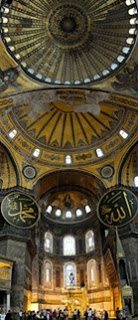
Byzantine Art
History, Characteristics: Christian Mosaics,
Icons of Constantinople.
MAIN A-Z INDEX - A-Z of ART MOVEMENTS

|
Byzantine Art
|
|
Centres of Byzantine-style |
The Collapse of Rome and the Rise of
|
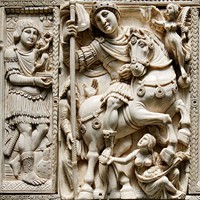 Barberini Diptych (c.500-550) Louvre Museum, Paris. A Byzantine masterpiece of ivory carving. Ivory reliefs were the main form of early Christian sculpture in Constantinople. |
|
EVOLUTION OF VISUAL
ART |
The style that characterized Byzantine art was almost entirely concerned with religious expression; specifically with the translation of church theology into artistic terms. Byzantine Architecture and painting (little sculpture was produced during the Byzantine era) remained uniform and anonymous and developed within a rigid tradition. The result was a sophistication of style rarely equalled in Western art. Byzantine medieval art began with mosaics decorating the walls and domes of churches, as well fresco wall-paintings. So beautiful was the effect of these mosaics that the form was taken up in Italy, especially in Rome and Ravenna. A less public art form in Constantinople, was the icon (from the Greek word 'eikon' meaning 'image') - the holy image panel-paintings which were developed in the monasteries of the eastern church, using encaustic wax paint on portable wooden panels. [See: Icons and Icon Painting.] The greatest collection of this type of early Biblical art is in the monastery of St Catherine in Sinai, founded in the 6th century by the Emperor Justinian. And see also, the Byzantine-influenced Garima Gospels (390-660) - world's most ancient illuminated gospel manuscript - from Ethiopia. |
|
RECOVERY OF MEDIEVAL ART ROMANESQUE ERA
|
During the period 1050-1200, tensions grew up between the Eastern Roman Empire and the slowly re-emerging city of Rome, whose Popes had managed (by careful diplomatic manoeuvering) to retain their authority as the centre of Western Christendom. At the same time, Italian city states like Venice were becoming rich on international trade. As a result, in 1204, Constantinople fell under the influence of Venetians. This duly led to a cultural exodus of renowned artists from the city back to Rome - the reverse of what had happened 800 years previously - and the beginnings of the proto-Renaissance period, exemplified by Giotto di Bondone's Scrovegni Chapel frescoes. However, even as it declined, Byzantine influence continued to make itself felt in the 13th and 14th centuries, notably in the Sienese School of painting and the International Gothic style (1375-1450), notably in International Gothic illuminations, like the Tres Riches Heures du Duc de Berry, by the Limbourg Brothers. See also Byzantine-inspired panel-paintings and altarpieces including Duccio's Stroganoff Madonna (1300) and Maesta Altarpiece (1311).
|
|
|
|
|
Using early Christian adaptations of late
Roman styles, the Byzantines developed a new visual language, expressing
the ritual and dogma of the united Church and state. Early on variants
flourished in Alexandria and Antioch, but increasingly the imperial bureaucracy
undertook the major commissions, and artists were sent out to the regions
requiring them, from the metropolis. Established in Constantinople, the
Byzantine style eventually spread far beyond the capital, round the Mediterranean
to southern Italy, up through the Balkans and into Russia. Within the dry brick exterior of S. Vitale in Ravenna, the worshipper is dazzled by a highly controlled explosion of colour blazoned across glittering gold. Mosaic art and beautifully grained marble cover almost all wall surfaces, virtually obliterating the architecture that bears them. The gold, flooding the background, suggests an infinity taken out of mortal time, on which the supernatural images float. In the apse, wrapped in their own remote mystery, Christ and saints preside unimpassioned. Nevertheless, in two flanking panels of mosaic, one showing the Emperor Justinian with his retinue and the other, opposite, his wife Theodora with her ladies, there persists a clear attempt at naturalistic portraiture, especially in the faces of Justinian and Theodora. Even so, their bodies seem to float rather than stand within the tubular folds of their draperies. In S. Vitale, and in Byzantine art generally, sculpture in the round plays a minimal part. However, the marble capitals (dating from the pre-Justinian's era) are carved with surprising delicacy, with purely oriental, highly stylized vine-scrolls and inscrutable animals. A rare example of Byzantine figurative sculpture is an impressiye head, perhaps that of Theodora, in which the Roman tradition of naturalistic portrait art lingers. To the East, Justinian's most important
surviving work is in the church, (slightly later than S. Vitale), of St
Catherine's Monastery on Mount Sinai. There, in the great Transfiguration
in the apse, the figures are again substantial presences, suspended weightlessly
in a golden empyrean. The contours, however, are freer, less rigid, than
at S. Vitale, and the limbs of the figures are strangely articulated -
almost an assemblage of component parts. This was to become a characteristic
and persistent trait in the Byzantine style. In the 8th and 9th centuries the development of the Byzantine style was catastrophically interrupted in all media. Art was not merely stopped in its tracks: there was a thorough, wide-ranging destruction of existing images throughout the Byzantine regions. Figurative art had long been attacked on the grounds that the Bible condemned the worship of images; in about 725 the iconoclasts (those who would have religious images destroyed) won the day against the iconodules (those who believed they were justified) with the promulgation of the first of a number of imperial edicts against images. Complicated arguments raged over the issue, but iconoclasm was also an assertion of imperial authority over a Church thought to have grown too rich and too powerful. It was surely owing to the Church that some tradition of art did persist, to flower again when the ban was lifted in 843. |
|
|
Byzantine Art: Revival and Development (843-1450) The halt to iconoclasm - the destructive campaign against images and those who believed in them - came in 843. The revival of religious art that followed was based on clearly formulated principles: images were accepted as valuable not for worship, but as channels through which the faithful could direct their prayer and somehow anchor the presence of divinity within their daily lives. Unlike in the later western Gothic revival, Byzantine art rarely had a didactic or narrative function, but was essentially impersonal, ceremonial and symbolic: it was an element in the performance of religious ritual. The disposition of images in churches was codified, rather as the liturgy was, and generally adhered to a set iconography: the great mosaic cycles were deployed about the Pantocrator (Christ in his role as ruler and judge) central in the main dome, and the Virgin and Child in the apse. Below, the main events of the Christian year - from Annunciation to Crucifixion and Resurrection - had their appointed places. Below again, hieratic figures of saints, martyrs and bishops were ranked in order. The end of iconoclasm opened an era of great activity, the so-called Macedonian Renaissance. It lasted from 867, when Basil I, founder of the Macedonian dynasty, became absolute ruler of what was now a purely Greek monarchy, almost until 1204, when Constantinople was disastrously sacked. Churches were redecorated throughout the Empire, and especially its capital: in Hagia Sophia in Constantinople, mosaics enormous in scale took up the old themes and stances, sometimes with great delicacy and refinement. Despite the steady erosion of its territory, Byzantium was seen by Europe as the light of civilization, an almost legendary city of gold. Literature, scholarship and an elaborate etiquette surrounded the Macedonian court; the 10th century Emperor Constantine VII Porphyrogenitos sculpted and himself illuminated the manuscripts he wrote. Though his power continued to diminish, the Emperor had enormous prestige, and the Byzantine style proved irresistible to the rest of Europe. Even in regimes politically and militarily hostile to Constantinople, Byzantine art was adopted and its medieval artists welcomed. In Greece, the Church of the Dormition at Daphni, near Athens, of about 1100, presents some of the finest mosaics of this period: there is a grave, classic sense of great delicacy in its Crucifixion, while the dome mosaic of The Pantocrator is one of the most formidable in any Byzantine church. In Venice, the huge expanses of S. Marco (begun 1063) were decorated by artists imported from the East, but their work was largely destroyed by fire in 1106, and later work by Venetian craftsmen is in a less pure style. In the cathedral on the nearby island of Torcello, however, The Virgin and Child, tall, lonely, and solitary as a spire against the vast gold space of the apse, is a 12th century survival. In Sicily, the first Norman king, Roger II (ruled 1130-54), was actively hostile to the Byzantine Empire yet he imported Greek artists, who created one of the finest mosaic cycles ever, in the apse and presbytery at Cefalu. The permeation of Byzantine art into Russia was initiated in 989 by the marriage of Vladimir of Kiev with the Byzantine princess Anna and his conversion to Eastern Christianity. Byzantine mosaicists were working in the Hagia Sophia at Kiev by the 1040s, and the Byzantine impact on Russian medieval painting remained crucial long after the fall of Constantinople.
The secular paintings and mosaics of the Macedonian revival have rarely survived - their most spectacular manifestation was lost in the burning of the legendary Great Palace in Constantinople during the Sack of 1204. Such works retained much more clearly classical features - the ivory panels of the Veroli casket are an example - but such features are to be found, too, in religious manuscripts and in some ivory reliefs (sculpture in the round was forbidden as a concession to the iconoclasts). The Joshua Roll, though it celebrates the military prowess of an Old Testament hero, reflects the pattern of Roman narrative columns of relief sculpture such as Trajan's Column in Rome; the famous Paris Psalter of about 950 is remarkably Roman both in feeling and iconography: in one illustration the young David as a musical shepherd is virtually indistinguishable from a pagan Orpheus, and is even attended by an allegorical nymph called Melody.
In 1204, the city of Constantinople was sacked by Latin Crusaders, and Latins ruled the city until 1261, when the Byzantine emperors returned. In the interim, craftsmen migrated elsewhere. In Macedonia and Serbia, fresco painting was already established, and the tradition continued steadily. Some 15 major fresco cycles survive, mostly by Greek artists. The fresco medium doubtless encouraged a fluency of expression and an emotional feeling not often apparent in mosaic. The final two centuries of Byzantium in its decay were troubled and torn with war, but surprisingly produced a third great artistic flowering. The fragmentary but still imposing Deesis in Hagia Sophia in Constantinople may have been constructed after the Latin domination, rather than during the 12th century. It has a new tenderness and humanity which was continued - for instance in the superb early 14th century cycle of the monastic church of Christ in Chora. In Russia, a distinctive style developed, reflected not only in masterpieces such as the icons of Rublev, but also in the individual interpretations of traditional themes by Theophanes the Greek, a Byzantine emigrant, working in a dashing, almost Impressionistic style in the 1370s in Novgorod. Though the central source of the Byzantine style was extinguished with the Turkish conquest of Constantinople in 1453, its influence continued in Russia and the Balkans, while in Italy the Byzantine strain (mingling with Gothic) persisted in the era of Pre-Renaissance Painting (c.1300-1400) ushered in by the works of Duccio di Buoninsegna (c.1255-1319) and Giotto (1270-1337). |
|
|
Icons (or ikons), generally small
and so easily transportable, are the best-known form of Byzantine art.
A tradition persists that the first icon was painted by St Luke the Evangelist,
showing the Virgin pointing to the Child on her left arm. However, no
examples that date from before the 6th century are known. Icons became
increasingly popular in Byzantium in the 6th and 7th centuries, to some
degree precipitating the reaction of iconoclasm. Although the iconoclasts
asserted that icons were being worshipped, their proper function was as
an aid to meditation; through the visible image the believer could apprehend
the invisible spirituality. Condensed into a small compass, they fulfilled
and fulfil the same function in the home as the mosaic decorations of
the churches - signalling the presence of divinity. The production of
icons for the Orthodox Churches has never ceased. Source: We gratefully acknowledge the use of material in the above article from David Piper's outstanding book "The Illustrated History of Art". |
|
• For more about Eastern Orthodox decorative arts from Constantinople, see: Homepage.
ENCYCLOPEDIA OF ART HISTORY |