Giotto
Biography of Italian Pre-Renaissance Painter.
MAIN A-Z INDEX - A-Z of ARTISTS

|
Giotto
|
|
COLOURS USED IN
PAINTING |
Giotto di Bondone (c.1267-1337)Contents • Biography |
|
CHRONOLOGY OF VISUAL
ARTS |
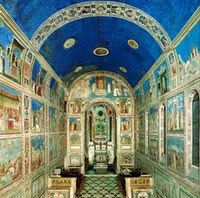
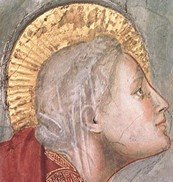
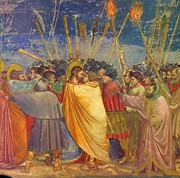
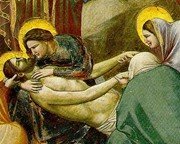
One of the early Old Masters, the Italian artist Giotto di Bondone was active during the Proto-Renaissance in Florence. Best known for his naturalistic fresco painting, Giotto, along with the Sienese painter Duccio di Buoninsegna (1255-1319) - was a key figure in 14th-century Pre-Renaissance Painting. Influenced by French Gothic sculpture, his unique contribution was to break away from the "flat" symbolism of Byzantine-style Christian art, and introduce instead a brand new realism, never previously seen. For the first time, the people in his religious paintings looked like real people with real emotions, and possessed a new three-dimensionality. Although much of his work has been destroyed, his greatest feat were the frescoes in the Scrovegni/Arena Chapel, in Padua. Painted during the period 1303-10, these Scrovegni Chapel Frescoes rank alongside the greatest examples of religious art ever created. See in particular The Betrayal of Christ (Kiss of Judas) (1305) and The Lamentation of Christ (1305). Other major works include his frescoes on the life of Saint Francis at Assisi, and in the church of Santa Croce in Florence. Without Giotto, it is inconceivable that the Florentine Renaissance - and perhaps even Renaissance art as a whole - would have developed as it did. |
|
|
|
WORLD'S BEST ART ARTS AND AESTHETICS |
Many of the details of Giotto's life are sketchy and open to controversy, including the date and place of his birth. It is believed that he was born around 1267 in a village called Vespignano, near Florence. His father was a small landowner described as 'a person of good standing' in public records from the time. Legend has it, the young Giotto was discovered by the renowned Italian painter Cimabue (1240-1302) while he was drawing pictures of his father's sheep. Apparently Cimbaue was so impressed he asked the boy's father if he could take him to Florence as an apprentice. However, it is far more probable that Giotto's family were well off enough to move to Florence and send the 12 year old Giotto to Cimbue's studio as an apprentice. Around a year later Giotto followed Cimabue to Rome where he was introduced to a school of fresco painters, including the famous Pietro Cavallini and the well-known Florentine architect and sculptor Arnolfo di Cambio. |
|
RECOVERY
OF MEDIEVAL ART WORLDS TOP ARTISTS |
|
|
The earliest of Giotto's known works, is believed to be a series of frescos painted in the Upper Church of Saint Francesco at Assisi, depicting scenes from the life of St Francis. At a time when realism in art was not yet popular, these frescos were refreshingly realistic and the figures very natural looking. However, there is some dispute as to whether they were executed by the hand of Giotto, and recent documents have come to light suggesting that the fresco was painted by a group of unnamed proto-Renaissance artists. If this is so, then Giotto's next work - the fresco cycle in the Scrovegni Chapel at Padua - owes much to the naturalism of these Assisi paintings. Scrovegni Chapel Fresco Cycle (c.1303-10) During the period 1303-10, Giotto painted a series of fresco murals in the Scrovegni Chapel in Padua. The Scrovegni Chapel, or Cappella degli Scrovegni was built by Enrico degli Scrovegni as a family chapel on the site of an ancient Roman arena - which is why it is sometimes called the Arena Chapel. Its interior walls are decorated throughout by a series of scenes from the Life of the Virgin Mary, and the Life of Christ. Covering the whole of the west wall around the chapel's entrance is Giotto's depiction of the Last Judgment, which includes a portrait of Enrico himself. The other walls are decorated with three tiers of frescoes: the top one is devoted to scenes from the Life of the Virgin Mary, the middle and lower ones show scenes from the Life of Jesus - a total of 39 scenes. Famous panels in the series include The Adoration of the Magi, in which a comet-like Star of Bethlehem streaks across the sky, and the Flight from Egypt. The influential 19th century English critic John Ruskin (1819-1900) said of Giotto's frescoes: "He painted the Madonna and St. Joseph and the Christ, ... but essentially they look like Mamma, Papa and Baby". These frescoes marked a major turning point in Western art. For the first time, we see figures who - in contrast to traditional iconography - are emotionally expressive and quite realistic looking. Although Giotto specialized in religious art, he broke from the traditions of Byzantine art (which valued the symbolic approach over realism) by infusing his figure drawing with real-life people, poses and expressions. He also introduced an early form of linear perspective into his painting. Although other artists like Pietro Cavallini had started working in this style, Giotto took it much further and set a new standard for figure painting. During the mid-16th century, Giorgio Vasari, the famous art historian, wrote many stories about Giotto's mastery of drawing. One story told how Pope Boniface VIII sent a messenger to Giotto to request samples of his work. As a response, Giotto dipped his brush into red paint and in one continuous stroke painted a perfect circle. He told the messenger to take the circle back to the Pope and that it's worth would be recognised. When the pope received the circle, according to Vasari, he 'instantly perceived that Giotto surpassed all other painters of his time'. In 1311 Giotto returned to Florence where he executed a mosaic for the facade of the old St. Peter's Basilica - the work is now lost except for some fragments. |
|
|
Giotto's reputation as a painter quickly grew, as did his commissions. By 1311 documents show he owned several large estates in Florence, and that his workshop had become the leading studio in Italy. But in spite of the demand for his services, no signed work of his survives. There is a certain measure of agreement that Giotto painted frescos at four chapels in the Franciscan church of Santa Croce in Florence, dating to about 1320. (Surviving works, can be seen in the Peruzzi and Bardi chapels.) Some of the frescos are in bad condition, as they were whitewashed in the 18th century, but despite this they remain impressive to this day. Several panel paintings on the Stefaneschi Altarpiece at the Vatican bear Giotto's signature, but it is believed that this is just a trademark confirming it came from his workshop, rather than a signature of his personal work. On the other hand, the Ognissanti Madonna (c.1315, Uffizi Gallery) is not signed, but the work is such a grandiose spectacular that it is universally accepted as Giotto's. Revered by this time - even by the more conservative Sienese School of painting, and by its leader Duccio di Buoninsegna, creator of masterpieces like the Maesta Altarpiece and the Stroganoff Madonna - as one of the great new innovative artists, Giotto was honored with the title of Magnus Magister (Great Master) in 1334 by the city of Florence and was appointed city architect and superintendent of public works. During this time he designed the famous campanile (bell tower) on St Peters Square, but died before the work was completed. He last known completed work is the decoration of Podesta Chapel in the Bargello, Florence. Giotto died in January 1337, but there is some controversy over the exact location of his grave. In 1970, bones were discovered underneath the paving of the Church of Santa Reparta (where his biographer claims he was buried). Forensic examination confirms that they were the bones of a painter (a range of chemicals including arsenic and lead, both commonly found in paint, were discovered in the bones). The front teeth were worn in such as way as to be consistent with holding a brush between the teeth. A reconstruction of the skeleton shows a man with a very large head, large crooked nose and one eye more prominent than the other. The bones were of a small man, only about 4 foot tall who suffered from a form of dwarfism. This would be consistent with a picture in one of the frescos at the church of Santa Croce of a dwarf-like figure which is supposed to be a self portrait of Giotto. His biographer, who was a friend of Giotto, says "there was no uglier man in the city of Florence". The body was reburied with honour near the grave of the Renaissance architect Filippo Brunelleschi. Legacy Works by Giotto can be seen in the best art museums in Italy. |
|
• For the evolution of the visual
arts, see: History of Art.
ENCYCLOPEDIA OF OLD MASTER PAINTERS |