Medieval Christian Art
Byzantine Icon Painting, Illuminated Manuscripts,
Carolingian/ Ottonian Cultures.
MAIN A-Z INDEX - A-Z of ART MOVEMENTS

|
Medieval Christian Art
|
|
|
Medieval Christian Art (c.600-1200)
|
|
MEDIEVAL CULTURE EVOLUTION
OF VISUAL ART |
For centuries after the decline of Rome, Western Europe was cloaked in barbarian darkness. No city - not even Rome itself - could compare with the magnificence of Constantinople, Cordoba or Baghdad. Europe produced no science, no schools of medieval art, no architecture to compare with its former achievements. For 600 years (400-1000) it remained a cultural backwater. Only one institution survived: the Church. Indeed, the role of the church in maintaining Western civilization and culture was pivotal. It continued to be, for example, the main sponsor of monumental architecture and sculpture. In fact one could say that the line between Christianity and paganism was also the line between Roman civilization and barbarism. Byzantine Medieval Christian Art After the sack of Rome (c.450) the headquarters of the Christian Church moved to Constantinople (now Istanbul). Although mostly an Asiatic city, Constantinople ruled over a Byzantine empire that spread into Eastern and Southern Europe. Its principal art forms, included icon painting (derived from Egyptian tomb portraits), mural painting (in both tempera and fresco) and mosaic art. (But see the Byzantium-inspired Garima Gospels 390-660 from Ethiopia's Abba Garima Monastery.) Byzantine icons proved highly popular in Russian medieval painting - see the Novgorod school of icon painting - whose leading painters included Theophanes the Greek (c.1340-1410) and the great Andrei Rublev (c.1360-1430), famous for the Holy Trinity Icon (1411-25) painted for the Trinity Monastery of St. Sergius, now in the Tretyakov Gallery. Similar techniques were adopted during the late Middle Ages in Italy by the Sienese school of painting,and in Russia by the Moscow school of painting. |
|
|
|
|
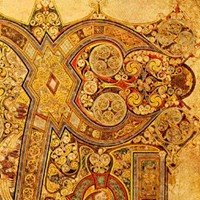
Irish Illuminated Manuscripts (650-900 CE) The finest examples of early Christian art in Western Europe, were the Irish and Anglo-Saxon illuminated gospel manuscripts dating from the mid-sixth century CE. They were succeeded by Carolingan and Byzantine illuminated texts as well as a host of Persian Islamic illuminations. This Insular form of Biblical art combined Celtic artistry with Anglo-Saxon metallurgical skills in numerous abbeys and monasteries across Ireland, such as those in Durrow, Clonmacnois, Clonfert, Kells and Monasterboice, as well as English and Scottish centres of religious scholarship like Iona and Lindisfarne. Created by artist-monks, the earliest examples of this monastic Irish art are the the Cathach of Columba (Colmcille) (c.610), and the Book of Dimma (c.620 CE); others include the Book of Durrow (c.650), the Lindisfarne Gospels (c.700), the Lichfield Gospels, the magnificent Book of Kells (c.800) and the Echternach Gospels. Their decorative content incorporated different combinations of red, yellow, green, blue, violet, purple, and turquoise blue. Some even used gold and silver text. With their fabulously intricate Celtic spirals, rhombuses, carpet pages and miniature pictures, these treasures must have appeared dazzling to the monks and people of the day. That said, most of this early Christian art remained portable and hidden, largely due to Viking banditry and the general insecurity of the Dark Ages. |
|
EVOLUTION OF VISUAL
ART |
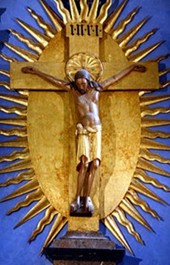
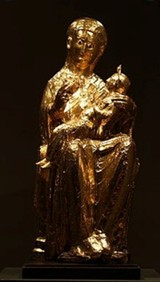
Carolingian Art (750-900) - Ottonian Art - Romanesque Style On the Continent, by the late eighth century (c.775), the Frankish Empire of the Christian King Charlemagne had become the strongest of the new states formed since the collapse of Rome. Over the next century, it extended itself across France, Germany, Holland and Belgium, and part of Italy. Charlemagne's court in Aachen attracted scholars, monks and theologians from all over Europe, and in the process sparked a cultural revival - Carolingian Art - that took over from the Irish art renaissance (c.650-900), which itself was beginning to come under pressure from the Vikings. Strongly inflenced by the Late Antiquity and Byzantine era, Charlemagne's scriptoriums and calligraphy workshops produced outstanding illuminated Christian manuscripts, such as: the Godscalc Evangelistary, the Lorsch Gospels and the Gospels of St Medard of Soissons. Also, Carolingian ivory carvers produced numerous examples of outstanding early Christian sculpture, in the form of plaques, dyptychs and personal fixtures. (For a discussion of Carolingian influence in 'Germany', see German Medieval Art). After Charlemagne came the era of Ottonian art, renowned for its architecture, as well as its precious metalwork - exemplified by works such as: the celebrated gilded oak carving entitled the Gero Cross (965–70, Cologne Cathedral; the Golden Madonna of Essen (c.980, Essen Cathedral), made with gold leaf and cloisonné enamel; and the Cross of Otto and Mathilda (c.973, Essen Cathedral). This in turn was followed by the first European-wide movement of the Middle Ages known as Romanesque art, of which an influential regional school was that of Mosan art, which emerged around Liege in present-day Belgium. Leading exponents of the school - which was noted in particular for its champlevé style of enamelling - included the goldsmiths Nicholas of Verdun (1156-1232) and Godefroid de Claire (1100-73).
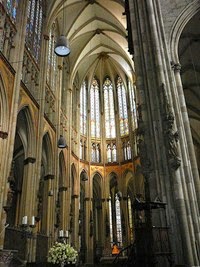
Power and Patronage of the Church With the religious support of Rome and the secular support of Charlemagne, European bishops - often men of powerful families - became key figures in local and regional affairs. With a new Millennium on the horizon, the church was poised to extend its patronage of religious art across Western Europe. Beginning with the stimulation of Romanesque style murals and illuminations in France and Spain, along with cathedrals at Santiago de Compostela (Spain) and Autun (France), this stirring of Roman power gathered momentum with the founding of new religious orders (Benedictines, Cluniacs, Cistercians), who helped to expand the genres of architecture, sculpture, and other visual arts, exemplified by the construction of the great European Gothic cathedrals and by the consequent upsurge in stained glass art. For a brief guide, see: Gothic art. For specific details of statues and reliefs, see: Gothic Sculpture. This Christian stimulus to the growth of European art - reinforced by elements of Byzantine Christian art - culminated in the great Renaissance movements which swept across the Continent in the fifteenth century. |
|
• For other art movements and periods,
see: History of Art.
ENCYCLOPEDIA OF ART HISTORY |