Viking Art
History, Characteristics of Borre, Jellinge,
Mammen, Ringerike, Urnes Cultures.
MAIN A-Z INDEX

|
Viking Art
|
|
|
Viking Art (c.700-1150)Contents • Viking Art:
Brief Introduction |
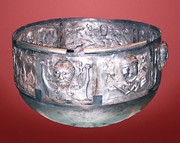 The Gundestrup Cauldron (c.400 CE) |
Vikings were Scandinavian seafaring warriors - pagan Danish, Norwegian and Swedish - who raided and colonized wide areas of Europe during the period 790-1050 CE. Viking or Norse settlements were achieved in North America, Greenland, Iceland, Ireland, Scotland, England and Continental Europe. In the East, Vikings expanded into the heart of Russia where they left their name - 'Rus' meaning red, after the red-haired Norsemen. Unfortunately, their raids were responsible for the decline of monastic art in Ireland, especially illuminated manuscripts. |
|
VIKINGS, also called Norsemen were |
|
ANCIENT ARTS AND
CULTURES DIFFERENT FORMS OF ARTS
|
As might be expected among a race of aggressive outdoor warriors, Viking art tends to be more functional and symbolic, rather than contemplative or expressive. And since Vikings were often moving from place to place, most Norse art consists of portable artworks, such as decorated drinking horns, body armour, pagan icons, paddles, and a wide range of objects used in daily life. That said, their wood carving and sculpture displays great inventiveness and level of skill, and Viking artists have left a rich legacy of extravagant animal ornament. Their metalworking was also of a high quality and both influenced and was influenced by Celtic metalwork art. Early Viking art focused on jewellery and weapons, while later craftsmen are known for their silver-work and runestones. Norse art also survives in the form of small-scale ivory carving as well as works in amber, jet, bone, walrus ivory and, occasionally, wood. Significant finds of Viking art have been made at: Oseberg, Borre, Jelling, Mammen (eg. the Mammen axe, currently displayed at the National Museum of Denmark, Copenhagen) Ringerike and Urnes. Moving away from the visual arts, the Viking interest in riddles and rhyme led to a rich tradition of poetry and story-telling, as celebrated in Old Norse epic sagas. But perhaps the greatest Viking achievement is the longship, whose ingenuity and effectiveness have raised it almost to an art form. Fast, light, maneuverable, and flexible, the longship could be quickly beached or launched, rowed by oarsmen or sailed in any wind. Not exactly fine art, perhaps, but fine craftsmanship. In summary, the imaginativeness and intricacy of Viking arts and crafts contrasts strongly with the other image of the pillaging barbarian. Norse craftsmen excelled in woodwork and metalwork, engraving and adorning brooches, weapons, implements, and ship timbers with a huge variety of animal forms and intricate patterns. There was hardly a material to hand which Viking craftsmen had not stopped to beautify or enhance. Examples of Norse art can be seen in museums in Copenhagen, Oslo and Stockholm. |
|
|
Styles of Viking Norse Art (850-1050) For the inhabitants of Scandinavia the Viking age was a period of rapid expansion, a period which lasted from the 9th to the mid 11th century. For piracy, trade, and colonization the Vikings travelled from Russia to Byzantium, from Iceland to Gibraltar. At the beginning of the 9th century factors both inside and beyond Scandinavia made the expansion possible. Reasons For Viking Migrations Overseas First, the population of Scandinavia rose and in the savage climate it only needed a few extra mouths to feed for small farms to become overcrowded. At the same time, the Viking ocean-going ship, the knorr, had reached a high stage of technical development which enabled men to sail to the Mediterranean and across the Atlantic. Secondly, the break-up of Charlemagne's empire and political disorders in the British Isles left a power vacuum which the Vikings were quick to exploit. Although they seldom missed the opportunity to raid a monastery or a town, the Vikings also had peaceful motives for travel. The Swedes conducted a profitable trade with eastern Europe and even with Asia Minor, moving up and down the Volga and Dnieper rivers. This accounts for the large amounts of Arabic silver found in eastern Swedish hoards. The Norwegians left their homes to settle around the north Atlantic, on the Scottish islands, Iceland, Greenland, and even, for a short while, in north America. They established themselves in Ireland, on the Isle of Man, and in north-west England: the fusions of cultures which occurred in these areas were to have important artistic results. On the other hand, the conquest of Normandy by the Norwegian or Danish Rollo, in 911, had practically no artistic effects on Viking styles. The Danes concentrated their activities on the northern part of the Holy Roman Empire and on eastern England. Here they were granted the Danelaw by King Alfred in 878 and under King Canute (reigned 1017-35) created the joint kingdom of England and Denmark. Impact of Religion on Viking Arts Religion, rather than political conditions or commercial activity, had the greatest effect on Viking art. In the 9th century Scandinavia was pagan and its inhabitants worshipped pagan gods such as Odin, Thor, and Frey. They frequently, though not consistently, practised inhumation, burying their dead along with a wide variety of grave goods. A ship, either real or symbolic, was often associated with the grave, to carry a dead person on his spiritual journey. Unfortunately for archaeologists, the advent of Christianity brought an end to burial with possessions, but the Vikings continued to bury hoards of gold and silver. Christianity made progress in Scandinavia for a variety of reasons, including the missionary efforts of such priests as Ansgar and Poppo, and the political ambitions of kings. Thus the attempts to convert Norway by King Olaf (the Saint) were closely linked to his desire to become sole ruler of the country. Denmark was converted under King Harold Bluetooth (c.980); Norway with the help of Anglo-Saxon missionaries during the 11th and 12th centuries; and Sweden, finally, in the late 12th century. Viking art can be divided into several distinct styles. They often overlap chronologically and so cannot be used for accurate dating, but they are useful when analyzing the content of a design. The styles take their names from the find-places of important objects. The approximate dates given to styles below are deduced from coins or from inscriptions that occasionally accompany finds. Generally, Viking art is based on the abstract animal forms which flourished in northern Europe from the period of migrations (c.400) onwards. The animal style consisted of contorted, writhing snakes and beasts whose actual shape is often barely recognizable. Such designs were almost entirely devoid of plant ornament and were most frequently applied to objects in daily use, for example swords, bridles, and buckles. Some representational art is found on carved stones, but probably more once existed on tapestries or wooden carvings. Most Viking buildings were made of wood and earth, and as such have mainly disappeared. However, excavations of the Danish military camps at Trelleborg and Fyrkat show that the Vikings could design settlements with mathematical precision. Houses themselves were long and low, with slightly convex walls made of posts and planks. They were buttressed by an additional row of inclined posts around the outside of the walls. Little is known about the architecture of the Vikings' shrines and temples. Oseberg Ship Burial
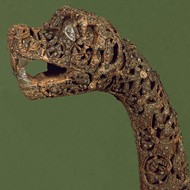
Site The ship itself was an elegant fjord cruiser - too low in the beam for long-distance voyages. Its stem and stern posts, terminating in spirals, are lavishly carved with interlocking animals. They have small heads, double-contoured bodies, and pierced heart-shaped hips. Another part of the ship is carved with a variation of the "gripping beast". This motif was a new feature in the 9th century, its compact form contrasting with the running ribbon animals. It is recognized by its round head, bulging eyes, snub nose, exaggerated biceps and thighs, and omnipresent gripping paws. It usually resembles a feline creature but on this occasion looks like a group of old men gripping each other's long beards. Viking Carvers/Sculptors Metalwork from the same stage of
development as the Oseberg objects is represented by finds from Broa,
Gotland (now in the State Historical Museum, Stockholm). They are mainly
gilt-bronze bridle mounts, a bridle bit, and sword hilt etc. Most of the
animal motifs found on them can be paralleled on the Oseberg objects. |
|
|
The Borre style flourished from about 840
to 980, and is named after the bridle mounts from Borre
in Norway (University Museum of Northern Antiquities, Oslo). The style
has three main elements, the most obvious being the ring-chain motif:
a two-stranded plait whose intersections are bound by a ring. Secondly
there is a type of gripping beast with a ribbon body whose claws clasp
the frame in which it is placed, and finally a backward-looking quadruped
with spirals on its hips and a pigtail. The Jellinge style (c.870-1000) is often
found in conjunction with the Borre style. For example, a brooch from
Odeshog, Ostergotland, has Borre interlace at its centre and typical Jellinge
animals around its sides (State Historical Museum, Stockholm). The style's
name is derived from a silver cup from Jelling, Jutland
(National Museum, Copenhagen). Each animal has a ribbon-like body, outlined
by a double contour. Its head with a long pigtail is in profile and the
upper jaw extends into a lip-lappet: the creature is derived from the
elongated gripping beast found at Borre. Mammen Style of
Viking Art Ringerike Style
of Viking Art |
|
|
The Ringerike style flourished especially well in England during the reign of King Canute (1016-35), because there were so many Viking patrons in England and because the style was easily assimilated by artists versed in the contemporary Winchester style. In manuscripts the subtle change from Winchester acanthus to Ringerike can be seen by comparing the Harley Psalter (British Library, London; MS. Harley 2904) with a manuscript in the University Library, Cambridge (Ff I 23). In the former, acanthus ornament is lush but controlled; in the latter thinner and thrusting, forever exceeding its boundaries. A sketch in the back of the Caedmon manuscript (Bodleian Library, Oxford; MS. Jun. rr) shows a perfect combination of Winchester rosettes in a Ringerike style border. A grave slab from St Paul's churchyard, London, is one of the better renderings in stone, depicting the beast and snake in struggle, carved in low relief (Museum of London). The background was painted in blue and black while the beast was covered in white dots. The style is admirably represented in English metalwork by the weather vane found at Winchester (Winchester Cathedral Library) and by the silver disc brooch from Sutton, Isle of Ely (British Museum, London). The Ringerike style was very influential in Ireland and can be seen on such objects as the crozier of the Abbots of Clonmacnoise (c.1120) and on the book shrines of the Cathach and the Misach (both c.1090; all in the National Museum of Ireland, Dublin). In England the style lost favour in the 1050s, shortly before the Norman Conquest, but it continued in Ireland until the 1120s. The last artistic invention of the Viking
world was the Urnes style. It can be seen evolving from the Ringerike
on a series of rune stones in Sweden. The series begins at Boge,
Gotland, with a thick-set beast extruding tendrils like those on the Kallunge
vane. Gradually the beast becomes more attenuated and elegant, as
seen at Strangnas, Sodermanland, and Ardre III, Gotland. Source: We gratefully acknowledge the use of material in the above article from "A History of Art" (1983), edited by Sir Lawrence Gowling. |
|
• For the main index, see: Homepage.
Art
Questions | Art Glossary |