National Museum of Ireland
History, Collection Highlights, Exhibitions, Opening Hours.

Irish Art Exhibitions
|
National Museum of Ireland |
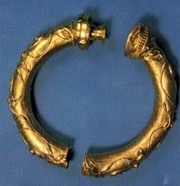 The Broighter Collar (Torc) (1st Century BCE), one of Ireland’s greatest surviving gold masterpieces of Celtic art from the pagan Iron Age. Found in Broighter, County Derry. |
National Museum of IrelandFounded in 1890, the National Museum of Ireland (Ard-Mhúsaem na hÉireann) is a major cultural institution consisting of four centres: three in the capital Dublin and one in County Mayo. The National Museum of Ireland has a strong focus on Irish art, the history of Irish art and Celtic culture. History and Archaeology The History and Archaeology part of the museum (Kildare Street, Dublin) commemorates prehistoric Ireland, with an emphasis on Irish metalwork. It highlights early Celtic gold masterpieces, illuminated religious manuscripts, outstanding examples of later Celtic metalwork and numerous church treasures from the medieval era, including the Viking age, and later times. The Museum houses special displays of artifacts from Egypt, and the Roman world, augmented at regular intervals by special exhibitions of Ancient art. |
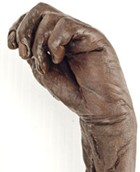 Bog Bodies (Wrist and Hand Detail) |
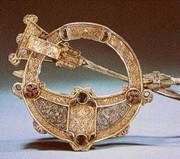 The Tara Brooch (c.700 CE). Made from silver gilt with a knitted silver wire, decorated in Celtic interlace patternwork. Discovered 1850 near Laytown, County Meath. |
Early Celtic and Irish Masterpieces Among the many outstanding early Irish exhibits are such masterpieces as the Ardagh Chalice, the Derrynaflan Chalice, the Derrynaflan Paten, the Moylough Belt Shrine, the Petrie Crown, the Tully Lough Cross, the Cross of Cong and the Tara Brooch, as well as the Broighter Hoard (including the gold Broighter collar and the gold Broighter boat, complete with anchor, mast, rowing benches, oars, and boathook.) Several of these Celtic Irish treasures would have been lost or melted down but for the intervention of archeological experts (eg. George Petrie) from the Royal Irish Academy and the Royal Society of Antiquaries of Ireland. These items in the National Museum of Ireland help to trace the development of Irish visual arts from the Newgrange era to the medieval Irish renaissance following the eclipse of Rome and the Dark Ages. |
| IRISH
ART GALLERIES For reviews of the best museums of arts in Ireland, see: - National Gallery of Ireland - Irish Museum of Modern Art - Hugh Lane Gallery Dublin - Chester Beatty Library - Trinity College Dublin Library - National Self-Portrait Collection - The Hunt Museum (Limerick) - Ulster Museum. |
Irish Metalwork and Jewellery The National Museum of Ireland collection contains some of the most important Irish antiquities of Celtic culture, discovered in Munster, Connacht, Leinster and Ulster, including personal gold jewellery, Viking swords, reliquaries, episcopal sculpture and croziers, as well as ecclesiastical metal vessels. Many items display exquisite craftsmanship, encompassing traditional metallurgical skills of casting, soldering, riveting, and mechanical joint-making; plus advanced goldsmith art involving the use of gold plate, gold foil, and delicate filigree work. Other specialist arts and crafts featured in these items include millefiori glass ornamentation, carving in ivory, amber, and engraving. Much of the abstract designwork is executed using Celtic patterns such as zoomorphic (animal-form) or geometrical motifs. |
|
|
Examples of Metalwork Art in the Museum Here are some of the highlights of the museum's collection of precious metal antiquities. Decorated Macehead Five Gold Bands |
|
|
Gold Lunula Gold Lunula Hoard of Gold Ornaments Gold Ear-Spools Gold Bracelet, Dress-Fasteners Hoard of Ear Ornaments Gold Disc (Fasteners and Bracelets) Gold Foil-Covered Bullae (Pendants) Gold Hoard of Collar, Pair of Gold Lock-Rings,
Bracelets, Ear Ornaments Gold Torc Broighter Gold Hoard |
|
Loughnashade Trumpet Petrie Crown Hoard of Bronze Bracelets, Amber Beads,
Gold Torcs Silver Spiral Rings Carving of Saint Patrick Moylough Belt Shrine The Tara Brooch The Loughan (Dalriada) Brooch The Cavan (Queen's) Brooch The Loughmoe (Tipperary) Brooch |
|
The Kilmainham Brooch The Ardagh Chalice and Hoard The Derrynaflan Chalice, Paten, Strainer
and Hoard Plaque Featuring an Ecclesiastical Figure
Engraving Silver Bossed Penannular Brooch The Ballinderry Sword Gold Ornaments The Roscrea Brooch |
|
Silver Penannular Brooch Cross of Cong Soisceal Molaise Shrine Shrine of the Stowe Missal Lismore Crozier Gold Ring Brooch Shrine of the Cathach (Battler) Domhnach Airgid ('Silver Church') Shrine Shrine of Saint Patrick's Tooth Natural History The Natural History Museum, which is also part of the National Museum of Ireland, is located on Merrion Street in central Dublin and houses exhibits and specimens from the animal kingdom around the world. Neither its collection of exhibits, nor its Victorian style building have altered greatly since the early twentieth century. |
|
Decorative Arts Opened in 1997, the historical decorative arts section of the National Museum of Ireland is situated at the Collins Barracks site, a former military building named after Michael Collins. This site houses the NMI's administrative centre, as well as the Great Seal of the Irish Free State. Among the many exhibits are items of furniture, silver, ceramics and glassware, money and weapons, as well as examples of folklife and costumes. A medieval Chinese porcelain vase dating from about 1300 is one of the highlights. In addition, the decorative arts section holds regular special exhibitions throughout the year. Country Life The Museum of Country Life, in Castlebar, in County Mayo, is the newest section of the National Museum of Ireland. Opened to the public in 2001, this section commemorates day-to-day Irish life from the mid-1800s to the mid-1900s, notably rural Ireland in the 1930s. There are special exhibits on the home, the natural environment, and forces for change.
More Details NMI Archaeology and History NMI Decorative Arts and History NMI Natural History NMI Country Life World's Greatest Art Galleries For details, see: Best Art Museums. |
|
• For details of other fine art exhibitions
and collections, see: Irish Art Galleries
and Museums.
ENCYCLOPEDIA OF ART |
