Making of Illuminated Manuscripts
Design and Manufacture of Medieval Gospel
Books.



|
Making of Illuminated Manuscripts
|
|
BIBLE ART |
Making of Illuminated Gospel ManuscriptsContents • Introduction Medieval Book
Painting Series |
|
ILLUSTRATED GOSPEL
TEXTS REVIVAL OF MEDIEVAL ART CHRISTIAN CELTIC-STYLE
ART ART IN IRELAND |
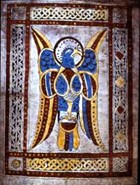
Illuminated manuscripts are some of the finest examples of early Christian religious art. The traditional folded and sewn manuscript book is called a 'codex' (from the Latin caudex meaning 'tree trunk' or 'bark'). The medieval codex in the West typically had three discrete ornamental elements - the initial letter, both large and small, the border decoration, and the miniature. Elaborately embellished initial letters were in use from the seventh century, when Irish and British illuminated Gospel books contained a richly calligraphic ornamentation of interlaced ribbons, foliage, and stylized birds and animals, heavily influenced by motifs from Celtic art. (See, for example, the incredible Chi Rho Monogram Page in the Book of Kells.) The arrangement of capital letters gradually extended into the borders of the text until the borders became features in their own right. The figures drawn inside the initial letters developed, too, and gradually became small scenes - stories, hence the term 'historiated initial'. These little pictures were often of high distinction. The word 'miniature' comes from the Latin word meaning 'to colour in red'; red was one of the earliest colours to be used in codices and gradually the term came to signify all the pictures which accompany the text in manuscript books. |
|
LOOKING FOR ART
BOOKS? DESIGNS OF THE CELTS |
|
|
In ancient times, texts were written on
papyrus (the origin of the word "paper"), a cheap reed material
used by the Greeks and the Egyptians. This was a good material for scrolls,
but not for a bound book, as the material was too fragile to withstand
the constant turning of pages or the sewing of the gatherings on to the
binding.
|
|
|
Occasionally locally-produced vellum was not up to scratch and in some books (for example, a Bible made for the monastery of St Alban's in 1135) we can see that illustrations have been made on separate pieces of parchment and dropped in. Professional parchmenters, highly skilled experts at their trade, are documented from at least 822, when Abbot Adelard of Corbie in France is recorded as having a parchment-maker on the payroll of the monastery. (See also Medieval Artists.) A skilled parchmenter, a man in a profession
which expanded greatly over the next 500 years, would be able to take
a skin and transform it into a soft, supple, white material for writing
on. The process, both time-consuming and complicated, scarcely changed
over 800 or 900 years. First, the parchmenter would select good skins,
paying close attention to colour and quality. The next step was to soak
the skins in a lime solution for several days and then scrape off all
the hair. Once the skin was cleaned, it was fixed with pegs on to a frame
to dry. Then the parchmenter would take a crescent-shaped knife called
a lunellum and scrape vigorously at both surfaces of the skin. With the
round blade of this special knife the parchmenter would run less risk
of cutting or tearing the skin, now stretched taut on its frame and of
course shrinking as it dried. (If the skin did tear, the cut could be
stitched; but there are manuscripts in which the parchment contains a
hole, and the scribe has carefully written round it.) The scraping and
stretching continued until the parchment was at the right thickness (the
little Bibles being made in fourteenth-century Paris used parchment which
was almost tissue thin). The dry sheets of vellum were then either rolled
or cut to shape and stored for use. The grain side, where the hair used
to be, is usually darker in colour and more velvety.
Paper Manuscripts: 1400 Onwards |
|
|
Gathering The
Manuscript There were two principal types of script used by monastic scribes: uncial and half-uncial. Uncial was a more formal script which first emerged during the fourth century, and which employed only capital letters. This design had been fully developed in the Roman Empire during the fourth century, and was used for writing books. The religious manuscripts brought to England by Saint Augustine and his followers, as well as those acquired later by Benedict Biscop and Ceolfrith, provided Irish and English scribes with many fine exemplars for this uncial script. Half-uncial or insular majuscule script was pioneered in early Christian Ireland and spread throughout Scotland, England and the Celtic abbeys and monasteries in mainland Europe. Half-uncial is used in many illuminated manuscripts, notably in the Lindisfarne Gospels and Book of Durrow. It was similar to the uncial capital script, but included a number of letter shapes which are similar to modern lower-case letters. It produces a well-balanced, easy-to-read script that is quicker to write than the older uncial style. On top of this, Irish scribes developed a third variety of writing which was a cursive script (joined-up) and thus even faster to write. Developed at a later stage, it is commonly only seen in illuminated manuscripts in the form of the glosses (notes) written in the margins or between lines of text after the manuscripts were first written. Finally, during the late-7th and early-8th century, Irish monastic scribes also developed a Gaelic script, although this too was reserved for marginal entries and sundry notes. |
|
Pens and Inks
Manuscript
Decorations and Illuminations Whatever the precise circumstances, even
before the first word was written in a book, the complete design for the
book illustration would have been mapped
out, from the overall hierarchy of design (Would there be gold throughout
the manuscript? Would there be full borders on each page? Would there
be a full-page miniature
painting of an apostle, or only decorated initial letters?) to the
design of each individual page. The rich, vibrant reds, blues and greens,
the yellows and purples of the decoration were added after the text, and
we can see from surviving unfinished manuscripts how spaces were roughed
out in ink for the religious paintings,
and decorated borders, or for the illuminated initials. These designs
were usually copied from a pattern or from the exemplar, and could be
adapted if necessary. They would have been sketched in, sometimes with
guidance as to the colour to be used, before being painted. Sometimes
the artist or colourist might be an itinerant professional. Experts have
discerned similarities in work which indicate that in some cases artists
worked as far apart as Canterbury, in northern England, and Hainault,
east of London. Medieval manuscripts are illuminated with
a very wide range of colours. Vermilion is the commonest. There
are other shades of red, too: madder, a plum colour, comes from
the madder plant; and the exotic dragonsblood, which we are told
is the mixed blood of dragons and elephants, spilt in battle (though more
prosaically it actually comes from the shrub pterocarpus draco). Blue
pigments were made from azurite (a blue stone rich in copper),
from the seeds of the plant turnsole, from cobalt, or, most luxuriously,
from lapis lazuli, to make ultramarine. Lapis lazuli comes only
from the region round Afghanistan, and Marco Polo speaks of visiting the
mines there at the end of the thirteenth century; but it was used in the
Lindisfarne Gospels Book six hundred
years before that, and must have been very precious for having made such
a long and arduous journey. Greens were made from malachite or
verdigris, yellows came from saffron or arsenic trisulphide,
white from white lead. Violet was made from the sunflower. Manuscript Binding |
|
• For information about the artistic
achievements of Monastic Ireland, see: Irish
Art Guide.
ENCYCLOPEDIA OF IRISH AND CELTIC ART |