Edward Burne-Jones
Biography of Pre-Raphaelite Painter &
Designer.
MAIN A-Z INDEX - A-Z of ARTISTS

|
Edward Burne-Jones
|
|
|
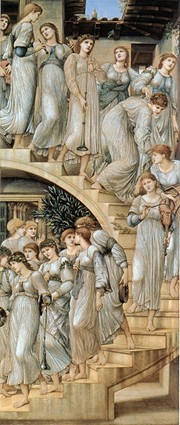
Sir Edward Burne-Jones (1833-1898)Biographical Summary An important contributor to Victorian art, Sir Edward Burne-Jones was an artist and designer who was associated with the Pre-Raphaelite Brotherhood. He turned to a career in art after meeting the painter Dante Gabriel Rossetti and the medievalist William Morris (later to become an active member, along with Burne-Jones, of the Arts and Crafts Movement) in 1855. Internationally famous in his time, Burne-Jones' painting is associated with Romanticism as well as Symbolism, and exercised a major influence on the development of other 19th century modern art movements like Art Nouveau and the Aesthetic movement. At first he specialized in watercolours but later progressed to large-scale colourful oil painting. He also worked with his friend Morris in the decorating business, collaborating on the designs of glass windows, tapestry, mosaics and printed fabrics. Best known works by Burne-Jones include: The Beguiling of Merlin (1874, Lady Lever Art Gallery, UK); The Golden Stairs (1876-80, Tate Britain, London) The Beggar Maid (1884, Tate Gallery, London); his series Pygmalion and the Image (1878, Birmingham Museum of Art) and Fair Rosamund and Queen Eleanor (1862, Tate, London). In 1998, to commemorate the centenary of the death of Edward Burne-Jones, the Museum of Modern Art, New York, held a major retrospective of his painting, which later travelled to the Musee d'Orsay in Paris. |
|
COLOURS USED IN
PAINTING 19TH CENTURY BRITISH ART WHAT IS VISUAL ART? WORLDS TOP ARTISTS |
|
WORLD'S GREATEST ART POSTERS
OF BURNE-JONES |
Early Works Burne-Jones was born in Birmingham, England in 1833. Between 1848 and 1852 he attended the Birmingham School of Art, before starting religious studies at Oxford. Here he became friends with William Morris, who shared his passion for the arts. They would remain lifelong friends and work together on many applied art and design projects. Burne-Jones had fully intended on becoming a church minister, but after meeting Dante Rossetti (1828-82), the leading member of the Pre-Raphaelite movement, he changed his mind. Rossetti was a painter, illustrator and poet, whose art was characterised by medieval themes and sensuality. Like other Pre-Raphaelite artists such as William Holman Hunt (1827-1910), Rossetti was in favour of the aesthetics, classical poses and natural compositions of Raphael (1483-1520) and his predecessors. He took on Burne-Jones as a student, although the latter was producing only watercolour painting, using themes associated with the medieval story of Fair Rosamond and Queen Eleanor. Rosamond was the mistress of King Henry II, and the artist depicted the heroine in light colours to represent innocence, and Queen Eleanor was depicted in dark angry blacks. The story was a popular one: in fact it had already been used by Rossetti and Arthur Hughes (1832-1915). Italy and the Renaissance Classics By the 1860s Burne-Jones was starting to discover his own artistic 'voice'. He visited Italy a number of times, with Morris and the art critic John Ruskin (1819-1900). Ruskin had first come to popular attention for his written support of JMW Turner, and his defense of naturalism in art. He subsequently put his weight behind Pre-Raphaelitism. While on a trip to Italy in 1862, Ruskin implanted a passion in Burne-Jones for Botticelli (1445-1510) and Michelangelo (1475-1564), as well as a love of symbolic narrative in painting. Some historians consider Burne-Jones' early Pre-Raphaelite-style painting to be merely a phase, and his mature work to be more Romantic and Symbolist in nature. Burne-Jones also got to know the Pre-Raphaelite painter John Everett Millais (1829-96), who painted Ruskin's portrait and stole his wife. Also the great Victorian neoclassical painter and sculptor Frederic Leighton (1830-1896) and the highly popular Sir Edwin Landseer (1802-73), noted for his sentimental portraits of dogs, and also his bronze lions in Trafalgar Square. William Morris & Co Meantime his friend, Morris (initially with Rossetti, Philip Webb, Ford Madox Brown and Burne-Jones himself) had founded a crafts and design business, William Morris & Co. After a shaky start, the company produced tapestries, stained glass windows, carpets, furniture, mosaics, and wallpapers. Burne-Jones made many designs for the company, primarily for stained glass and tapestry, converting some of them into paintings - such as his King Mark and La Belle Iseult (1862, Birmingham Museum of Art). The stained glass windows at Christ's Cathedral, London are by Morris & Co, and were designed by Burne-Jones. Oil Paintings During the 1870s, Burne-Jones worked primarily in oils, on large canvases. He also collaborated with the fine art photographer Frederick Hollyer whose reproduction of paintings would bring Burne-Jone's work to a larger audience in the years to come. In 1877 Burne-Jones was a critical contributor to the first exhibition of the long-established Grosvenor Gallery, London, which put the seal on his growing popularity. In 1878 his works were exhibited in France at the Exposition Universelle. His later works included many oil paintings such as The Golden Stairs (1880, Tate Gallery, London) and The Beggar Maid (1884, Tate Gallery). Other paintings included: Pygmalion and the Image Series (c.1878, Birmingham Museum of Art); the Perseus Series (1875-1885, Southampton City Art Gallery) and the Briar Rose Series (1890, The Faringdon Collection, Buscot Park, The National Trust). The Briar Rose series consist of four large pictures illustrating the story of Sleeping Beauty. The series had occupied him for almost 30 years. Awards and Legacy In 1885, Burne-Jones was elected to the Royal Academy, where he exhibited only once from which he resigned three years later. Meantime his marriage to the artist Georgiana (Georgie) MacDonald (1840-1920) was successful and happy. His son, Philip, became a portraitist, while his daughter Margaret married John William Mackail, Professor at Oxford and biographer of William Morris. In 1894 Burne-Jones was made a baronet. He died in 1898 after an attack of influenza. Burne-Jones exerted considerable influence on contemporary British painting. Two of his assistants - Thomas Matthews Rooke (1842-1942) and Charles Fairfax Murray (1849-1919) - went on to have successful art careers in their own right. Murray later became an important art dealer and arranged for the sale of many of Burne-Jone's paintings to the Birmingham Museum and Art Gallery, which today holds the largest collection of his works. Burne-Jones also influenced the Birmingham Group, an important school of modern artists, who formed an important link between the remaining few Pre-Raphaelites and the new Slade Symbolists. He also had an important colouristic influence on the Dutch-born subject painter Lawrence Alma-Tadema (1836-1912). The Museum of Modern Art in New York, one of the best art museums in the world, celebrated the centenary of Burne-Jone's death in 1998, with a large exhibition of his works, which then moved to the Musee d'Orsay in Paris. |
|
• For more biographies of English
artists, see: Famous Painters.
ENCYCLOPEDIA OF VISUAL ARTISTS |