Art in India
Brief Guide to the Visual Arts of the Indian
Subcontinent.
MAIN A-Z INDEX

|
Art in India
|
|
DIFFERENT FORMS OF ARTS |
Art in India: Painting, Sculpture, ArchitectureContents • Introduction - Classical
Indian Painting (Up to 1150 CE) |
|
ASIAN ART CHINESE BUDDHIST
ART |
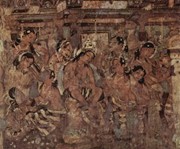
The cultural heritage of India is one of the richest and most ancient in the world, rivalled only by Chinese art. The art of sculpture, the most highly respected medium for artists, was widely practised throughout the subcontinent, and buildings were profusely adorned with it. The subject matter of Indian sculpture was almost invariably abstracted human forms that were portrayed to instruct people in the truths of the Hindu Buddhist or Jain religions. Painting in India typically concerned religious deities and kings and was influenced in style by Chinese painting as well as the art of Ancient Persia and other countries from middle and central Asia, as well as Greece. Painting in India encompasses Buddhist murals in the Ajanta caves and the Brihadisvara Temple, to the large frescoes of Ellora to the miniaturist tradition of Mughal, to the mixed-media embellished works from the Tanjore school. The paintings from Gandhar-Taxila are influenced by Persia to the west, while the eastern style of Indian painting - taking inspiration from Indian mythology, grew up around the Nalanda school of art. Indian civilization is also a rich source of architecture and architectural styles, one of its more minor examples being the famous Taj Mahal. Please Note: for important dates in the evolution of Asian culture, see: Chinese Art Timeline (18,000 BCE - present). The art of India begins way back in the Paleolithic culture of the Stone Age, with the famous Bhimbetka petroglyphs at the Auditorium Cave, Bhimbetka, Madhya Pradesh, as well as other petroglyphs at Daraki-Chattan, a narrow, deep rock shelter in the Indragarh Hill, near Tehsil Bhanpura, Madhya Pradesh. These primitive cupules and instances of rock art have been dated to as far back as 290,000-700,000 BCE. (For other prehistoric artworks in the Far East, see also: Chinese Neolithic art.) Later, Buddhists were associated with many instances of cave art, which was imitated in the seventh century by Hindus at Badami, Aihole, Ellora, Salsette, Elephanta, Aurangabad and Mamallapuram. In addition, Buddhist literature is full of descriptions about late Iron Age royal palaces in India being decorated with a variety of religious art including frescoes and panel paintings but no such works have survived. The best early frescoes to have emerged are those from the Brihadisvara Temple at Chola, and the murals on temple walls in Pundarikapuram, Ettumanoor, Aymanam and Trivandrum. (See also: Prehistoric Art Timeline.) |
|
ART OF ISLAM |
|
|
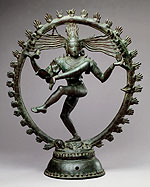
There is almost no individuality in Indian sculpture, because figures are conceived of as shapes that are more perfect than any to be found in human models. Sculpting in India dates from the Indus Valley civilization of 2500-1800 BCE, when small items of bronze sculpture and terracotta sculpture were produced. An early masterpiece is The Dancing Girl of Mohenjo-Daro (c.2500-2000 BCE, National Museum, New Delhi), arguably the finest surviving statuette of the Indus Valley culture. This was followed by the great circular stone pillars and carved lions of the Maurya period (c. 250 BCE), and the mature Indian gigurative sculpture of the second and first centuries BCE, in which Hindu and Buddhist themes were already well established. (For 2nd millennium arts in China, see Shang Dynasty art c.1600-1000 BCE.) A wide range of sculptural styles subsequently emerged in different parts of India over succeeding centuries, but by 900 CE Indian plastic art had reached a form that has lasted with little change up to modern times. This sculpture is distinguished not by a sense of plastic fullness but rather by its linear character: the figure is conceived from the standpoint of its outline, and typically is graceful and slender with supple limbs. From 900 CE onwards, this sculpture was used mainly as architectural decoration with huge numbers of relatively small figures of mediocre quality being produced for this purpose. Note: For a guide to the principles behind Eastern painting and sculpture as exemplified by art in China, see: Traditional Chinese Art: Characteristics. For a comparison with another Far Eastern culture, see: Korean Art (c.3000 BCE onwards). See also: Chinese Buddhist Sculpture (c.100-present). There is no one style of painting in India. Geography, climate, local cultural traditions, demographics all help to shape art along regional lines. Also, outside artistic influences are more strongly felt in border regions. Not surprisingly therefore, Indian painting is a complex patchwork of differing styles, with different approaches to both figure drawing and figure painting. Here are a few examples. Madhubani Practiced in the Mithila region of Bihar state, India, the origins of Madhubani painting traditionally derive from the time of the Ramayana, when King Janak commissioned artists to portray the marriage of his daughter, Sita, with Sri Rama who was regarded as the incarnation of the Hindu god Vishnu. |
|
Mughal Mughal painting is a miniaturist style of Indian painting, typically executed to illustrate texts and manuscripts. It emerged and flourished during the the Mughal Empire in the sixteenth-nineteenth centuries, coinciding with the upsurge in the art of illumination in Persia, which reached its heyday during the Safavid Dynasty (1501-1722). In fact, Mughal pictures were a blend of Indian and Islamic art. One of the key patrons of Mughal painting was Akbar (1556-1605). At Fatehpur Sikri, he employed the two Persian master painters Abdus Samad and Mir Sayyid Ali, and attracted artists from throughout India and Persia. They painted on cloth using vivid reds, blues and greens, as well more muted Persian colours of pink and peach. Rajput Another type of miniature court-style art, Rajput painting flourished in particular during the eighteenth century, in the royal courts of Rajputana. Typically it depicts a variety of themes, including Krishna’s life, epics like the Ramayana and the Mahabharata, as well as landscapes, and people. Colours used were usually extracted from minerals, plants, even conch shells. Brushes used by Rajput artists were typically very fine and tapered. Mysore Bengal Arguably the two greatest examples of architecture from the Indian subcontinent, are the 11th century Kandariya Mahadeva Hindu Temple (1017-29) at Khajuraho in Madhya Pradesh - noted for its Nagara-style architecture, and extraordinary erotic relief sculpture - and the 17th century Taj Mahal (1632-54) in Agra, Uttar Pradesh - noted for its Mughal (Mogul) designs and serene Islamic art - either of which can compare with the finest architectural works in the West. For a comparison with South-East Asian architecture, see: the 12th century Angkor Wat Khmer Temple (1115-45) in Cambodia. As well as painting, sculpture and architecture, India has a rich tradition of crafts including gold-work, silver and other precious metalwork, paper-art, weaving and designing of artifacts such as jewellery and toys. Not surprisingly, this wealth of talent and ingenuity now includes some of the world's most innovative computer software and graphics designers. |
|
|
|
• For other art styles, movements
and periods, see: History of Art.
ENCYCLOPEDIA OF EAST ASIAN ART |