Guillaume Coustou
Biography of French Baroque Sculptor Famous
for The Marly Horse.
MAIN A-Z INDEX - A-Z of SCULPTURE

|
Guillaume Coustou
|
|
|
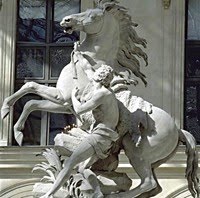
Guillaume Coustou I (1677-1746)A member of a French dynasty of sculptors headed by the woodcarver Francois Coustou (d.1690), and the brother-in-law of the Baroque sculptor Antoine Coysevox (1640-1720), Guillaume Coustou studied at the French Academy of Painting and Sculpture, and also in Rome, before returning to France where his exceptional talents were employed by King Louis XIV. A highly talented figure in Baroque sculpture, Guillaume Coustou is best known for his two pieces of marble sculpture, each called Horse restrained by a Groom (1739-45, Louvre Museum, Paris), known jointly as the Marly Horses. Originally created for the royal chateau at Marly, then relocated to the Place de la Concorde before settling finally at the Louvre, these powerful statues exude equestrian elegance and power. They are among the most enduring images of energetic Baroque art of the early eighteenth century. |
|
EVOLUTION OF SCULPTURE SCULPTURE (c.1600-1750) BEST SCULPTORS |
|
|
Biography Nicolas Coustou (1658-1733), Guillaume's elder brother, was also a sculptor and it was he who blazed a trail for his younger sibling. In 1676 Nicolas went to Paris in 1676 to under his uncle, Antoine Coysevox, President of the recently-established French Academy of Painting and Sculpture. In 1682, he gained the Prix de Rome, which entitled him to four years education at the French Academy of Rome. On his return to France Nicolas became a full member of the Academy where he led a highly successful academic career (one of his pupils was the famous artist Louis-Francois Roubiliac (1695-1762), becoming Professor of Sculpture, later Rector and finally Chancellor. An artist of remarkable ability, he was - despite the influence of earlier virtuosi like Michelangelo (1475-1564) and Alessandro Algardi (1598-1654) - a perfect exemplar of French Baroque sculpture. |
|
Fall and Rise Better than his brother - in fact one of the great French Baroque artists, Guillaume Coustou also won the Prix de Rome (Colbert prize) (in 1697), and also went to study in the Italian capital, but fell out with the Academy authorities and quit. He was only rescued from a life of homelessness by the French sculptor Pierre Legros II (1666-1719), who befriended him and helped him with further study, notably of Bernini's works. Returning to Paris about 1700, he helped Coysevox in the completion of his two monumental equestrian statues of Fame and Mercury, designed for the park at the chateau of Marly. In 1704 he was, like his elder brother, elected a member of the French Academy, presenting his marble statuette of Hercules on the Funeral Pyre (1703, Louvre), a work that clearly demonstrates his virtuosity in stone sculpture and dynamic composition. Like his brother Nicolas, Guillaume enjoyed a successful career within the Academy, becoming Professor of Sculpture and later Rector. The Marly Horses Also employed by French King Louis XIV, Guillaume Coustou's greatest works are the two marble horses with grooms ("The Marly Horses"). Reinterpreting the theme of the colossal Horse Tamers in the Piazza Quirinale in Rome, each of these classic Baroque sculptures consists of a rider trying to tame a wild horse, allowing us to marvel at Coustou's portrayal of spirited impetuosity and tangible realism. Designed initially for the Terrace de l'Abreuvoir (horse trough) at the King's chateau at Marly, to replace Coysevox's Mercury and Fame sculptures, which had been relocated to the Tuileries Gardens in 1719, these beautiful equestrian works were transferred in 1794 to the Place de la Concorde at the entrance to the Champs Elysees, where they have stood ever since, although they have been replaced by copies while the originals have been moved to the Louvre.
Other Sculptures by Guillaume Coustou Other works by Coustou include the colossal groups The Ocean and The Mediterranean, for the park at Marly; also for Marly, Daphne chased by Apollo (1714, Louvre), a collaboration with his brother Nicolas; the bronze sculpture Rhone, which formed part of the statue of King Louis XIV at Lyons; and in Paris, the relief sculpture depicting Louis XIV mounted and accompanied by Justice and Prudence and the bronze figures of Mars and Minerva (1733-34), at the entrance of the Hotel des Invalides. Other notable figurative sculptures by Guillaume Coustou include: the running figure of Hippomenes, positioned in the middle of one of the carp pools at Marly; a pair of life-size marble sculptures of King Louis XV as Jupiter and Marie Leszczynska as Juno for the chateau de Petit-Bourg, next to Versailles; a bronze statue of Diana and a Hind, for the Tuileries Gardens in Paris, and a marble Bust of Samuel Bernard (1735, Metropolitan Museum of Art). Guillaume Coustou I was survived by two sons, both of whom were artists. Guillaume Coustou II (1716-1777) became a sculptor and was noted for works like the marble Apotheosis of St Francis Xavier (1743, Bordeaux, Church of St Paul), Apollo (1753, château de Bellevue), Mars and Venus (1769, Schloss Sanssouci, Potsdam) and others. The younger Charles Pierre Coustou (1721-97) was active as an architect. |
|
• For the history and types of sculpture,
see: Homepage.
Plastic
Art |