Jean-Baptiste Pigalle
Biography of French Late Baroque Classical
Sculptor.
MAIN A-Z INDEX - A-Z of SCULPTURE

|
Jean-Baptiste Pigalle
|
|
EVOLUTION OF SCULPTURE |
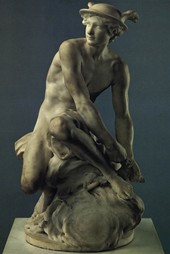
Jean-Baptiste Pigalle (1714-1785)After a hard early life, Jean-Baptiste Pigalle achieved widespread recognition and became one of the greatest sculptors of the 18th century. His style of sculpture which incorporates elements of Baroque sculpture as well as conventional Neoclassical art, closely reflected the shifts in taste of the Ancien Regime under Louis XV (reigned 1715-74), while he also cultivated the friendship of the Philosophers and tried to reflect their ideas in sculptural form. Pigalle made his reputation with his acclaimed marble sculpture of Mercury (1741-2, Louvre; the terracotta model is in the Metropolitan Museum of Art, NY), which was shown at the French Academy of Fine Arts in 1744. After this, his rise was swift: in 1752 he was made Professor of Sculpture at the Academy, and received a number of royal commissions. His main rival at court was Etienne-Maurice Falconet (1716-91) who leaned towards rococo art, and together they regained for France a superiority in European sculpture (over Italy in particular) which it retained until the French Revolution. Blessed with great technical ability as a carver, Pigalle was equally comfortable with both small-scale genre works and large-scale tomb art. He is probably best known for his male nude of Voltaire (1770-6, Louvre) and the grandiloquent tomb of Maurice of Saxony (1753, St Thomas, Strasbourg). Works by Pigalle can be seen in some of the best art museums and sculpture gardens across Europe. |
|
BEST WORKS OF SCULPTURE SCULPTURE (c.1600-1750) |
|
MEDIUMS |
Biography Born in Paris, the seventh child of a carpenter in the employ of Louis XIV. He trained as an apprentice first under the sculptor Robert le Lorrain, then under Jean-Baptiste Lemoyne (1679-1731). He entered the French Academy's competition for the Prix de Rome (which entitled the winner to 4 years free study in Rome), and although he failed to win the award, he decided to study in Rome anyway. Accordingly, having no money, he walked to the Italian capital from Paris, and - after finally arriving - struggled for 4 long years (1736-40) to pay for his lodgings and upkeep. His sculptures did attract buyers, however: the French sculptor Guillaume Coustou (1716-1777) bought several items, while the French ambassador to Italy was another patron. |
|
|
Pigalle's Statue of Mercury Returning to Paris in 1741, after a sojourn in Lyon, Pigalle set about being "approved" by the French Academy of Painting and Sculpture. Accordingly he presented a terracotta model of Mercury attaching His Talaria (Winged Sandals) (1740, Metropolitan Museum of Art, New York) for approval. Possibly inspired by an engraving of Mercury and Argus, a picture by the 17th-century Flemish artist Jacob Jordaens (1593-1678), Pigalle's work had such vitality and dynamic potential that the crouching figure became an allegory of speed. In response, the Academy requested him to transpose the work into marble for his admission piece, which he duly did - Mercury attaching His Talaria (Winged Sandals) (1741-2, Louvre) - and in July 1744 he was accepted as a full member of the Academy. The work itself was an instant success. Voltaire compared it to the finest Greek sculpture; artists included its image in a number of paintings; while in 1770 a small-scale porcelain version was manufactured by the Sevres Porcelain Factory.
As well as Louis XV, Pigalle also received commissions from Madame de Pompadour. In return, Pigalle depicted her in the allegorical statue of Friendship (1753, Louvre). His other aristocratic contacts secured him numerous commissions, including the Tomb of Marshal d'Harcourt (c.1764, Notre Dame de Paris), and the Mausoleum of Maurice of Saxony (1777, St Thomas Lutheran church, Strasbourg). |
|
|
Nude Sculpture of Voltaire Pigalle's most famous work Voltaire (1776, Institut de France, purchased by the Louvre in 1962) was funded by public subscription as well as contributions from Frederick II King of Prussia. It was the first statue in France erected to a living writer, and Pigalle's nude composition caused an utter scandal when it was first exhibited. Consisting of an unidealized and emaciated nude body of an old man, it was nevertheless redeemed by its dynamic pose, as well as the beauty of Voltaire's facial expression, hinting at the triumph of mind over matter.
Differing Reactions Even so, the statue attracted fierce criticism and disgust. King Gustavus III of Sweden even volunteered to pay for the cost of a coat! Voltaire himself was against it, finally agreeing to it only in the name of artistic freedom. Critics derided the work's supposed classicism (note: Greek sculptors habitually depicted Gods and heroes in the nude, as the human body was considered to be the supreme example of beauty), pointing out that the Greeks used idealized physical representations, rather than Pigalle's choice of emaciated body and sagging flesh. Interestingly when the celebrated neoclassicist sculptor Jean-Antoine Houdon (1741-1828) executed his Seated Sculpture of Voltaire (1781, Comedie Francaise), he enclosed the philosopher in a mass of reassuring drapery. Nowadays, however, Pigalle's nude Voltaire is seen as a masterpiece. Technically brilliant, and an exemplary study of anatomy, the bright almost ecstatic expression proclaims the triumph of the mind over the physical limitations of the body. As well as monumental sculpture, Pigalle displayed his classical realism in a variety of other genres, including portraiture. Especially outstanding are his representations of children, as exemplified by Child with a Cage (c.1735). |
|
• For more about 18th century French
sculpture, see: Homepage.
Plastic
Art |