Baroque & Rococo Sculptors
Biographies of Plastic Artists from the
17th and 18th Century.
MAIN A-Z INDEX - A-Z of SCULPTURE

|
Baroque & Rococo Sculptors
|
|
Baroque/Rococo Sculptors (c.1600-1750)
Contents • Baroque
Sculptors Related Articles Baroque SculptorsAlthough Bernini (1598-1680) was unquestionably the greatest practitioner of Baroque sculpture of the 17th century - see, for instance, his dramatic Ecstasy of Saint Teresa (1647-52) - he was not the only sculptor in Rome, and he had rivals who practised a more restrained type of sculpture that found favour with more conservative patrons, who preferred their Christian art to be more modest in style. Bernini was regarded by them as an extremist who carried his exuberance to the point of bad taste, while outside the papal court there were circles which were devoted to the study of antiquity, such as that of Cassiano del Pozzo. Bernini's relationship to his contemporaries and indeed his successors can be seen by looking at the series of papal tombs in St Peter's Basilica Rome, to which he contributed two examples. (See also: Baroque Architecture.) The immediate predecessor to Bernini's first papal tomb of Urban VIII, was Guglielmo della Porta's tomb of Paul III, which owes its present arrangement to Bernini's alterations. The tomb of Urban VIII was to occupy the opposite niche, and its overall format is dictated by the need for it to correspond to the pyramidal composition of della Porta's work. Bernini worked on the tomb for twenty years until 1647, and many additions, such as the bronze skeleton, clearly belong to a later stage in its development. In the place of della Porta's emblematic Virtues, which derive from Michelangelo's Medici Chapel, Bernini makes the Virtues contribute to the theme of the loss to humanity caused by the death of the pope. Both the figure of the pope and the sarcophagus beneath are in bronze, contrasting with the stone of the Virtues, the whole group being set against a background of coloured marble. The use of colour and contrasting materials is an important development, but the concept for Bernini's second tomb, of Alexander VII, is more far reaching, and was to be the prototype for the dramatic imagery of later baroque tombs. The pyramidal composition is retained but the separate elements are now unified by a dramatic conceit, in which the Virtues are animated by reaction to the advent of Death in the form of a skeleton emerging from a door beneath the tomb. The figure of Death pushes his way through a shroud made of Sicilian jasper towards the praying figure of the pope, who remains unaware of Death's approach, while the Virtues react with horror and dismay. |
|
The monument to Pope Leo XI (1634-52) by Alessandro Algardi (1595-1654) avoids the dramatic devices of Bernini; but its classical restraint was to make it, despite its relative feebleness, an even greater influence than Bernini's papal tombs. Algardi was the only sculptor who could be regarded as a serious rival to Bernini and who could have been considered for the honour of making a papal tomb during Bernini's lifetime. He had studied in the Carracci Academy of Bologna run by Annibale Carracci and had practised as a restorer of antique sculpture in Rome before slowly working his way to eminence. The tomb of Leo XI was begun shortly after Bernini's Urban VIII monument, and Algardi's tomb is, therefore, of great importance in the development of baroque sculpture because it is the first major work to attempt to reconcile the naturalism of Bernini with a more classical style and as such is the forerunner of many monuments in Italy, France and Flanders. While the debt to Bernini can be seen in the full and animated folds of the drapery, Algardi has not attempted to exploit the dramatic possibilities of the traditional elements of the tomb. The work is executed totally in marble, the subtle variations of tone and colour which animate the surfaces of Bernini's sculptures yielding to a polished and natural surface that accentuates the monumentality of the figures. Algardi's wonderful marble sculpture Ecstasy of Saint Philip Neri (1638, Santa Maria in Vallicella, Rome) is one of the greatest sculptures ever. |
|
Algardi is the principal sculptor of the style of Baroque sculpture known as high baroque classicism, and this term accurately characterizes his half-way position between Bernini and the classicist Francois Duquesnoy (1594-1643), known as Il Fiammingo, a Fleming who frequented the circle of Cassiano del Pozzo and shared a house at one time with Nicolas Poussin. Duquesnoy is a shadowy figure who left very few works, but his studies of children were highly prized and he was later regarded as the only 'modern' who could be compared with the 'ancients'. Like Poussin, he was instinctively drawn to the more classical of antique Greek sculpture, and the knowledge of classical remains that he gained from work on Cassiano del Pozzo's corpus of antiquities led him to make a distinction between the styles of Greek and Roman art more than a century before Johann Joachim Winckelmann (1717-68), who is usually given credit for that discovery. The St Susanna of S. Maria di Loreto is the principal example of his severe style, and its clarity and decorum were regarded by the academic writers as demonstrating the most perfect synthesis of nature and the antique. The draperies flow elegantly, following the shape of the body, while the figure is balanced in perfect grace and repose, exhibiting no emotion but only 'un aria dolce di grazia purissima' (Bellori). Nonetheless, it is not a completely self-contained statue, for the turn of the head away from the body and the gently pointing hand are conceived in relation to the architecture of the church, and these gestures gently draw the spectator's attention towards the holiness of the setting in an essentially baroque manner.
No sculptors of powerful originality emerged in Rome in the second half of the seventeenth century and Bernini's pupils and assistants, Ercole Ferrata for instance, who had actually modelled most of his major works, added little to the elements of his style in their own work. The influence of Algardi and Duquesnoy was perhaps greater than that of Bernini, and their work was the basis of the predominant mode of sculpture in Europe until the end of the seventeenth century. Under Louis XIV, Paris began to supersede Rome as the artistic capital of Europe, while French artists had developed a self-confidence that owed much to the reputation of Nicolas Poussin, and the growing authority of their Art Academy in Rome, which had been founded in 1666. Yet the international style of the late seventeenth century owes almost everything to Roman sculpture of the early part of the century, and the French contribution was less to the development of the baroque as a style than to the achievement of competence and adaptability, through centralization of commissions and uniformity of instruction. Most of the important French sculptors studied at the French Academy in Rome, but even those who did not were able to form an idea of the antique from small bronzes which could be easily transported. Works from Italian centres outside Rome also helped to disseminate the influence of the early baroque and the two superbly finished bronzes of Apollo Flaying Marsyas and Mercury Binding Prometheus by Foggini in the Victoria and Albert Museum, provide an example of the way in which Italian influence spread to France. Giovanni Battisto Foggini (1652-1725) was a Florentine sculptor who worked for the Medici family and these two pieces were a gift from Cosimo III, Grand Duke of Tuscany, to the court painter Hyacinthe Rigaud in exchange for the latter's self-portrait in 1716. The works probably date from some years before then and they show the lasting influence of even Bernini's early work, The figure of Apollo derives from Bernini's Apollo and Daphne and Foggini has also adopted some of Bernini's formal principles; he preserves a relief-like frontality, but the gestures are restrained and classical.
|
|
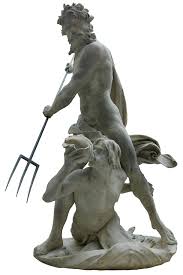
Bernini himself had made a triumphal visit to Paris to submit designs for the Louvre (subsequently rejected) and to carve the great bust of Louis XIV, recorded in great detail in the Journal of Chantelou. Although the greatness of Bernini compelled admiration in France, his ideas were not sympathetically received by the French court which, under Colbert guidance, had set up a rigidly centralized system for the production of all kinds of works of art. Under Colbert's rule, which lasted until 1683. the painter Lebrun was in absolute control of all commissions, and the greatest sculptural project of the age, the ornamentation of the gardens of Versailles owes everything to the principles that he imposed on painting and the decorative arts as well. The sculpture at Versailles forms a part of Louis XIV's gigantic scheme of self-glorification. in which the reality of centralized absolutism is enshrined in the cult of Louis XIV as Apollo or sun-god. Sculpture played an important role in the realization of this concept, and most of the works in Versailles were intended to be both allegorical and decorative. Francois
Girardon (1628-1715), was not the greatest sculptor to work for
Louis XIV, but he embodies the style of the Le Brun period from about
1652 to 1683, when the fall of Colbert heralded a more baroque phase.
The elements of his style can be seen in the Pluto and Proserpine
in the gardens of Versailles. The directness and illusionism of Bernini's
version of the same subject has been subtly neutralized in Girardon's
group. Pluto and Proserpine avoid the spectator's eyes, and the action
of the group, instead of encroaching on our space, seems contained within
a series of graceful curves, while the figure of Proserpine's mother is
shown within the composition instead of being the object of Proserpine's
search as in Bernini's version. |
|
Puget was one of the very few sculptors to recapture the immediacy of Bernini's best work, yet ironically he was seen as almost anything but a baroque sculptor; he was regarded in France successively as a classical sculptor and as an ancestor of romanticism, one of Baudelaire's 'les Phares'. In a sense, both these elements are to be found in Puget's work. With no other artist in this book has the legend so coloured the perception of his work. To Delacroix he was a tragic genius who, like himself, had been misunderstood by his contemporaries, while to the realists of the later nineteenth century he was a son of toil who had rejected the tyrannical culture of Louis XIV. These verdicts are perhaps more evocative of his personality than his art, for despite his labour in the dockyards of Toulon and his neglect by his contemporaries, his sculpture shows a full awareness of Michelangelo, Bernini, Giambologna and antiquity.
Puget was born in 1620 in Marseilles, and his work for Pietro da Cartona as a painter in Florence brought him into direct contact with the Italian baroque at an early age. He returned to France in 1643, and his two caryatids for the Hotel de Ville in Toulon of 1656 established him as an artist of originality who was able to combine a knowledge of baroque movement with a tragic intensity that recalls the 'gothic' qualities that Rodin was to find in Michelangelo. He began to receive commissions in France, but his work for Fouquet, the banker, at Vaux-le-Vicomte was curtailed after the fall of his patron, and he stayed on in Genoa where he had gone to get some marble for Fouquet and established himself as a local sculptor about 1660. From this period dates the bozzetto of the Blessed Alessandro Sauli, which shows his mastery of the idiom of Bernini combined with an elegance and religious intensity that looks forward to the German baroque of the eighteenth century. On his return to France in 1667, he worked in the dockyards of Toulon and Marseilles until in 1670 he was given permission to work on two sculptures, one of which was to be the Milo of Crotona. The figure of Milo, whose hand is caught in a tree, clearly owes a lot to Laocoon and His Sons, but at the same time the composition is more formal than the earlier baroque. The movement is contained within a structure of parallel lines rather than curves, giving a sense of restraint to the figure and heightening the sense of inner anguish. Although the figure should be seen from the front, it is contained within the space defined by the pedestal. Thus, Puget's emotional power is held in check by a classical framework, and it is a measure of the strength of these contradictory forces that Puget should have been acceptable to the baroque taste of the court and yet he was the only sculptor of his age to be admired for his classical 'correctness' by the followers of Jacques-Louis David. The success of the Milo was only a temporary triumph, for he was to die embittered after summary treatment from the court, to which his bad temper and arrogance contributed. But Puget was not a man of his own time; the strength of his individuality can be seen in his figure of a Faun, whose closest cousin is Rodin's Adam - a resemblance noted by Rodin's contemporaries though he himself disclaimed direct influence.
|
|
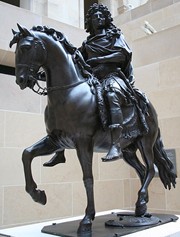
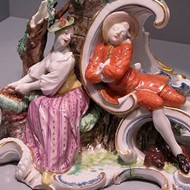
The rococo is the flimsiest of all the generic labels used by art historians, and does not at all imply a profound change from the baroque. Indeed the term 'rococo' in so far as it can be applied to sculpture should be understood as describing not a different style from the baroque. but merely a variation on the style brought to fruition by Bernini and his contemporaries. One may, however, talk about rococo qualities in a work of sculpture - informality, gaiety, a concern for matters of the heart and a self-conscious avoidance of seriousness. The eighteenth century opened in France in a mood of reaction against the extreme formality of the court of Louis XIV, and the new spirit that was expressed by the victory of the 'Rubenistes' at the French Academy over the academic 'Poussinistes' can also be seen in the unforced naturalism of Coysevox's late busts. Yet sculpture could boast no Watteau, for it was scarcely a medium adapted to express the subtleties of human behaviour. Probably the most successful sculptor of the first half of the eighteenth century was Guillaume Coustou (1677-1746), Director of the French Academy from 1707, who continued the baroque trend of his uncle Coysevox. His principal works, Les Chevaux de Marly, 1740-45, which now stand on the Champs Elysees in Paris, were originally designed for the gardens of Marly, another of Louis XIV's residences. His pupil, Edme Bouchardon (1698-1762). is a more interesting figure. whose feeling for the antique led him to anticipate the later trend towards neoclassicism, as in his fountain of the Rue de Grenelle. His equestrian statue of Louis XV, destroyed in the Revolution, was more severe than Girardon's statue of Louis XIV, and it was criticized by Cochin as being too polished and finished, but, like the former. it was based on Marcus Aurelius in Rome, and despite the distance in time from Girardon it is not greatly dissimilar in style. Bouchardon also shows himself as a pioneer in his portrait of John, Lord Hervey, in which the torso is simplified in deliberate imitation of a Roman imperial bust. |
|
Perhaps only one sculptural project really
captured the nuances of amorous feeling that we associate with the circle
of Madame de Pompadour, and that belongs to a period when there were already
stirrings against the rococo. In 1750 Madame de Pompadour was rejected
as a mistress by Louis XV, but intent on maintaining her position she
set herself up as a friend and companion of the king rather than as a
lover, and an allegorical sculpture of herself as 'L'Amitie' was made
to symbolize her new relationship. The sculptor she chose was Jean-Baptiste
Pigalle, a favourite of her brother the Marquis de Marigny, who was responsible
for official commissions at the time. Pigalle's alternative scheme, which was
carried out, although the figure of the king was destroyed during the
Revolution, shows Louis XV as the model ruler of the Enlightenment, the
protector of the welfare and prosperity of his people. Pigalle in a letter
to Voltaire describes the pedestal as follows: 'On two sides of the pedestal
are two emblematic figures, one symbolizing Benign Government [Douceur
du Government] and the other well-being of Subjects [Felicite des Peuples].
Douceur du Gouvernment is represented by a woman holding in one hand a
rudder and directing with the other an unchained lion to show that a Frenchman,
despite his strength, submits willingly to a beneficial government ...
Felicite des Peuples is rendered by a happy citizen enjoying perfect calm
in the middle of abundance, symbolized by corn which bears fruits, pearls
and other riches. The olive branches grow around him; he sits on sacks
of goods; he has his purse open to denote his security.' Thanks largely to the writings of the Earl of Shaftesbury, the contemplation of works of art was associated with virtuous conduct and became a part of the education of English gentlemen, whose peregrinations around Italy led to the growth of a whole industry of restorers, archaeologists and fakers to satisfy their demand for knowledge and acquisition. Rysbrack was the ideal sculptor to cater to the demands of the new patrons, and his judicious mixture of conscious classicism and baroque vitality left him without a rival until his supremacy was challenged by the more graceful and naturalistic works of the Frenchman Roubiliac, who came over to England shortly after 1730. Rysbrack was a pupil of the classicizing Antwerp sculptor Vervoort, whose adherence to the tradition of Duquesnoy was handed on to his pupil. Roubiliac, however, studied in the French Academy, where he knew Nicholas Coustou, and also under the German baroque sculptor Balthasar Permoser in Dresden; a background that is reflected in his leanings towards a more theatrical conception of the tomb and a more vivid naturalism in portraiture. In practice, the work of the two artists is sometimes extremely close, for both artists had the ability to accommodate themselves to the fashion of the day, and the requirements of connoisseurs. The Stourhead Hercules (1747), for example, is a deliberate attempt by Rysbrack to put conventional academic theory into practice by making an ideal figure of Hercules by combining parts from the strongest men available. According to Horace Walpole, 'This authentic statue for which he (Rysbrack) borrowed the head of the Farnesian god, was compiled from various parts and limbs of seven or eight of the strongest and best-made men in London, chiefly the bruisers and boxers of the then flourishing amphitheatre for boxing, the sculptor selecting the parts which were the most truly formed in each. The monumental tomb had been one of the principal sources of sculptural commissions in the seventeenth century and both Rysbrack and Roubiliac extended the current formulae by using their knowledge of tomb sculpture in other countries. Perhaps Rysbrack's most noble achievement is the monument to Sir Isaac Newton (1730-31) in Westminster Abbey, which combines a baroque handling with a classical dignity formerly considered appropriate only for politicians and rulers. The composition is now wrecked by gothic additions, but it shows Newton resting on his achievements, his elbow placed on four huge volumes. The allegory, in the form of two Duquesnoy-like weeping putti and the mourning figure of Astronomy seated on a globe, is secondary to the noble figure of Newton, whose body is draped with a grandly carved toga while the noble head is enlivened by the broken silhouette of the hair. Although Newton is pointing towards a scroll held by the putti, the action is kept to a minimum. Rysbrack's tomb is a repudiation of the theatrical qualities of the kind of baroque tomb pioneered by Bernini, but the rococo taste of the next generation allowed occasional reversions to a full-blooded pictorial conception. In Roubiliac's monument to Lady Elizabeth Nightingale of 1761, the figure of Death, which is obviously drawn from Bernini's Alexander VII tomb, is the only allegorical figure left in the composition, and the husband, trying vainly to deflect the fatal dart, is depicted with harrowing naturalism. Unlike Bernini's tomb, in which the pope"s composure suggests the triviality of death in the face of faith and goodness, Roubiliac shows death as something that deprives the world of a beautiful soul despite man's feeble efforts to forestall him. The formal vocabulary of the tomb is derived from Bernini, but in its more secular imagery it is closer to the later tomb of the Camte d'Harcourt by Pigalle of 1771-77, which concentrates on the human implications of death and resurrection, showing the widow, 'la nouvelle Artemise', as she was called at the time, at the moment of her reunion with her husband after death. The contrast between Rysbrack and Roubiliac can be seen most clearly in their respective busts of Alexander Pope. Rysbrack shows the poet en neglige, his shirt unbuttoned in a manner derived from Coysevox's portrait of Matthew Prior, but the head is given an intellectual grandeur that gives no hint of Pope's ugliness and vulnerability. Roubiliac's image of the poet is more tragic, for the carving is particularized, exploring the bone structure and wrinkles of that extraordinary head. Roubiliac has attempted a 'speaking likeness', though the cropped head and toga are, ironically, in conscious imitation of a Roman bust. Roubiliac's success in assimilating the more relaxed mood emanating from France in the 1730s can also be seen in the figure of Handel made for Vauxhall Gardens (1738). Handel is shown playing a heavenly lyre, while a cherub below records the promptings of the Muse, but the easy naturalness of the pose almost parodies the pomposity of the allegory. The most extreme manifestation of the rococo
in sculpture is to be found in Germany, although it is usually of a less
sophisticated character than the decorative art of Paris salons of the
early eighteenth century. The sculpture produced in the German principalities
in the eighteenth century is too diverse to permit generalization, but
much of the best and most characteristic work of the period shows a remarkable
continuation of the earlier spirit of the high baroque. Balthazar
Permoser (1651-1732), the Dresden sculptor, had studied in Italy
in the latter part of the seventeenth century, but his desire to bring
pictorial qualities into sculpture was certainly derived from a study
of Bernini's works, and he left as a personal testament a now-destroyed
group of Painting Embracing Sculpture. None the less, the elegance
of his figures is unmistakably a development of the late baroque, and
nothing illustrates more clearly the ambiguity of the term 'rococo' as
an art-historical style than these German works of the eighteenth century. - For more information about Rococo sculptors,
see: Rococo Artists. |
|
• For a list of the world's best ever
stone/wood-carvers, see: Greatest Sculptors.
Plastic
Art |