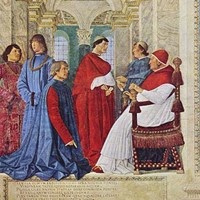
Academy of Art in Rome
Fine Arts School, Funded by Pope and Federico
Zuccari.
MAIN A-Z INDEX - A-Z of ART MOVEMENTS

|
Academy of Art in Rome
|
|
MEANING OF ART
|
Academy of Art, Rome
|
|
|
|
WORLD'S GREATEST
ARTWORKS EVOLUTION
OF VISUAL ART MODERN ART COLLEGES |
In 1633, Pope Urban VIII granted the Academy a monopoly of all public art commissions, as well as the right to levy taxes on all artists and art-dealers - measures which aroused considerable opposition. Such events, allied to the fact that many prominent painters and sculptors were never admitted to the Academy, led to continuing controversy. Also, as with many other official academies across Europe, the Accademia di San Luca became embroiled in numerous debates about what constituted idealized art. Painting Genres Italian academies were the foremost promoters of Renaissance Art and its underlying traditions. The latter established a clear hierarchy of genres, with history painting at the top, followed by portraiture, genre-works, landscape painting, and lastly still life. This ranking system caused widespread discontent among artists and certain national art movements with a tradition of still life interiors, like the Genre Painters of the Dutch/Flemish school. |
|
The Academy Art Collection From the outset, the governing statutes of Saint Luke's Academy provided that any artist admitted to associate or full academician membership should donate a portrait or other artwork to the Academy. As a result, its collection of painting and sculpture now totals more than 500 portraits and a unique assembly of drawings.
Other European Academies The first academy outside Italy was founded in 1583 at Haarlem in Holland, under Karel Van Manda (1548-1606). In France, the first was the Académie Royale de Peinture et de Sculpture (aka Académie des Beaux-Arts), founded in Paris in 1648, through the efforts of the painter Lebrun (1619-1690). In Britain, the Royal Academy of Arts London was established in 1768. In Ireland the Royal Hibernian Academy (RHA) was established in 1823, followed in 1930 by the Royal Ulster Academy of Arts (RUA). NOTE: the Accademia di San Luca should not be confused with the Florentine benevolent society or confraternity of artists, known as the Company of St Luke, an artist group initiated in the fourteenth century. |
|
• For other art movements and periods,
see: History of Art.
Art
Movements |