Academy of Art in Florence
Florentine Fine Arts School, Funded by
Medici Family.
MAIN A-Z INDEX - A-Z of ART MOVEMENTS

|
Academy of Art in Florence
|
|
MEANING OF ART MODERN ART COLLEGES |
Academy of Art, Florence
|
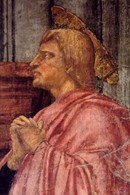 Detail From 'The Trinity' (1425) by Tommaso Masaccio. One of the greatest Renaissance paintings. |
|
WORLD'S GREATEST
ARTWORKS EVOLUTION
OF VISUAL ART
|
Genre Controversy Like the art academy in Rome, the Accademia di San Luca, the Florentine Academy promoted academic art by observing the hierarchy of the genres, in keeping with the artistic principles of the high renaissance. This ranked paintings in the following order of importance: first, history painting, then portraits, genre-painting, landscape and still life. Other European academies, like the French Académie des Beaux-Arts and (to a lesser extent) the Royal Academy of Arts London, as well as the Royal Hibernian Academy and the Royal Ulster Academy, operated along the same lines, and thus followed the same ranking system. Not unnaturally, this led to dissatisfaction among many famous artists who painted landscapes and still lifes.
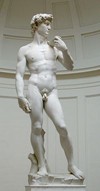
The Accademia Art Collection Among the Accademia di Belle Arti Firenze's collection, housed in its gallery, are a magnificent assembly of Early and High Renaissance painting by Sandro Botticelli, Paolo Uccello, Domenico Ghirlandaio (one of Michelangelo's teachers), and Andrea del Sarto - the last significant Florentine painter before the advent of Mannerism. In addition, it houses the original plaster for 'The Rape of the Sabine Women' (1583) - the Mannerist bronze sculpture by Giambologna, also known as Giovanni da Bologna, plus a number of Florentine Gothic-style canvases and Orthodox icons from Russia. Michelangelo Collection The highlight of the gallery is a mini-collection of works by Michelangelo. It includes his sculpture 'David' (1504) - initially sent to the Academy for restoration - a statue of Saint Matthew, and several pieces of sculpture designed for the tomb of Pope Julius II. |
|
• For other art movements and periods,
see: History of Art.
Art
Movements |