Gregor Erhart
Biography of Gothic German Sculptor, Medieval
Wood-Carver.
MAIN A-Z INDEX - A-Z of SCULPTURE

|
Gregor Erhart
|
|
|
Gregor Erhart (c.1470-1540)Born in Ulm, Swabia, into a family of wood-carvers, the late Gothic sculptor Gregor Erhart trained in the workshop of his father Michael Erhart, who was active in the city between 1469-1522 and second only to Hans Multscher. Michael had already helped to train the incomparable late Gothic wood-carver Tilman Riemenschneider, who went on to practise in Wurzburg. Gregor Erhart's early sculpture is difficult to distinguish from that of his father and teacher, with the result that attributions are much disputed by curators and historians. Their most important collaboration was the sculpting of the Blaubeuren Altarpiece (1490-4), a work which marked the high-point of Michael Erhart's career and his mature Ulm style of work. In 1494, Gregor Erhart obtained citizenship of the prosperous German mercantile city of Augsburg, where he became a master-sculptor two years later. He spent all his working life in the city, becoming its leading sculptor within a decade. |
|
FAMOUS MEDIEVAL
SCULPTORS RENAISSANCE IN NORTH
EUROPE BEST SCULPTORS BEST WORKS OF SCULPTURE |
|
MEDIEVAL SCULPTURE EVOLUTION OF SCULPTURE FORMS OF SCULPTING |
Renaissance Influence In the 1490s, Augsburg was one of the few cities north of the Alps to be influenced by Italian Renaissance sculpture and painting, and its promotion of the humanistic and artistic ideals of classical antiquity. This influence, it is believed, had a significant impact on the work of Gregor Erhart and his studio, inducing him to step beyond the modelling and compositional constrictions of International Gothic traditions and give his figures a new freedom and plasticity. Erhart's mixing of Gothic and Renaissance ideas is based upon a single work of his - the Virgin of Mercy from the Cistercian Abbey of Kaisheim - (lost in World War II), with which others were compared. Several of the latter have now been attributed to him, including the famous life like, full-length, polychrome wooden sculpture of the St Mary Magdalene in the Louvre, also known as "La Belle Allemande". (See also Female Nudes in Art History.) |
|
|
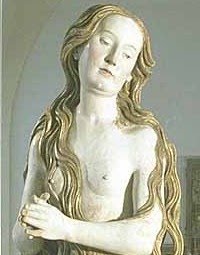
Sainte Marie-Madeleine (Louvre) Erhart's unusual life-size nude limewood statue of St. Mary Magdalen, sculpted about 1510, depicts her as a mystic ascetic, clothed only by her long hair. The figure was originally held up by carved angels and suspended from the vault of a church, possibly the church of St. Mary Magdalen in the Dominican convent of Augsburg, which was rebuilt around 1515. The sculpture was later taken down and the supporting angels removed. The wooden statue was offered for sale on the German art market in the late 19th century by the Siegfried Lammle Collection (Munich), and was eventually purchased by the Louvre Museum in Paris, in 1902. |
|
|
The Saint's peaceful grace and gentle face conform to the refined style of the Swabian late-Gothic tradition, but the thrusting hip - indicating a classical contrapposto - and the harmony and fullness of the nude body reflect a search for formal beauty that is specific to the traditions of the Renaissance. Thus instead of creating a thin, unreal figure in the Gothic manner, he creates feminine curves, tensed muscles and exceptional sensual sensitivity.
Some critics disapprove of the nude appearance of the statue but any suggestion of profanity should be tempered by the figure's meditative expression which was intended to convey the subject's mystic ecstasy, while her beauty and golden hair point to her holy radiance. The unclothed female body is thus in line with the conventions of medieval sculpture. In this work, Gregor Erhart has produced a masterpiece of the Middle Ages. |
|
• For the history and types of sculpture, see: Homepage.
Plastic
Art |