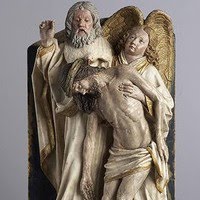
Hans Multscher
Biography of German Late Gothic Sculptor.
MAIN A-Z INDEX - A-Z of SCULPTURE

|
Hans Multscher
|
|
|
Hans Multscher (1400-1467)An important figure in German Renaissance art, Hans Multscher was a realist sculptor, engraver and painter from the Bavarian region. His style was highly influenced by the Flemish realist sculptor Claus Sluter, and he became an important figure in the transition from International Gothic to a more naturalistic idiom in line with contemporary Italian Renaissance sculpture, which was unfolding south of the Alps. Multscher was a financially successful artisan, hiring up to 16 assistants in his workshop at any one time. It was largely because of his prodigious production ability, that the style of northern realism was spread as far as it was. Multscher's most famous sculpture is his famous Wurzacher altarpiece (1437), and also his Sterzing Altarpiece (1457), Tyrol (now housed in the Multscher Museum, Sterzing). |
|
FAMOUS MEDIEVAL
SCULPTORS BEST SCULPTORS EVOLUTION OF SCULPTURE BEST SCULPTURE |
|
MEDIEVAL SCULPTURE FORMS OF SCULPTING
|
Biography Born in 1400 in Reichenhofen, Bavaria, Multscher is first documented as a sculptor in 1427, the same year as his marriage to Adelheid Kitzin, in Ulm. His early work shows Northern European Renaissance influences, and suggests that he had travelled to the Netherlands, Burgundy and France. The same year, in 1427 he was recorded as being made a freeman of the city of Ulm, where it appears he settled down and developed his own workshop. This workshop would go on to employ up to 16 assistants, including his brother Heinrich. Wurzacher Altarpiece and Other Works In 1427 Multscher carved figures of Charles the Great and equestrian statues of the kings of Poland and Bohemia for the eastern facade of the Ulm town hall. In 1437 he painted the Wurzacher Altarpiece (now partially lost), the only actual paintings some experts say can be truly attributed to him. The paintings display a realism nearer to contemporary Flemish than German painting but are considered the most important of German paintings in the 15th century. |
|
|
Originally there was a carved central Shrine, in which a Crucifixion group were depicted. When the wing doors closed, the altar showed four scenes relating to the Madonna: The Nativity, The Adoration of the Magi, The Descent of the Holy Ghost and The Death of the Virgin. The inner side of the wings showed four scenes from the Passion: Christ on the Mount of Olives, Christ before Pilate, Christ bearing the Cross and the Resurrection. At some time in history, the altar was dismantled and lost - so the only remains we have are the actual panel paintings (now housed in the Staatliche Museen, Berlin). Sterzing Altarpiece In 1456, Multscher received a down payment for an altarpiece at Sterzing. This work of altarpiece art demonstrates Multscher’s departure from the so-called 'soft style' and move towards a greater degree of realism. The draperies of his statues are more expertly carved, and give an indication of the body underneath. The altarpiece consists of marble carvings of saints and the Virgin Mary and paintings. It is not 100 percent certain whether Multscher himself actually practiced painting, or whether the task was handled by a craftsman in his workshop.
Other known works by Multscher include a stone sculpture of St George and St John the Evangelist (1450, Ulm Cathedral); and a stone relief figure 'Model of a Tomb' (1435, Bayerisches Nationalmuseum, Munich). Hans Multscher died in 1467 leaving behind a successful workshop and an important contribution towards the development of Northern Renaissance art. After Multscher's death, the city of Ulm was fortunate in having Michael Erhart's workshop to rely upon. Michael Erhart had already taught the great Wurzburg sculptor Tilman Riemenschneider, and went on to raise a highly creative son, Gregor Erhart (c.1470-1540) who left Ulm to practise in Augsburg. Additional works by Hans Multscher can be seen in the Bayerisches Nationalmuseum, Munich. |
|
• For the history and types of sculpture, see: Homepage.
Plastic
Art |