Domenico Ghirlandaio
Biography of Early Renaissance Florentine
Painter.
MAIN A-Z INDEX - A-Z of ARTISTS

|
Domenico Ghirlandaio
|
|
|
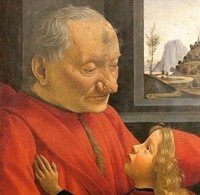
Domenico Ghirlandaio (1449-94)The Italian Early Renaissance painter Domenico Ghirlandaio was born in Florence, and once said: "Let me work ... now that I've begun to know how to do it, I only regret that I haven't been commissioned to paint narrative pictures on all the walls of Florence." Though he failed to win the commission in question, Ghirlandaio did receive many others for portraits, altarpieces, and frescoes. In addition, he sketched some of the best drawings of the Renaissance. Although possessed of a solid, prosaic and somewhat old-fashioned style when compared to his contemporary Botticelli (1445-1510), he was, between 1480 and 1490, the most popular and prolific artist in Florence and made a significant contribution to Renaissance art. |
|
COLOURS USED IN
PAINTING ITALIAN RENAISSANCE
ERA GREAT EUROPEAN PAINTERS |
|
HISTORY LIST OF PAINTERS/SCULPTORS
|
Ghirlandaio's fresco paintings are evocative
pageants of Florentine life. Whatever the ostensible subjects, they contain
numerous portraits of his patrons, their families and friends. The tastes
and values of his patrons - usually wealthy bankers - are reflected in
the impeccable craftsmanship, rich colour and restrained grandeur of his
paintings. While responsive to his immediate surroundings, he also looked
to the past for inspiration. In his last and most important works, he
established an influential revival of the monumental tradition of Tuscan
painting.
Much like these artists, during the 1470s and early 1480s Ghirlandaio turned from the static style of mid-century Florentine painting to nurture a striking if stilted vitality. In early works - such as the frescoes of the S.Fina Chapel (1475; Collegiata, San Gimignano), The Last Supper in the refectory of the Ognissanti (1480; Florence), and the St Jerome in his Study (1480; Ognissanti, Florence) - Ghirlandaio adopted a linear style in which sharp highlights and shadows fragment hard, shiny forms into small, clear facets. Such angular, gleaming forms give tense energy to his early paintings. Ghirlandaio's most celebrated religious paintings are those he painted during the 1480s. They include the tempera frescoes of the Sala dei Gigli (1482; Palazzo Vecchio, Florence), the frescoes and altarpiece of the Sassetti Chapel (1482-85; S.Trinita, Florence), The Last Supper in S.Marco (1485; Florence), and The Visitation (1491; Louvre, Paris). During this decade he constantly augmented the monumentality of his paintings, though he never fully embraced the austere nobility of his early Renaissance models. His late paintings are grand, but they are also garrulous. He always retained something of the vivacity of his early style, partly because he enlivened all his paintings with an abundance of naturalistic or Classical details. The symbolic isolation of certain naturalistic elements in Flemish painting attracted Ghirlandaio. For example, he borrowed the bundle of wheat in The Adoration of the Shepherds (1485; S.Trinita, Florence) from the rich array of such naturalistic symbols in Adoration of the Shepherds (1478; Uffizi, Florence) by Hugo van der Goes (1440-82), a painting that had only recently arrived in the city. |
|
|
In addition, Ghirlandaio shared his contemporaries'
enthusiasm for antique art. He amassed an influential vocabulary of antique
ornament and pictorial motifs which he used to enrich his paintings. In
the Adoration of the Shepherds of 1485, for example, he placed
the Christ Child before an antique marble sarcophagus with a Latin inscription
prophesying His birth. In the Sala dei Gigli, Ghirlandaio depicted six
Roman heroes within painted architecture reminiscent of Roman triumphal
arches, but imitative of no single antique model. In addition to being invaluable records of Florentine culture, Ghirlandaio's paintings are also significant artistic achievements. He forged a distinctive, eclectic style from widely disparate elements in Florentine, Flemish and Classical art. One of the great contributors to Early Renaissance painting, his style commands special attention both because of the range of his borrowings and because of his effort to weave those borrowings together. His attempt to achieve a synthesis reflects an unprecedented self-consciousness about the personal and cultural implications of artistic style. The marked range and rapidity of change in Ghirlandaio's manner of painting, and in that of his great heirs Raphael and Michelangelo, sprang partly from this new approach to artistic style. Among his pupils was Fra Bartolommeo (1472-1517) who became one of the most influential High Renaissance painters in Florence.
|
|
• For profiles of the great artistic
movements/periods, see: History of Art.
Visual
Artists, Greatest |