Filippo Brunelleschi
Biography of Early Renaissance Architect & Sculptor, Designer of the Dome of Florence Cathedral.
Encyclopedia of Irish and World Art - HOMEPAGE


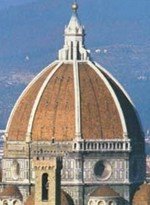
The Dome of Florence Cathedral,
designed by Filippo Brunelleschi.
See: Renaissance Architecture.

Filippo Brunelleschi (1377-1446)

The Florentine genius Filippo Brunelleschi was architect, engineer, and sculptor at a critical time in the evolution of Florence as the centre of the early Italian Renaissance.

For his pioneering work in constructing the massive dome for the city's cathedral, he was and remains an iconic figure in Quattrocento culture, and, along with Tommaso Masaccio (c.1401-28) and Donatello (1386-1466), one of the three most influential artists in early 15th-century Florence. His impact on Renaissance art and culture is incalculable.

Biography

ITALIAN RENAISSANCE ERA
Famous artists include:
Cimabue (c.1240-1302)
Giotto di Bondone (1267-1337)
Gentile da Fabriano (1370-1427)
Lorenzo Ghiberti (1378-1455)
Donatello (1386-1466)
Paolo Uccello (1397-1475)
Fra Angelico (1400-55)
Tommaso Masaccio (1401-1428)
Leon Battista Alberti (1404-72)
Piero della Francesca (1420-92)
Andrea Mantegna (1430-1506)
Donato Bramante (1444-1514)
Alessandro Botticelli (1445-1510)
Domenico Ghirlandaio (1449-94)
Leonardo da Vinci (1452-1519)
Michelangelo (1475-1564)
Titian (1477-1576)
Raphael (1483-1520)
Jacopo Tintoretto (1518-1594)
Paolo Veronese (1528-1588)
Giambologna (1529-1608)
Caravaggio (1573-1610)

HISTORY
For an account of the evolution
of art in Italy during the 15th and
16th centuries, see:
Proto-Renaissance (c.1300-1400)
Early Renaissance (1400-90)
High Renaissance (1490-1530)
Mannerism (1530-1600)
Renaissance in Florence (Medici)
Renaissance in Rome (Papal)
Renaissance in Venice (Colour)

LIST OF PAINTERS/SCULPTORS
For a list of artists from
the Quattrocento and
Cinquecento in Italy, see:
Early Renaissance Artists
High Renaissance Artists
Mannerist Artists.

WORLD'S BEST SCULPTORS
For the top 100 world's best
stone/wood carvers and bronze
artists, see: Greatest Sculptors.

GREAT EUROPEAN PAINTERS
For biographies and paintings
of the greatest artists in Europe
see: Old Masters: Top 100.

WORLD'S BEST ART
For a list of the finest artworks:
Greatest Paintings Ever
Oils, watercolours, fresco
from Giotto to postmodernism.
Greatest Sculptures Ever
Works in stone, bronze, wood
from 33,000 BCE-present.

Paintings by Renaissance artists
are in the best art museums
around the world.

The son of Brunellesco Lippi, a Florentine notary who held important posts in the Republic and was sometimes entrusted with diplomatic missions, Filippo was enrolled as a master of the goldsmiths' guild in 1398; in the following year he was active in the studio of Lunardo di Matteo Ducci da Pistoia, for whom he made some silver figures for the altar of S.Jacopo in Pistoia Cathedral.

Brunelleschi initially came to prominence as a result of the competition for the second bronze door of the Florence Baptistery, held in 1401, in which he participated alongside Ghiberti and five other sculptors. This contest has been described as the first art competition since Antiquity. In fact, it seems to have been common late medieval practice for a patron to invite several artists to submit designs before concluding a contract. Lorenzo Ghiberti (1378-1455) and the anonymous biographer of Brunelleschi, believed to be Antonio di Tuccio Manetti, differ in their accounts of the result of this contest. While Ghiberti states that he won outright, the biographer claims that Brunelleschi and Ghiberti were invited to share the commission and that Brunelleschi subsequently withdrew.

Although Brunelleschi is known to have participated in sculptural commissions around 1409 and in 1415, he seems to have turned away from sculpture during the decade following the competition. Between 1404 and 1406 he served as a consultant on the fabric of Florence Cathedral, and it was probably around this time that he first visited Rome.

It is not known precisely when Brunelleschi formulated the principles of "one-point" perspective which were subsequently employed by Tommaso Masaccio (1401-1428) and codified by Leon Battista Alberti (1404-72), although his discovery could hardly have been made later than the second decade of the 15th century. There is little evidence that Brunelleschi was interested in fine art painting; the two small perspectival views with which he is said to have demonstrated his ideas imply that his studies of this subject were primarily directed towards the requirements of architecture.

Little is known of Brunelleschi's work as an architect prior to 1417, when he was asked to give his opinion on the dome of Florence Cathedral. Although the approximate design of the dome had been established as early as 1367, its actual execution remained a supremely difficult engineering problem. Originally working alongside Ghiberti, Brunelleschi soon acquired control over the supervision of the work. The completion of this enterprise spanned the rest of his life and it remains his most famous achievement. He overcame the main task of enclosing the enormous drum (which was already standing) by introducing a double-shell dome. This required a series of ingenious technical innovations to reduce weight and ensure maximum strength. The scaffolding and the weight-lifting devices needed to erect the massive superstructure of the dome posed serious difficulties in themselves. Brunelleschi surmounted every problem as it arose, with a brilliant display of engineering skill and meticulous attention to each detail of the construction.

Brunelleschi's earliest surviving public building is the Ospedale degli Innocenti, Florence, begun in 1419. Its long semi-circular arcade reveals a clear debt to the Tuscan Romanesque, but the precision with which these medieval forms are applied, and the modular system of proportion with which the disposition of the whole design is governed, are entirely Classical. In 1421, Brunelleschi began the church of S.Lorenzo. Here he brought the traditional basilican plan up to date with a rigid application of modular theory, embracing the arcade bays, the span of the nave, and the equally-sized transepts, choir, and crossing, each of which stands in a precise proportional ratio to the others. The clarity of Brunelleschi's thought is well exemplified by the Old Sacristy of the church, adjoining the main building. A simple cube, rationally linked by pendentives to its dome above, it stands as virtually the first of a succession of centrally planned Renaissance structures.

With S.Spirito, begun in 1436 but completed after his death, Brunelleschi continued to develop his ideas upon the basilican church without being hampered, as he had been at S.Lorenzo, by an existing ground plan. The design was tightened up by continuing the aisle in an unbroken band around the transepts, choir, and west front, and by simplifying the ratio of arcade to clerestory from 5:3 to 1:1. Brunelleschi's original design incorporated a ring of semicircular chapel niches, visible from the outside, which established a formal congruity between the exterior wall and the interior configuration of the building.


Although Brunelleschi was commissioned to design the Pazzi Chapel in the cloister of S.Croce in 1429, the building seems to have progressed slowly and was not completed until many years after the architect's death. It consists of a domed central square, extended to an oblong by barrel-vaulted side bays, and further elaborated by a square, domed choir and a barrel-vaulted portico. This runs longitudinally across the facade of the building, firmly knitting the new structure into the cloister within which, it stands. The exquisitely balanced proportions of the design are underscored by the subtle polychromy of the gray moldings set against the paler walls, and enlivened by the glazed majolica roundels on the walls and in the spandrels of the dome. It was partly because of this innovatory system of interior decoration that the Pazzi Chapel proved so influential upon subsequent generations of architects.

Unfortunately, Brunelleschi's design for S.Maria degli Angeli (1434-7) was never completed. Consisting of a domed octagonal lantern surrounded by a ring of eight chapels, it would have been the first true centrally planned building of the Renaissance - it marks a high point in Brunelleschi's development as an architect. In 1436 he designed a last centrally planned structure: the lantern of Florence Cathedral. An octagonal tempietto, braced against the ribs of the dome by flying buttresses, this design aptly demonstrates the structural purpose of the lantern and at the same time provides a superb conclusion to Brunelleschi's great composition.

In addition to these works, Brunelleschi's name has been associated with other important Florentine buildings, including the Palazzo delia Parte Guelfa and even the Palazzo Pitti which was not begun until long after his death. Uniting his vast store of traditional engineering expertise with a new awareness of Classical models, and a personal genius for coherent and rational design, Brunelleschi transformed the outlook of the Florentine architectural world. More than any other individual, he established the forms and demonstrated the preoccupations of Italian Renaissance architecture.

• For biographies of great modern painters and sculptors, see: Famous Artists.
• For profiles of the great artistic movements/periods, see: History of Art.
• For a chronological list of events, see: Timeline: History of Art.
• For biographies of great painters from Ireland, see: Famous Irish Artists.
• For information about famous artists in Ireland, see: Irish Art Encyclopedia.

• To update this biography of the Early Renaissance architect Filippo Brunelleschi, click here.


Art Movements | Art Questions | Art Glossary | Visual Artists, Greatest | Art Types
Sitemap: Art in Ireland | Sitemap: Irish Painters/Sculptors | Sitemap: International Art
ENCYCLOPEDIA OF IRISH AND WORLD ART
© visual-arts-cork.com. All rights reserved.