Germain Pilon
Biography of French Renaissance & Mannerist
Sculptor.
MAIN A-Z INDEX - A-Z of SCULPTURE

|
Germain Pilon
|
|
FORMS OF SCULPTING EVOLUTION OF SCULPTURE |
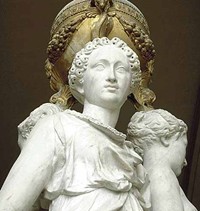
Germain Pilon (1529-1590)One of the finest French Renaissance sculptors, Germain Pilon excelled as a medallist and portrait sculptor. He produced various types of sculpture, including bronze, marble, terracotta and wood. He was influenced by the Fontainebleau School in France, as well as Italian Renaissance sculpture and sixteenth century Italian Mannerism. Along with Jean Goujon (active 1540-63), Pilon is considered one of the most important French sculptors of the cinquecento (16th century). His most famous surviving works are the sculpture of Three Graces holding the heart of Henry II of France (1561, Louvre) and the Tomb of Catherine de Medici and Henry II (1563-70, Abbey Church, Saint-Denis). His works can also be seen in some of the best art museums in Europe. Early Life Born in 1529, Pilon's father was a sculptor with his own workshop and it assumed this is where the young Pilon received his early training. Together, they may have worked on sculptures at Solesmes Abbey (Solesmes, France) before returning to Paris in 1550. Pilon went on to apprentice with Pierre Bontemps (1507-68), the famous French Renaissance artist famous for his funeral monuments. |
|
BEST SCULPTORS BEST WORKS OF SCULPTURE RENAISSANCE SCULPTURE |
|
|
Pilon excelled in all fields, drawing as well as sculpture. By 1555 he was providing models for Parisian goldsmiths. His early works were influenced by Renaissance art from Italy, especially those of Michelangelo, but out of this, his works moved towards Mannerism - favouring intensity and ambiguity. His figures were elongated and had exaggerated poses. His work developed mid-career and became even more realistic, displaying theatrical emotion. Heart of Henri II Pilon's first and most famous marble sculpture is the monument Heart of Henri II (1561, Louvre, also known as The Three Graces). Although he was still young, the fact that he was entrusted with such an important commission, shows that he was already considered in high regard. The group statue consists of three graces, holding an urn over their head. Executed from a single block of marble, the delicate and graceful sculpture is an outstanding piece of art, blending the best of French and Italian sculptural influences. |
|
|
Commissioned by Queen Catherine in 1561 to honour her late husband, Henry II who had died after being wounded in a tournament in 1559. It was also intended to receive the Queen's heart on her death. The Three Graces recall a cassolette designed for Francis I by Raphael and engraved by Marcantonio Raimondi. The light tunics, the elegance and gestures, the serenity of their faces all are refernces to antique statuary. However Pilon 'modernised' the sculpture by adapting Mannerism's elongated slender figures. The artist carved deep into the marble, so that the drapery catches the light, suggesting real movement. The beauty of the group is completed by the very fine craftsmanship.
Mausoleum by Catherine de Medici Pilon's next important commission was a mausoleum requested by Catherine de Medici for herself, her husband (Henry II) and their children. Begun in the early 1560's, the marble mausoleum was built at the Abbey Church, Saint-Denis. Francesco Primaticcio (1504-1570) designed the work and Pilon carried out the sculptures. The kneeling effigies of Henry and Catherine on the upper tier of the tomb are cast in bronze, although the primary material used is marble. Portraits and Medallions Pilon was also a popular portrait sculptor and medallist. A fine example of this is the bronze bust of Charles IX of France (c.1574, Wallace Collection, London). On the strength of his realistic sculptural skills, Pilon was appointed Controller General of the Paris Mint in 1572, and made some of the finest medallions, medals, and coins of his time. Pilon's mature work, as exemplified by his statue of St. Francis in Ecstasy (1583, Church of St Jean, Paris) is characterised by even greater freedom and naturalism. Other important sculptures include: The Virgin of Sorrows (1580, Louvre,
Paris) Monument to René de Biraghe
(1575-90, Louvre) The Lamentation (1580-85, Louvre) Pilon died in 1590. His emotional style of art is thought by some to have been too personal to inspire imitation. Nevertheless, his works represent an important step towards greater naturalism and were to influence French Baroque artists in later generations. |
|
• For the history and types of sculpture,
see: Homepage.
Plastic
Art |