Alonso Berruguete
Biography of Spanish Mannerist Sculptor.
MAIN A-Z INDEX - A-Z of SCULPTURE

|
Alonso Berruguete
|
|
BEST SCULPTORS |
Alonso Berruguete (c.1486-1561)The Spanish painter, carver and architect, Alonso Gonzalez de Berruguete, became the greatest of all Renaissance sculptors in Spain. He was associated in particular with the beginnings of Mannerism, in the same way as his father - the artist Pedro Berruguete (d.1504) - was linked with the start of the Spanish Renaissance itself. Active in Valladolid and Toledo, Alonso Berruguete preferred not to focus on formal techniques of sculpture, and instead developed a highly expressive and emotional style. His expressionist wood carving depicting religious torment and ecstasy gained him a reputation as the finest Spanish sculptor of the 16th century. Rapidly becoming a person of enormous wealth, he rarely had to solicit commissions, a luxury unknown to other Spanish Renaissance artists of the day. He was an older contemporary of the Spanish sculptor Juan de Juni (1506-1577), who was another pioneer of the Mannerist style. Early Life: Trains in Florence and Rome Alonso Berruguete was born in Valladolid, where he learned the art of sculpture and painting in his father's workshop. Like his father before him, Alonso spent time training in Italy: he was in Florence and Rome from 1504 to 1517. His original intention had been to develop his talent as a painter, but after taking up an opportunity to study sculpture under Michelangelo, whom he is said to have assisted in the execution of some works, he discovered a greater talent for sculpting. During his time in Florence, Berruguete absorbed himself in Renaissance sculpture and befriended a wide range of painters and sculptors, including Andrea del Sarto and Baccio Bandinelli (1493-1560), and gained a deserved reputation alongside the likes of Jacopo Pontormo (1494-1556) and Rosso Fiorentino, while completing works left unfinished by other artists, such as Coronation of the Virgin by Filippino Lippi (1457-1504). |
|
RENAISSANCE SCULPTURE EVOLUTION OF SCULPTURE SCULPTING MEDIA |
|
FINEST SCULPTURE |
|
|
|
Returns to Spain Returning home to Spain, Berruguete executed an alabaster relief for Valencia Cathedral, entitled the Resurrection (1517). Heavily influenced by Mannerist methods absorbed from his time in Rome and Florence, notably those of Michelangelo, it was the first of several Italian-style sculptures that helped spread the early 16th century Italian Mannerist ideas across Spain. Berruguete was initially patronized by Emperor Charles V, who appointed him court painter and later chancery scribe in Valladolid. The latter benefice allowed him to acquire great wealth. However, his career as an artist was based primarily on his success as a sculptor. |
|
|
To begin with he set up a workshop in Valladolid, hired a number of apprentices, and - it is said - charged prices to match his growing reputation. Spain was prospering and Berruguete reportedly was determined to be accorded the same respect as that enjoyed by Italian artists. In due course, Berruguete built himself a palace in Valladolid, close by the monastery of S. Benito, for which he created one of his greatest altarpieces. He enjoyed an extremely lucrative career, and was ennobled in 1559, some two years before his death, when the regent of Portugal, Princess Juana, gave him the village of Ventosa with its 120 inhabitants.
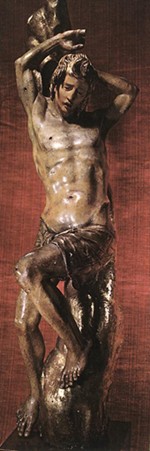
Sculptures by Alonso Berruguete Berruguete was active initially in the Valladolid region, then later in Toledo. His best known works of Christian art include: the almost complete altarpiece for the monastery of La Mejorada, Olmedo (1526, now in Valladolid); altarpiece of S. Benito (1527-1532), now in Valladolid Museum; the altar of the Irish College in Salamanca (1529-32); the choir stalls in Toledo Cathedral (1539-43); the marble funeral monument to the Cardinal Archbishop Juan de Tavera at the hospital of St. John the Baptist, in Toledo (1557-1561). Other works attributed to him can be found in Madrid (Palace of El Pardo), Arezzo, Uffizi Gallery Florence, Borghese Gallery Rome, Munich and Budapest. Altarpieces Berruguete's powerful cinquecento altarpieces typically spanned the entire apse of the church, being divided by a lavishly decorated architectural framework in which he placed his individual figures and relief panels. In this way, he created a single dramatic spectacle of religious decoration, and above all, feeling. See for instance the emotion of Abraham and Isaac, or the suffering of St. Sebastian in the altarpiece of S. Benito. The expressionism of Berreguate's sculpture, characterized by writhing, wailing, ecstatic figures, tortured drapery and brilliant colours, reflected the religious emotionalism of the age, and it is no surprise that he was succeeded in Toledo, from around 1577, by the equally emotive artist El Greco (1541-1614). Berruguete carved mainly in wood (painted and unpainted), as well as marble, alabaster and stone. It is believed that he carved and painted all figurative sculpture in polychromed-wood, but relied on his assistants to produce works like the alabaster Transfiguration in Toledo Cathedral (1543-1548) and also his last work, the monument to Cardinal Juan de Tavera. Legacy Berruguete's genius lay in his creation of a uniquely Spanish style of mannerist sculpture, expressing an uncontrollable passion and spiritual ecstasy which burns the soul of the spectator. |
|
• For the history of Spanish sculpture, see: Homepage.
ENCYCLOPEDIA OF SCULPTURE |