Jean Goujon
Biography of French Renaissance Mannerist
Sculptor.
MAIN A-Z INDEX - A-Z of SCULPTURE

|
Jean Goujon
|
|
EVOLUTION OF SCULPTURE |
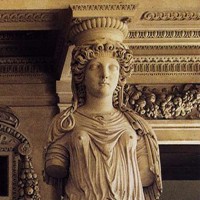
Jean Goujon (c.1510-68)The classical artist Goujon ranks alongside Germain Pilon as one of the greatest Renaissance sculptors in 16th century France. Although much of his sculpture was lost in the French Revolution, his surviving works reveal a distinctive Mannerism style, full of grace and delicacy, and as sophisticated as the finest works of painting and decoration of the contemporary Fontainebleau School (1530-1610). The style is most evident in his decorations for the Fontaine des Innocents, Paris (1547-49) - the six relief panels of nymphs from the fountain, with their delicately carved rippling drapery - which are seen as his masterpiece. Goujon is also famous for his sculptural decoration of the Louvre palace (1549-1562), in collaboration with the architect Pierre Lescot. Sadly, nearly all Goujon's Louvre sculpture has been heavily and poorly restored, including the famous caryatids (1550-51) in the Salle des Caryatides. Although Goujon's reputation was slightly eclipsed at the end of the 16th century by a more overtly mannerist style, he remained a favourite of later French Classicists and Neoclassicists. |
|
BEST SCULPTORS RENAISSANCE SCULPTURE BEST WORKS OF SCULPTURE |
|
MEDIUMS
|
Early Life Very little is known of Goujon's early life, or how he trained as a sculptor. He may have been be born in Normandy, around 1510. The first reference to him in documentation is 30 years later, when he worked on the Church of Saint-Maclou, Rouen, in 1540. Goujon is recorded in church accounts as the carver of columns supporting the organ loft. The pure classicism of the columns leads us to suppose that he must have stayed in Italy and absorbed the principles of Italian Renaissance sculpture, although for him to have taken up Mannerism as he did, shows that he was exceptionally quick on the uptake! By 1544 Goujon had moved to Paris and was employed by Pierre Lescot, the famous architect of the Louvre. He began working on the restorations of Saint-Germain l'Auxerrois, which was a church when the Louvre was still a Palace. He created some delicate relief sculpture which with their grace and delicacy owe something to Benvenuto Cellini. Chateau d’Ecouen Between 1544 and 1547 Goujon was occupied with work at the Chateau d’Ecouen, north of Paris. The Chateau was owned by Anne de Montmorency, a major patron of the arts in France, and a protector of Huguenot artists, when the court was strongly Catholic. He decorated his chapel with sculptures by Goujon, but also by Barthelemy Prieur, Jean Bullant and Bernard Palissy. Unfortunately, no building records survive, so the author of its grisaille stained glass and frescoes are not clear. It was decorated in the style of the School of Fontainebleau. |
|
|
Fontaine des Innocents In 1547 Goujon began work on decorations of the Fontaine des Innocents (Fountain of the Innocents), Paris. The elongated figures enclosed in tall vertical panels convey a rhythmical linear pattern of great elegance in the arrangement of their filmy costumes. Much of these decorations are now on display at the Louvre, including tall reliefs nymphs, trition and puttis. The elongated figures are delicate and light and display influences of Cellini and the drawings of Francesco Primaticcio (1504-1570). The decorations, working under the guidance of Pierre Lescot, occupied Goujon until 1562. The essence of Goujon's art can be summarised in these works: all exemplifying his characteristic fluid movements, subtle modelling and rippling folds of drapery. The Salle des Caryatides in the western wing of the Louvre contains his most ambitious sculpture. Originally designed to accommodate court entertainment, the floor is supported by four marble caryatids (sculpted female figures serving as an architectural support) in a classical Grecian style. Goujon's figures are draped in sheer cloth, clearly revealing the bodily forms beneath. This sort of rigorous classical sculpting, combined with sensuous modelling is archetypal Mannerism.
Other Sculptures by Goujon Monument to Louis de Breze (c.1540,
Cathedral, Rouen) The Seasons: Spring and Summer (1550-56,
Hotel Carnavalet, Paris). Diane and the Stag (1550-54, Louvre,
Paris) There is no record of any work executed after 1562. It is possible that Goujon was persecuted because of protestant Huguenot tendencies, and left France and died in Bologna. Beloved by classicists, his style of sculpture was popularised throughout France by engravings by artists of the School of Fontainebleau. |
|
• For more about French Renaissance
sculpture, see: Homepage.
Plastic
Art |