Andrea Della Robbia
Biography of Early Renaissance Terracotta
Sculptor.
MAIN A-Z INDEX - A-Z of SCULPTURE

|
Andrea Della Robbia
|
|
SCULPTING MEDIA |
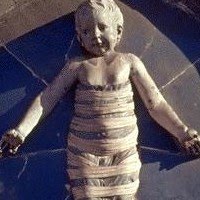
Andrea Della Robbia (1435-1525)An important pioneer of sculpture during the Italian Renaissance, Andrea della Robbia was born into a family of Florentine artists renowned for their terracotta sculpture - notably items of Christian art. He was son of Marco della Robbia and the nephew and pupil of Luca della Robbia (1400-1482). Specializing in narrative Renaissance sculpture, Andrea Della Robbia's best-known work is the Foundling Children (Bambino Tondi) (1463-66), ten tondos, or round sculptures, on the facade of Spedale degli Innocenti, Florence. Unfortunately, late in life, he was severely criticized by the fundamentalist preacher Girolamo Savonarola (1452-98). Biography Born in the same year as the sculptor and metalworker Andrea del Verrocchio (1435-1488), Andrea Della Robbia was trained by his uncle in both ceramic art and sculpture - the family business was based on its formula for a coloured glazed terracotta - but Andrea produced and sold enamelled reliefs in terracotta more widely, even in the smaller towns. In addition, he broadened their application to various architectural uses, such as friezes, fountains, and large retables above and behind church altars. |
|
BEST SCULPTORS RENAISSANCE (1400-1600) BEST WORKS OF SCULPTURE |
|
HISTORY OF SCULPTURE
|
His earliest works, at La Verna and Arezzo, showed much of the dignity typical of his uncle. After this came a period of graceful works, exemplified by the altar in the Osservanza near Siena, and in the lunette overlooking the door of Prato cathedral in Tuscany. But historians consider that his sculptures in the lunette of Pistoia cathedral and those above the entrances of S. Maria della Quercia at Viterbo lacked his previous refinement and bordered on sentimentality. Foundling Children Tondos (Bambino Tondi) Probably the finest work of Christian art by Andrea Della Robbia is the set of medallions comprising reliefs of babies in white on blue ground arranged on the facade of the foundling hospital at Florence (Spedale degli Innocenti). Each quite different, these beautiful child-figures are created with extraordinary skill., and place Andrea in the first rank of early Renaissance artists. Madonna and Child Reliefs For guilds, craft and trade associations, and private art collectors, Andrea Della Robbia created a diverse range of reliefs of the Madonna and Child, all characterized by great elegance of pose and expression. In these, typically, the main relief is left white, but decoratively framed with naturalistic garlands of fruit and flowers painted in a variety of coloured enamels. One improvement introduced by Andrea Della Robbia, in the creation of these enamelled figures, was to leave bare the face, hands and other exposed fleshy parts - for greater effect - as exemplified in the tympanum relief of the meeting of St Domenic and St Francis in the loggia of the Florentine hospital of San Paolo.
|
|
|
Retirement Andrea was one of the most long-lived sculptors of the Renaissance in Florence. On his retirement, the Robbia family workshop was carried on by his five sons. Giovanni della Robbia (1469-1529) was the eldest and most important. He created the font for the sacristy (1497) of S. Maria Novella, in a very similar manner to that of his father, but his more individual sculptures like the Nativity (1521, Museo Nazionale), the Tabernacolo della Fontacine (1522, Via Nazionale) and the medallions at the Ceppo Hospital at Pistoia, are characterized by inept composition and bad taste in colour. Fra Mattia demonstrated better sculptural ability in his high altar at Montecassiano (1527), but the middle brothers Fra Ambrogio and Luca di Andrea were largely imitators. Andrea Della Robbia's youngest son, Girolamo della Robbia (1488-1566), was an architect as well as a sculptor. He moved to France and worked for many years near Paris. His terracotta enamelled sculptures for the Chateau de Madrid were admired by many, even if they had little impact on 16th-century French sculpture. |
|
• For the history and types of sculpture, see: Homepage.
Plastic
Art |