David Teniers the Younger
Biography of Dutch Genre-Painter, Antwerp
School.
MAIN A-Z INDEX - A-Z of ARTISTS

|
David Teniers the Younger
|
|
NETHERLANDISH ART |
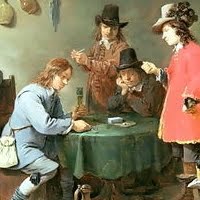
David Teniers the Younger (1610-90)Biography David Teniers, one of the leading Flemish painters of the 17th century, was born at Antwerp, in 1610, admitted to the mastery in 1633, married a rich heiress, and received every honour up to a title of nobility. His father, David Teniers the Elder, was a painter who had studied at Rome with Elsheimer. The young David saw his father paint little mythologies and idyls, tavern scenes, pictures of sorcerers and alchemists. That great vagrant genius, Adriaen Brouwer (1605-38), was at Antwerp in the early 1630's, and his was a leading influence on young David Teniers until his fortieth year. In the manner of Adriaen Brouwer he painted over 100 genre-paintings of tavern scenes, in keeping with the new aesthetics of Protestant Reformation art (c.1520-1700). Technically, there is a predominance of Brouwer's diaphanous browns about a single colour note. Psychologically, the attitude is quite different. For Brouwer the pot-house was a place of joyous or frantic disorder; for Teniers it was a place of decent conviviality. And, while he repeats Brouwer's cellar installation, with large still-life features in foreground, Teniers does not shut the space in, in Brouwer's sinister fashion. Teniers likes to give glimpses into adjoining rooms, and typically introduces more figures. See also: Baroque Art (1600-1700). |
|
WORLD'S BEST ART DUTCH REALISM SCHOOL |
|
DUTCH REALIST
STILL LIFE |
Early Paintings Of the many pictures of this sort the Smokers, is one of the most handsomely lighted, constructed and composed. The view of people about a fireplace in a back room is charmingly introduced and most skillfully subordinated. Of similar tact in placing many figures at varying distances is the Smoker. A personal interest attaches to the Self-portrait in an Inn. The handsome young painter looks out between the big wineglass which he holds in one hand while he keeps a magnificent five gallon jug at uneasy balance on the floor with the other. The still life, a cask, the big jug, a rude bench with pots on and under it, is delightfully painted, and there is the usual reassuring glimpse of a group, in the back room, quietly occupied about a table and before a fireplace. These pictures all fall about his thirtieth year and show a fine accomplishment. |
|
WORLDS TOP ARTISTS
|
|
|
Soon Teniers got a great reputation for incredibly speedy workmanship. It is recorded that he could finish one of these carefully executed oil paintings in the late afternoon hours. They were called, whether mockingly or admiringly we do not know, his "after dinners." While chiefly engaged with his tavern themes, Teniers sought a wider interest in certain pictures of alchemists busy in their laboratories, or saints afflicted by diabolical temptations. His father had treated such subjects, and Jerome Bosch had with rare mastery interpreted the theme of temptation as hallucination. The alchemist pictures are among the most complicated Teniers ever attempted. He rejoices in the jumble of scientific apparatus and multiplies secondary incidents. In his handling of the subject there is no satire. He takes the alchemist at face value, as a scientist, which suggests that he himself was credulous, for, with the beginnings of real science alchemy was already losing prestige. The Temptations are more amusing than impressive.
Teniers never rises to the grotesque and horrific possibilities of the
theme. He is a true Netherlander in feeling that no woman is physically
alluring unless she be expensively dressed, and in the latest mode. Thus
the temptresses who are led up to St. Anthony by an ingratiating horned
witch look like the modest Dutch gentlewomen whom Gabriel
Metsu (1629-67) painted so admiringly. St. Anthony himself seems more
shocked at the impropriety of a woman invading his wilderness than deeply
moved by the woman's attractiveness. The demons and monsters who sit or
fly about are made up from stuffed fish or monkeys, and again are mildly
amusing, and produce no terror. All this may be verified in the Temptation
at the Prado in Madrid, which is one of the best of its class. It has
much romantic charm and no seriousness whatever. |
|
Rubens had been
a witness at Teniers' wedding, and from that year or perhaps a little
earlier his influence is marked. The brown sauce of Brouwer pretty well
disappears from Teniers' palette, his pictures are still tonal rather
than colourful, but the colour
tone is subtly achieved through a harmony of many hues and tints. Rubens,
in his final delicate style, had abandoned his old frank colour in favour
of a magic which is able to give his warm neutrals a suggestion of every
sort of colour. His opalescences were inimitable, but Teniers intelligently
grasped the principle behind them and applied it in his own cautious fashion. Possibly even better are the landscape
paintings in which the figure interest is slighter. Here the picture
of himself and his wife before his country house is notable, (National
Gallery London). Men are hauling a net in a canal before the point from
which two of the three towers rise proudly before the evening sky. Teniers,
booted, hatted and cloaked like an officer, stands indifferently while
an aged and obsequious fisherman is about to offer a fine fish to Madame,
attired like a princess. A superfluous maid and page emphasize the gentility
of the pair. This group is merely tucked in a corner, the picture being
essentially a landscape, but the corner tells a lot about the painter
who would be a gentleman. Guardroom Paintings The abundant still life in these works Teniers handles most cleverly, also arranging it with taste. The little action involved is well indicated. One senses an ease more complete because it may at any time be broken by an emergency call. Whoever has done guard duty will admit the naturalness of Teniers' interpretation of that life. Kitchen Paintings In the 1640s Teniers' Dutch Realism begins to feature a series of kitchen pictures. The subject, with its variety of still life and picturesque possibilities of illumination, had attracted many good Dutch painters. Teniers gave it its most sumptuous expression in the famous Kitchen, 1644. The well-dressed housewife - it can hardly be the cook - sits and peels an apple, a little page holds a basin ready. She is surrounded by what is virtually a market; a great dinner must be in hand. The mounted skin of a swan on a table is ready for its ornamental function. Under the table is a big hare; a leg of mutton, with pheasants and ducks, on the floor; at the right, beside a copper wine cooler, big turbot and smaller fish lie on the floor. Above the housewife's head a plucked turkey hangs by the feet on the wall, forming a sort of trophy and a superbly decorative spot. In the left background are three figures, one of whom superintends the sizzling of no less than twenty roasts of various kinds and sizes on three spits. All this sounds like illustrative features carelessly heaped up. On the contrary, all the odd forms, colours and textures have their compositional value. Nothing could be shifted, taken away or added without some impairment of pictorial unity. Perhaps the picture should be regarded chiefly as a stunt-if so, a stunt magnificently carried off. Royal Patronage Teniers' late forties and early fifties
were a time of embarrassment and distress. In 1655 his wife died, and,
though in less than a year and a half he replaced her with another heiress,
very soon he was in litigation with his sons about their mother's will.
The Guild of St. Luke took legal action against his auctions. His extravagance
imperiled the tenure of his beloved Three Towers. Worst of all, the Spanish
College of Heralds, which ultimately granted his request, reported that
he could become a noble only on condition of ceasing to keep shop and
painting for pay. Legacy While his character seems to have been vain and self-seeking, nothing of that appears in his art. His pictures of all sorts run into the thousands, and among them it would be hard to find one that is either neglected or pretentious. As an artist his self-knowledge seems perfect, and he never rebelled at his limitations. The revived interest in such far greater painters as Brouwer, Ostade, Terborch and Vermeer has caused an unwarranted reaction against Teniers' previously exaggerated fame. There is much to be said for an artist who is so consistently amusing and skillful. One of the most reliable of Netherlandish Old Masters, he had the positive merit of retaining his interest in the rich and wholesome theme of peasant life for a quarter of a century after it had gone out of fashion. The would-be country gentleman and small nobleman viewed his peasant neighbours without caricature or condescension, painting them precisely as he saw and understood them. Again, the courtier never yielded a whit to that invasion of false French elegance which was rapidly undermining the sturdy native tradition of the Low Countries. In short, few minor painters of his time, or of any time, give more reasonable grounds for praise than David Teniers. A necessary qualifying consideration is that his brush was far more witty than his mind. Works by Teniers can be seen in the best art museums across Europe. |
|
• For biographies of great artists,
see: Famous Painters.
Visual
Artists, Greatest |