Jan Steen
Biography of Dutch Realist Genre-Painter
of Haarlem School.
MAIN A-Z INDEX - A-Z of ARTISTS

|
Jan Steen
|
|
DUTCH GOLDEN AGE WORLDS TOP ARTISTS AESTHETICS |
Jan Steen (1629-79)His Style of Dutch Realism One of Holland's best genre painters, Jan Steen, though born and trained at Leiden, must be regarded as an honorary member of the school of Haarlem, for he came under its influence, adopted its technical methods and there painted his best pictures, including some of the greatest genre paintings of the period. He is a link between the older and younger genre painters, less objective than, say, Adriaen van Ostade (1610-85) and Gerard Terborch (1617-81), less sentimental than the Mierises. In his particular style of Dutch Realism, Steen possibly gives himself too unreservedly to his subject matter, somewhat neglecting pictorial, in favour of human, expression. His themes are usually invested with his own humorous, moralizing or satirical comment. He can at times play the showman, tweaking the beholder's elbow lest he miss something. Behind his pictures one feels the genial and quizzical man. No painter of the Dutch Baroque has studied the relations of children with grown-ups with more insight and charm. He conveys infectiously the animation of games and work and family festivals with eager participants, and he catches equally well some exquisite and unexpected aspect of a solitary figure - as that glimpse of his fair wife about to put on a stocking. Almost alone of Dutch Old Masters, he is fully aware of the comedy played between doctors who are half quacks and pretty women who are imaginary invalids. His was a widely roving eye and sympathy. |
|
DUTCH REALISM SCHOOL |
|
DUTCH REALIST STILL
LIFE WORLD'S BEST ART
|
Such mobility of temperament is hardly Dutch, as it was hardly Dutch to remain a good Catholic. The Dutch, who, after all, adored him, had their revenge in loading his legend with all the peccadillos and some of the sins. Here legend has probably made too much of the fact that he was generally in straits and normally convivial. No wastrel can have painted in less than thirty years of activity over five hundred carefully finished pictures. Biography The next year he was working at The Hague, where he married the fair Margaret van Goyen, daughter of the famous marine and landscape painter Jan van Goyen. Margaret's gracious form appears in many of Jan Steen's pictures. |
|
|
From about 1660 to 1671 Jan Steen painted at Haarlem. This is the moment of his prime and of his best pictures. In 1669 his wife, Margaret, died and a year later the apothecary seized all the pictures in Jan Steen's house and auctioned them publicly to cover a bill of ten gulden. After this chagrin Jan Steen moved back to his native Leiden, where, in 1672, he was licensed as a tavern keeper. The next year he married the widow, Maria van Egmont. His remaining six years seem to have passed in relative tranquillity. Some money probably came with the widow, and he himself had excellent personal qualifications as a host. He died in 1679, only fifty-three years old. Artistic Composition and Subject Matter A similar triumph in the visionary vein is the Bedroom, at Buckingham Palace, London. It is dated 1663. One looks through an arched doorway whose dark mass serves as a frame, beyond a lute and an open music book on the threshold, to a room shimmering with straw-yellow and pale-blue stuffs, where on a bed a pretty young woman, his wife, dressed in a yellow, furred coat and a blue skirt, sits with crossed bare legs, reaching down a fine hand to draw on a stocking. Again there is a sense of surprise and revelation, as if one had had the good luck to walk past this door and happen on this gracious apparition. Jan Steen is rarely at the level of these two pictures. Indeed, he is best known for his pictures of large groups, family festivals, busy inn courts - so many documents of Old Holland at play. One of the earliest is Prince's Day. The birthday, November 14, of the future deliverer of Holland, William of Orange, was celebrated by the common folk, who rightly saw in him their champion against the wealthy patricians. What we have in this picture is rather a patriotic rally at an inn than a family affair. In this animated composition of some twenty figures the eye finds few points of rest. One may say that three pictures are arbitrarily juxtaposed - the group at the right behind the bald-headed man who, burlesquing a knightly act, kneels with a wooden sword before an amused young woman and an offish little group; the fine young pair at the left centre; the card-players at the left. There is some suggestion of Peter Bruegel, whose pictures Jan Steen must have known, and the comparison suggests the superiority of Bruegel's linear and flat painting, for this sort of subject, over Steen's atmospheric tonalities. Again, the big caldrons and platters in the foreground seem put in to fill an unexpected void, without plan. The defects of this picture are found in all of his more elaborate compositions. |
|
|
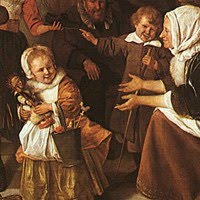
His best groups are less populous and on a smaller scale. Entirely winning is the painting of his own family about 1663. Except for two old people engrossed with a little girl, the rest, to the setter dog, are listening with pleasure and perhaps a shade of ridicule to the earnest piping of the eldest son. The light falls in handsomely, picking out faces, headdresses, tablecloth, massive copper kitchen utensils on the floor, and a hanging wicker bird cage which relieves effectually the general gloom of the upper part. Of very similar attractiveness is St.
Nicholas' Day, where the chief motive is a roguish little girl refusing
to show her presents to her mother. The various attitudes and dispositions
of the celebrators are admirably caught, and the whole picture yields
the intended sense of decently convivial merrymaking. Another typical
example of this kind of picture is the Flemish Feast. It shows
at their best, Steen's animation and ability in catching transient expressions
and postures - if perhaps just a little over-egged and overcrowded. In general, Jan Steen is more regardful
of pictorial unity in subjects with few figures, such as the Fighting
Card-Players, where the quarrel releases a little avalanche of plunging
figures and falling furniture; the Card-Players, Buckingham Palace,
London, one of Steen's sparsest and neatest compositions, in which everything
is as clear as in a Bruegel. Legacy The companionableness of Jan Steen's 17th century Dutch painting is so obvious that any critical summary, beyond the analysis of his pictures, already given, seems superfluous. It is also unnecessary and ungracious to emphasize his artistic inferiority to such Dutch little masters as Brouwer, Ostade, Vermeer and Terborch. Jan Steen died in 1679, at fifty-three, probably reluctant to leave the life which had never failed to interest and amuse him. Works by Jan Steen can be seen in the best art museums across Europe, notably the Rijksmuseum Amsterdam. |
|
• For important dates and a chronological
list of events, see: Timeline:
History of Art.
ENCYCLOPEDIA OF OLD MASTER
PAINTERS |