|
DUTCH REALIST STILL
LIFE
For the best still life painters:
Jan Davidsz de Heem (1606-83)
Utrecht School of Dutch Realism.
Willem Kalf (1619-93)
Pronkstilleven Paintings.
Samuel van Hoogstraten (1627-78)
Interiors, genre works, still lifes.
Rachel Ruysch (1664-1750)
Flower painter, still lifes.
WORLDS TOP ARTISTS
For top creative practitioners, see:
Best Artists of All Time.
For the greatest genre-painting, see:
Best Genre Painters.
For the top allegorical painting,
see: Best History Painters.
|
Biography
Gerard Terborch was born in 1617, at Zwolle, central port of the Zuyder
Zee. His father, an unsuccessful painter, but a widely traveled and acquainted
man, had settled down to making his living as tax collector. Three marriages
were blessed by no less than twelve children, half of whom developed as
amateur painters, musicians, or both. The father, a man of considerable
education and of ready sympathies, was proud of his talented brood, and
did what he could to further their interests.
There are drawings
by Gerard as early as his eighth year, and really spirited sketches of
skaters which he did at fourteen. At eighteen, Terborch was at Amsterdam,
having earlier been a pupil of Pieter Molyn at Haarlem. It speaks for
his independence that, seeing in the impressionable years the most brilliant
painting in the world, the mere boy maintained the sobriety of his own
handling and outlook. Before he was twenty he had visited England. Probably
he painted there some of those characterful little oval half-lengths and
full-length portraits which we
are unable to date. Indeed, it seems that before his fifties his activity
was chiefly in small portraiture. Probably he found the competition at
Amsterdam too pressing, for in 1646, at twenty-nine, he went to Munster,
in Westphalia, to profit by the peace conference - much as ambitious young
portrait painters naturally went to Versailles in 1920.
Here, he produced the extraordinary figurative
painting called the Delegates swearing to the Peace Treaty
(1648). The group is composed with clarity and dignity, the tiny heads
have much character, the decorative character and impressiveness of the
scene are well felt. Usually we feel sure Terborch practiced a gentleman's
phlegmatism, but even he must have had a catch in the throat over the
ceremony that ended the Thirty Years' War and gave legal sanction to the
independence of Holland. He seems to have painted this grand little historical
piece on his own account, and not on a commission. It is not only intrinsically
his most important picture, but also one of the most instructive for its
early date.
From Munster, having, according to credible tradition, won the good will
of the Spanish envoy, Penaranda, Terborch went on to Madrid, where he
painted a portrait of Philip IV and received the gift of a golden chain.
Terborch's sojourn in Madrid raises the alluring possibility of relations
with the art of Velazquez, which, in its objectivity,
reticence and rectitude has much in common with his own. This possibility
of direct influence from Velazquez has been too summarily dismissed. Velazquez
himself left Madrid for Italy shortly after Terborch's arrival, but the
works of his glorious prime were readily accessible. The somewhat heavy
courtliness of their accent was thoroughly congenial to Terborch, and
might have taught him much. In particular, the example of a workmanship
which, without calling attention to itself, gave great emphasis to the
painted forms, might have been valuable to a young painter who had been
influenced by the overt and almost overadvertised dexterity of Frans
Hals and his followers at Haarlem.
For instance there seems to be firm hints of Velazquez in the stance and
compositional arrangement of the little full-length portraits of Terborch's
maturity - the portly effigy of himself, at The Hague; two male portraits
in Berlin; a Husband and Wife, in London; and the very sensitive
portraits of Jan van Doren and his Wife, previously in the collection
of Mr. Robert Lehman, New York. Something entirely undefinable in the
refinement of the lighting may be coincidence, but the setting of the
figures on a floor rising steeply in perspective to the actual horizon,
is rare in Holland but invariable in Velazquez. The stance gains a piquancy
from admitting the optical facts. Generally, in full-length portraiture
the horizon is arbitrarily lowered in the interest of making a more stable
base for the figure.
On St. Valentine's Day of 1654, being thirty-seven years old and ready
to settle down, Terborch married the prosperous widow, Gertrude Matthyssen,
who lived at Deventer, twenty miles up the Issel from Zwolle. He moved
to his wife's property, became a magistrate, doubtless continued to frequent
the company of officers off duty, and otherwise varied the possible tedium
of public service and a childless marriage by painting a few very fine
pictures. He died near the end of 1681, at sixty-four, one of the most
"aristocratic" of all Dutch Old
Masters.
Composition and Subject Matter
It is not the range but the intensity of Terborch's art that counts. In
all, the interest centres on the figures, and the setting is carried only
to the point of suggesting the general character. Depth and sense of space
are of minor concern to him. So is atmospheric envelopment, though it
is always sensitively considered. The compositional patterns again are
generally of the simplest kind, deriving from the figure in focus or the
relations of the group. It is a rich and dusky world, that of Terborch.
The women wear sheeny satins, or velvet bordered with ermine; the men
are got up in all masculine bravery; generally a velvet table cover of
crimson hue echoes the richness of the costumes. This art, which rests
on the discreet use of really very simple elements, has a singularly aristocratic
flavour. It seems as if Terborch imposed himself almost as much by his
eliminations as by his positive assertion - just as a gentle person is
almost as well known by what he never deigns to do as by what he actually
does.
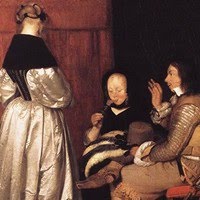
A most characteristic Terborch is the picture miscalled Paternal Admonition.
The traditional title fooled as shrewd a critic as Goethe, but a little
scrutiny of the picture will show that there is nothing fatherly about
the plea of the confidently seated young blade to the fine young woman
with her back turned to us. Nor is the shrewd old woman drinking a glass
of wine a chaperon. She is rather a referee in a business matter with
amorous implications. The building of the group against the standing figure
in a sort of side wise pyramid is simple, odd and very effective.
The same motive is presented overtly in the Piece of Money. This
time the officer is too much in a hurry to establish his winter relations
to remove his corselet and change to civilian costume. He makes no pretense
of courtliness, but shows a handful of gold pieces to the pretty girl
who, without putting down her wineglass and pitcher, studies the offering
very thoughtfully. She shows no more hesitation in considering the offer
than he shows in making it. On both sides is a world where the buying
of a woman's favours is entirely in the day's work. The contrast of types
- the predatory male and his predestined prey - is effected without apparent
emphasis. The picture is at once most concrete and a universal symbol.
Of the numerous pictures of women of his own class, those with one or
two figures are the best. They have a quiet and irresistible elegance
of mere execution. The various Music Lessons and Concerts by Terborch
all seem to me well below his best accomplishment. Perhaps the theme did
not really interest him, and he tried not too successfully to give it
animation. Such waiver of cool and impartial observation would be very
impairing to such an art as his.
We perhaps see him at his painterlike best in such pictures as Lady
in her Room. It is just a view of the back of a lady clad in white
satin, with the merest suggestion of a well-appointed room, but the costume
tells a lot about a soft type of woman, living a life of privileged ease.
More intentionally picturesque is the Concert. A woman seen from
behind bows the cello, while another woman, seated behind a harpsichord,
plays the accompaniment. It is a picture which, in its bright and harmonious
colouring and its odd pattern, competes with Vermeer, but with only partial
success, for the placing of the distant figure is ambiguous. It could
be a bust on the harpsichord. Again the elaborate pattern yields little
sense of space. The mere painting of the back of the cellist is at once
brilliant, restrained and sumptuous.
While, on the whole, Terborch shows less
gusto in painting honest women than in depicting the other sort, surely
one of his best pictures is the Woman washing her Hands. It is
in the best tradition of Dutch genre painting. It dignifies an ordinary
act without sentimentalizing it, it expresses truly and charmingly the
artist's difference in attitude towards the pretty hands of the lady herself
and those of the servant. The realization of a rich interior, though on
a lower key, is as complete as Vermeer's, the touching off of details,
such as the jug and the carved picture frames, is of a magical and entirely
unpretentious dexterity, which celebrates not itself, but the object under
observation. It is one of the most elaborately composed Terborchs, without
any sacrifice of the simplicity of central motive, which is merely the
desirability of a comely and well-groomed woman.
Legacy
In summing up Terbarch's accomplishment one recalls the wise saying of
George Moore about a kindred genius, Manet. In substance it runs: there
is nothing but fine painting in him, and it is foolish to look for anything
else. This is the general truth about Terborch. Works by Gerard Terborch
can be seen in the best art museums across
Europe.
|