Benedetto Antelami
Biography of Medieval Italian Romanesque
Sculptor.
MAIN A-Z INDEX - A-Z of SCULPTURE

|
Benedetto Antelami
|
|
SCULPTING MEDIA |
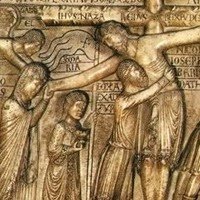
Benedetto Antelami (c.1150-1230)The Italian architect and sculptor of the Romanesque school, Benedetto Antelami, is considered to be one of the most important artists of the period immediately preceding that of the great Pisa sculptor Nicola Pisano. Antelami's Romanesque sculpture, with its elongated figures and compact composition, was very fashionable in Parma towards the end of the 12th-century. The city's cathedral is adorned with his Crucifixion and Deposition from the Cross - a marble bas-relief of remarkable quality. Antelami was also the builder of the Baptistery, which is decorated with fourteen of his influential statues of the Labours of the Month. A master of Romanesque art, Antelami was also an important forerunner of the coming style of Gothic art. Biography Little is known about Antelami's origins or how he became proficient in the art of sculpture. It is likely that he came originally from Lombardy, perhaps from Val d'Intelvi. According to at least one historian, his sculptural technique derived from local north Italian traditions. However, taking into account the Provencal style of his art, it is believed that he served his apprenticeship at Saint-Trophime d'Arles. |
|
MEDIEVAL SCULPTURE FAMOUS MEDIEVAL
SCULPTORS |
|
|
Cathedral of Parma At any rate, by 1178 he was already at work on his bas-relief of the Deposition from the cross, in the right transept of the Cathedral of Parma. Within the framework of Romanesque architecture, this work betrays wider influences, notably those of classical and Byzantine sculpture. There is a strong classicising style to the relief, seen especially in the gentle folds of the drapery on each figure. Antelami's treatment of the drapery reveals the strong influence that the classical sculpture, still visible in Italy, had on his work. Here, the lines of the drapery add a sense of movement to the otherwise still composition. The figures' unnatural proportions, for example their large clumsy hands and feet, do not detract from the overall impression of the work; instead, they add a humanistic element to the sombre piece.
Baptistry of Parma In 1196, Antelami began work on the sculptural decoration of the Baptistry of Parma, a building he also designed. Between 1196 and 1214, he created the lunettes (arched apertures) of the three portals. The exterior depicted various Biblical themes including the Last Judgement and the Adoration of the Magi, while the interior portrayed the Flight into Egypt, and David playing the harp, as well as high-relief (alto-relievo) figurative allegories of the months and the seasons. Here, as in the Deposition relief in the Cathedral, Antelami's work is characterized by its realism and emotion, within - it must be said - the rather formalistic conventions of the age. Other Works Medieval art by Antelami can also be seen in the Fidenza Cathedral, as well as on the main west portal of the Basilica di San Marco, Venice, and in the Museum of Antique Art in Milan. |
|
• For the history and types of sculpture, see: Homepage.
Plastic
Art | Visual Artists, Greatest |