|
During the downturn of the 1990s, the firm's
main offices in London and New York, underwent extensive renovations.
In New York, by 2000, six additional floors had been added to its York
Avenue headquarters, including a gallery that has been described as "one
of the great dramatic exhibition spaces of New York...an environment to
rival almost any of the city's museums." By 2001, Sotheby's was able
to open a second base at Olympia in London to complement sales at its
New Bond Street headquarters, doubling its gallery space in London. In
addition, by the turn of the Millennium Sotheby's was the first international
art auction house to hold auctions on the Internet.
World Record
Prices Set at Sotheby's Auctions
Sotheby's has achieved numerous world record
prices at its art auctions for works by Old Masters as well as the world's
top contemporary artists.
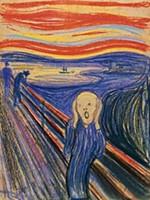
• The Scream (1895), by Edvard
Munch. Sold by Sotheby's New York in 2012 for $119.9 million. One
of the most iconic paintings in the history
of expressionist painting.
• Silver Car Crash (Double Disaster)
(1963), by Andy Warhol. Sold
in 2013 by Sotheby's New York for $105 million. The most expensive example
of pop art, and a typically voyeuristic
example of Andy Warhol's
Pop Art of the sixties.
• Garçon à la pipe,
by Pablo Picasso. Sold for $104.2
million in 2004 at Sotheby's New York. A classic work of modern
art, and the costliest example of naturalist figure
painting.
• Dora Maar au Chat, by Picasso.
Sold in 2006 at Sotheby's New York for $95.2 million.
• Triptych 1976, by Francis
Bacon. Sold at Sotheby's New York in 2008
for $86.3 million. The world's second-most expensive triptych,
after Portrait of Lucien Freud - also by Bacon.
• Nude Sitting on a Divan (1917),
by Modigliani. Sold by Sotheby's
New York in 2010 for $68.9 million.
• White Center (Yellow, Pink and
Lavender on Rose) by Mark
Rothko. Sold by Sotheby's New York in 2007 for $72.8 million. The
world's secon most expensive example of Colour
Field Painting, after Orange, Red, Yellow (1961) also by Rothko.
• Bal Au Moulin de la Galette
(1876) by Pierre-Auguste Renoir.
Sold for $78.1 million in 1990 at Sotheby's, New York. One of the most
famous Impressionist
paintings in the world.
• Massacre of the Innocents
(1611) by Peter Paul Rubens. Sold
for $76.7 million in 2002, at Sotheby's, London. One of the best
Baroque paintings, this work by the Flemish Baroque
artist is the most expensive oil by any of the Old Masters.
• Untitled (1952), by Mark
Rothko. Sold in 2014 by Sotheby's New York for $66.2 million.
• 1949-A-No.1 (1949), by Clyfford
Still. Sold by Sotheby's New York in 2011 for $61.7 million.
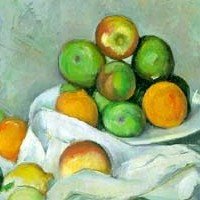
• Rideau, Cruchon et Compotier
(1894), by Paul Cezanne. Sold
in 1999 by Sotheby's New York for $60.5 million. Regarded as one of the
greatest examples of still life
painting by one of the best
still life painters since the 17th century.
• Study From Innocent X, by
Francis Bacon. Sold for $52.6 million at Sotheby's New York, in 2007.
• In 2007, Sotheby's achieved the
highest auction price ever achieved by a sculpture: the 5,000-year old
Guennol Lioness, a 3-inch tall limestone lion from ancient Mesopotamia.
This exquisite piece of Sumerian art
sold for $57 million.
Sales of
Irish Art
Sotheby's has been responsible for numerous
record-breaking auction prices for works of Irish
art, including:
• Portrait of Gardenia St. George
With Riding Crop. By Sir William
Orpen. Sold by Sotheby's London in June 2001, for £1,983,500.
• The Wild Ones. By Jack
Butler Yeats.
£1,233,500 (Sotheby's London, May 1999)
• Travelling Woman with Newspaper.
By Louis le Brocquy.
£1,158,500 (Sotheby's London, May 18 2000)
• King Lear weeping over the body
of Cordelia. By James Barry.
£982,400 (Sotheby's London, May 2006)
• Portrait of Mrs St. George.
By Sir William Orpen.
£924,000 (Sotheby's London, May 16 2003)
Price-fixing
Controversy
In recent years, Sotheby's has an intense
rivalry with Christie's for the coveted position of the world's
No 1 Fine Art Auctioneer. In February 2000, Sotheby's CEO Diana Brooks
stepped down following an FBI investigation into allegations of price-fixing
between the two auction houses. In October 2000, Brooks admitted guilt
and implicated Taubman, the largest shareholder of Sotheby's at the time,
who was himself charged with and later found guilty of conspiracy.
|