Lucas Cranach the Elder
Biography of German Portrait Painter, Printmaker.



|
Lucas Cranach the Elder
|
|
|
Lucas Cranach (1472-1553)Contents • Biography |
|
|
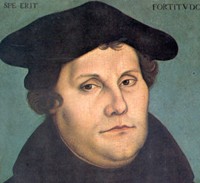
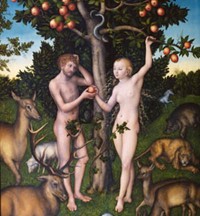
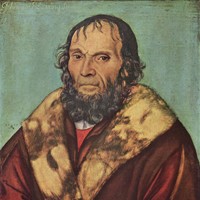
The German painter, printmaker, engraver and illustrator, Lucas Cranach, was one of leading Old Masters of the Northern Renaissance. Influenced by the work of his Nuremberg contemporary Albrecht Durer (1471-1528), and by German Gothic art, as well as the innovations of Italian Renaissance art, he developed an individual style of oil painting that combined landscape and narrative scenes to form a romantic whole. This made him a leading figure in German Renaissance art and a founding member of the Danube School in southern Germany. Lucas Cranach is also noted for his female nudes, his court portraits and his religious art - especially his later Protestant works. His most famous paintings include Adam and Eve (1528, Uffizi, Florence), Portrait of Doctor Johann Schoner (1529, Royal Museums of Fine Arts, Brussels), Portrait of Martin Luther (1543, Uffizi, Florence), and The Fountain of Youth (1546, Gemaldegalerie, SMPK, Berlin). His portrait art, which is infused with decorative features, contrasts with the more realistic modelling skills of the great Hans Holbein the Younger (1497-1543), his German contemporary. |
|
WORLD'S BEST ART |
|
WORLDS TOP ARTISTS
|
Born in Kronach, Bavaria, his father Hans Cranach was also an artist and obviously wanted his son to follow in his footsteps, as he named him after St Luke, the patron saint of painters. Lucas Cranach absorbed the rudiments of drawing and painting in his father's workshop, after which he may have been apprenticed to German masters in Bamberg, the nearby provincial capital.
Between 1500 and 1504 Cranach resided in Vienna, where the first of his surviving works were painted, immediately after 1500. They include, from around 1501, a Crucifixion (Kunsthistorisches Museum, Vienna) and two altar-panels representing St Valentine and the Stigmatization of St Frances (Academy of Art, Vienna), followed in 1502 by a panel of St Jerome Penitent and three wood-engravings; two Crucifixions and a St Stephen, dated. Full of reminders of Durer's Apocalypse (1498), all these early works by Cranach are characterized by bony figures with grimacing expressions, together with a marked feeling for nature, evident in the predominance of the landscape, or, in the case of St Stephen, in the two trees full of dragons and angels, which serve as a frame. The dynamism of these early paintings is repeated in a wood-engraving of The Agony in the Garden (1503, Metropolitan Museum of Art, New York), and in the Crucifixion (1503, Alte Pinakothek, Munich). In this latter picture the crosses, by their positioning, are integrated into the landscape much more than they would have been had they been shown from the front, an arrangement that stresses the human rather than the redemptive meaning of the event. |
|
|
In accordance with the established Hierarchy of the Genres, most artists of the time focused on producing biblical history painting, but Cranach in his early career - in addition to his portrait art and Biblical works - enjoyed landscape painting for its own sake and produced numerous scenic pictures featuring deer and wild boar, using strong colours and bold designs. Other artists from the Danube area, like Albrecht Altdorfer (1480-1538), Jorg Breu, Rueland Frueauf, Wolf Huber were similarly inspired by nature, and together they became known as the Danube School. While in Vienna, Cranach also painted a number of portraits of scholars and their wives, such as his double panel paintings of the Viennese humanist Johann Cuspinian and his Wife (1502, Oskar Reinhart Collection), and of the Rector of Vienna University Johann Stephen Reuss and his Wife (1503, Nuremberg Museum and Berlin-Dahlem), which reveal his close contacts with Viennese humanist circles. Court Painter to the Elector of Saxony In 1504 Cranach was offered (and accepted) the position of court painter to the Elector of Saxony, Frederick the Wise, at Wittenberg. He spent the rest of his life in Wittenberg as official artist to three successive Electors. He was elected Burgomaster in 1537 and 1540, and was a friend of the eminent Protestant theologians Martin Luther (1483-1546) and Philipp Melanchton (1497-1560). He went on to paint Luther's portrait in 1553 and also that of Luther's wife, mother and father. However, while Cranach felt an allegiance to the Protestant cause, it did not prevent him from undertaking commissions from Cardinal Albrecht von Brandenburg - one of the great Catholic patrons of his day - and other similar customers. By comparing the earliest works he produced at Wittenberg - The Martyrdom of St Catherine (1506, Gemaldegalerie Alte Meister, Dresden) - with another panel painting of the same subject (1503, Private Collection, Budapest), dating from the end of his time in Austria, it is possible to gauge his development. The dynamic and aggressive figures in the Budapest panel have, in the Wittenberg painting, become careful and unemphatic; the spirit that characterized the early works has gone. In the field of engraving - for instance, in the St Anthony of 1506 - the dynamic style of his early days was maintained rather longer, but the features that are first evident in The Martyrdom of St Catherine gradually become more apparent. In 1509, Cranach travelled to the Netherlands to paint Emperor Maximilian and his son Charles V. This was a considerable honour and shows that he was already one of the most respected Northern Renaissance artists of the time. Up until this point, when Cranach completed a work, he signed his work with his initials. In 1509, the Elector granted him a winged snake as a personal motto, and this motif appears on all his pictures after this date. While the trip to the Netherlands considerably increased his painter's vocabulary - he was particularly inspired by Flemish painting and Italian Renaissance paintings - it had little influence on his style - a style to which he adhered for the rest of his life and which, not without reason, has been considered a diminution of his art. Abandoning his early concern with integrating the figures in a whole, he sought something entirely different. In the Altarpiece of the Holy Family (1511, Academy of Art, Vienna) the figures that stand out against a sober background of buildings are shown in isolation. This tendency to isolation emerges even more strongly in the altarpiece Cardinal Albrecht von Brandenberg as St Jerome in his Study (1526, Ringling Museum, Sarasota). If the engraving of Albrecht Durer (1471-1528) owes its power to its all-enveloping atmosphere, this feature is totally absent from Cranach's painting. Every figure and object is clearly defined, and a wider perspective is introduced, which makes it possible to create more space around objects. The landscape itself - which had previously been treated as a living space for the human figure - is now used as decor - a feature that was to become even more marked, in such later paintings as The Deer Hunt (1529, KM, Vienna) where the horizon is raised. The tendency to isolate the figures appears, too, in the many paintings of Venus and Lucretia. Set against a sombre background, they are reminiscent of Botticelli's Birth of Venus in the way they are presented. Nudes and Mythological Paintings From the reign of the Elector Johann (1526-32) onwards, Cranach produced numerous female nudes and examples of mythological painting, taken from Greek mythology. Famous examples include: Adam and Eve (1528, Uffizi), Venus (1529, Louvre), Cupid Complaining to Venus (1530, National Gallery, London), and The Fountain of Youth (1546, Gemaldegalerie, SMPK, Berlin). At the same time he continued his religious art - see: Virgin and Child under the Apple Tree (1530, Hermitage, St Petersburg) - as well as his portraiture, which remained a major part of his output throughout his career. Cranach has bequeathed us images not only of the Electors of Saxony - see, for instance, Frederick the Wise (1519-20, Kunstmuseum, Zurich) - but also of Martin Luther, whom he painted several times - see, for instance, Portrait of Martin Luther (1543, Uffizi, Florence). Other famous portrait paintings include Portrait of Doctor Johann Schoner (1529, Royal Museums of Fine Arts, Brussels). Vigorously drawn, the faces stand out decoratively against a generally uniform, evenly lit background. In addition, Cranach completed numerous wood and copper engravings of his portraits. A hard worker and an astute businessman, Cranach acquired a reputation as the fastest painter in the region. In his busy workshop, he and his assistants turned out watercolour paintings, oils and prints in conveyor-belt fashion. According to documents from the time, in 1533 alone he received and completed an order for sixty pairs of portraits of the Elector and his brother. In addition, due to his close relationship with Martin Luther, Cranach was called upon to translate the most important subjects of the new Protestant religious doctrine into images. While these works are not always very remarkable as works of art, they remain important as didactic illustrations of newly coined theological subjects. Original Sin and Redemption can be considered as the first codifications of Protestant iconography, which spread very widely. Cranach continued working until his late 70s - see, for instance, his Self-Portrait (1550, Uffizi) which testifies to the longevity of his creative powers. Finally, in 1553 he handed over his workshop to his son, Lucas the Younger (1515-86), who carried on his style: in fact, to this day, it is difficult to differentiate precisely between the work of the two Cranachs. Cranach the Elder died at Weimar in 1553, and was survived by three sons and one daughter. He remains one of the most notable figures in the history of art of the Northern Renaissance, and the Lutheran Church continues to commemorate his life as an artist, every year on April 6. Lucas Cranach's paintings and prints can be found in many of the world's best art museums. His best known works include: - The Crucifixion (1502) Kunsthistorisches
Museum, Vienna. See also: German Medieval Art (800-1250). |
|
• For more German painters, see: Homepage.
ENCYCLOPEDIA OF OLD MASTER PAINTERS |