Franz Marc
Biography of German Expressionist Painter,
Blue Rider Group.
MAIN A-Z INDEX - A-Z of ARTISTS

|
Franz Marc
|
|
|
Franz Marc (1880-1916)Contents • Biography NOTE: For analysis of works by German Expressionists
like Franz Marc, |
|
|
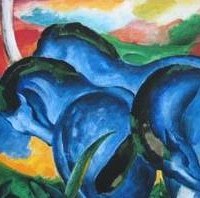
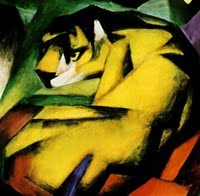
One of the great exponents of Expressionism, the German artist Franz Marc was - along with Wassily Kandinsky - one of the founders of the Blue Rider Group (Der Blaue Reiter), a seminal style of German expressionism, based in Munich. Early visits to Paris in 1903 and 1907 introduced him to Impressionism and Post-Impressionism, although he was strongly attracted to the work of Van Gogh (1853-90), under whose influence his painting style moved towards expressionism. Tragically, he was killed at Verdun, at the age of 36. His painting Leaping Horses (Springende Pferde, 1910, private collection), was sold in 2009 at Christie's for nearly 5 million dollars. Now ranked among the top modern artists and one of the greatest expressionist painters, Franz Marc's best known works include Tiger (1912, Stadtische Galerie im Lenbachhaus), The Large Blue Horses (1911, Walker Art Centre, Minneapolis), and Red Horses (1911, private collection). For more about Marc's contribution to the style of expressionism, see: History of Expressionist Painting (c.1880-1930). |
|
WORLDS TOP ARTISTS POSTERS
OF FRANZ MARC
|
|
|
Training as an
Artist Blue Rider
German Expressionist Group |
|
|
Der Blaue
Reiter Artists & Movement
Meets Robert
Delaunay Marc made over 60 prints in woodcut and lithography and many gouache paintings. His work is characterised by bright primary colours, simplicity of form and almost Cubist portrayal of animals. In his 1910 painting Leaping Horses (Springende Pferde), Marc wrote of his aims 'What seems so promising in the new work being done by the Neueknstervereinigung is the utterly spiritualized and dematerialized inwardness of feeling which our fathers... never even attempted to explore in a picture'. For Marc the horse was an animal that had been celebrated since Roman days, and into the 18th/19th centuries by famous artists including George Stubbs, Gericault, Delacroix, Degas and von Maree. The horse was a powerful symbol of grace, energy and power of nature. He attempted to separate elements of picture-making - that of form, rhythm, implied movement and colour - into a harmony in relation to the spirit and nature of its subject matter. Leaping Horses is unique among his horse works in that it attempts to apply Pointillist or Divisionist techniques. He unifies animals and landscape, colour and form with an under current of abstraction. Like Flights of Swallows by the Futurist painter Giacomo Balla, Marc sought to evoke the underlying, hidden abstract patterns, rhythms and laws of Nature. As Marc wrote: 'Nature is lawless because it is an eternal chain of coming and going... I write as if I already know something about these... laws which I have dreamt about! But I am searching with the entire longing of my soul and with all my strength after them and I have a slight idea that they are already in my paintings'. Ultimately he turned to abstract art in order to express the universal synthesis he believed existed in nature. Leaping Horses, with its block like marks of pure colour is similar to pictures by the Neo-Impressionist Paul Signac. Marc was also influenced by Russian Rayonism (1912-14) a Cubo-Futurist style of painting developed by Mikhail Larionov (1881-1964) and Natalia Goncharova (1881-1962). At the same time he exerted an influence on several Russian artists including David Burlyuk (1882-1967). Dies at Verdun Famous expressionist paintings by Franz Marc include: - Leaping Horses (Springende
Pferde, 1910, private collection) The Franz Marc Museum in Kochel am See, Germany, is a major centre for works by Marc. In addition, as befits one of the great 20th century painters, his pictures can be seen in a number of the best art museums in America, including: - Fine Arts Museums of San Francisco |
|
• For more information about Expressionism, see: Homepage.
ENCYCLOPEDIA OF VISUAL ARTISTS |