Orphism
History, Characteristics of Orphic-Cubism,
Simultanism.
MAIN A-Z INDEX - A-Z of ART MOVEMENTS

|
Orphism
|
|
20TH CENTURY MOVEMENTS |
Orphism (c.1910-13)What is Orphism? What is Orphic Cubism? It was a short-lived but influential style of colourful abstract art, created mainly by Robert Delaunay (1885-1941) and his wife Sonia Delaunay-Terk (1895-1979), in response to the austere monochromatic style of analytical Cubism championed by Picasso and Georges Braque. Other abstract painters associated with Orphism include the French-Czech painter Frank Kupka (1871-1957), Francis Picabia (1879-1953), Jean Metzinger (1883-1956), Marcel Duchamp (1887-1968), Fernand Leger (1881-1955), and others. The actual name "Orphism" was first used in this sense by the French poet Guillaume Apollinaire (born Wilhelm Apollinaris de Kostrowitzky) (1880-1918), after the Greek singer and musician Orpheus, whose music even tamed wild beasts. Apollinaire used it - perhaps after reading Kandinsky's book "Uber das Geistige in der Kunst" (Munich, 1912), or speaking with Francis Picabia and his wife, Gabrielle Buffet-Picabia - to express the harmonious composition and lyrical aesthetic of the new style. |
|
WORLD'S BEST ARTISTS |
|
EVOLUTION OF VISUAL
ART WORLD'S GREATEST
ARTWORKS WHAT IS ART? GEOMETRIC ABSTRACTION |
Characteristics Orphist painting was a blend of Fauvism (colour), Cubism (fragmentary planes) and Futurism (sense of motion). In some ways it was a very early type of Lyrical Abstraction. It appealed to the senses, using overlapping planes of contrasting colours, and colour-combinations based on the colour theory known as the "Law of Simultaneous Contrast of Colours," pioneered by the 19th century French chemist Michel-Eugene Chevreul. Delaunay himself avoided the name Orphism, preferring the more modern Futurist-sounding term Simultanism to describe his method of capturing fleeting visual sensations. Not only did Simultanism make reference to the law of simultaneous colour contrast upon which it was based, but it was seen as a particularly apt name for a style of modern art. It is exemplified by Delaunay's paintings like The Cardiff Team (1912-13; Van Abbe Museum, Eindhoven) and La Ville de Paris (1912; Musee d'Art Moderne de la Ville de Paris). |
|
|
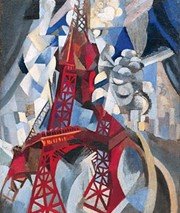
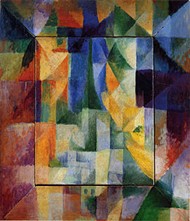
Robert Delaunay Robert Delaunay initiated Orphic Cubism during the period 1908-10, when he began producing Cubist-style works with vivid colours instead of the trendy browns and greys of Braque and Picasso. His subjects were also quite different - he used dynamic Futurist-style urban imagery rather than the more conventional Cubist still-life forms. All this is illustrated by his series of pictures of the Tour d'Eiffel, such as The Eiffel Tower (1910, Guggenheim Museum NY) and The Red Tower (1912). Hereafter, he gradually dispensed with recognizable subject matter, and turned to an early type of lyrical abstraction, relying exclusively on form and colour to communicate his chosen aesthetic. He employed rectangular shapes in the "Fenetres" (windows) series, and circular shapes in the "Disks" - mixed with an insistent strain of symbolism. The effect of brilliant light and colour was enhanced by "simultaneous contrast", the result of careful juxtapositioning of colours. Delaunay's friendship with Apollinaire led to close collaboration. Apollinaire produced numerous articles and commentaries on Delaunay's paintings, in which he promoted Orphism, as the latest trend of the Ecole de Paris. In March 1913, Robert and Sonia Delaunay's Orphist work was shown for the first time at the Salon des Independants. In addition, Robert's paintings were exhibited at a one-man show at the prestigious Sturm Gallery in Berlin (owned by Herwarth Walden), where it strongly influenced painters like Franz Marc (1880-1916), Auguste Macke (1887-1914), and Paul Klee (1879-1940) as well as Wassily Kandinsky (1866-1944) and Marc Chagall (1887-1985). Delaunay and his wife were also represented at the Herbst Salon (organized by Der Sturm), along with abstract works by Picabia, Metzinger, Gleizes, Leger and several Futurist painters. The new idiom was also noticed by The New York Times, which ran an article in October 1913 entitled "Orphism: The Latest Painting Cult", in which it paid particular attention to the significant roles played by Delaunay and Kupka. After 1913, only the Delaunays (and Kupka) continued to paint in the Orphist style, along with one or two pupils like the Americans Patrick Henry Bruce (1881-1936) and Arthur Burdett Frost. Most of the other artists associated with Orphism moved on to explore other methods of painting. Art and Music Similar Groups and Styles Orphism overlapped to a degree with the Section d'Or (Golden Section), a loose association of French Cubist painters including Delaunay, Picabia, Metzinger, Leger, Duchamp-Villon, Gleizes, Juan Gris, and Jacques Villon. The group held only one exhibition, at the Galerie la Boetie, Paris, in October 1912, and it was during his lecture at this exhibition that Apollinaire first used the name Orphism. A second similar group, comprising many of the same members, was called the Puteaux Group, which held informal meetings in the studios of Raymond Duchamp-Villon and Jacques Villon. The emergence of Orphism reflected the wider vision of Cubism held by those in the Puteaux group including Albert Gleizes and his co-author Jean Metzinger who wrote the first treatise on Cubism entitled Du Cubisme (1912). Orphic Cubism was also imitated by other Parisian artists, including two Paris-based American painters Morgan Russell (1886-1953) and Stanton Macdonald-Wright (1890-1973) who founded a very similar style known as Synchromism, in 1912. Famous Orphist Paintings The most important 20th century paintings by Orphic Cubists include: Robert Delaunay Sonia Delaunay-Terk Jean Metzinger Franz Marc Stanton Macdonald-Wright |
|
|
|
• For information about visual arts, see: Homepage.
Visual
Artists, Greatest |