Thomas Lawrence
Biography and Paintings of English Rococo Portrait Artist.


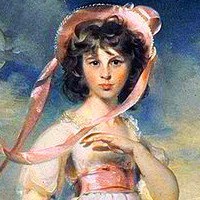
Sarah Goodin Barrett Moulton:
"Pinkie" (1794) Huntington Institute,
San Marino, California

Thomas Lawrence (1769–1830)

The precociously talented artist Thomas Lawrence began his career as a crayon-portraitist and trained at the Royal Academy Schools in 1787, before becoming one of England's most prominent and fashionable portrait artists, and one of the foremost contributors to English figurative painting. He is the typical Regency society painter and his portrait art reflected the glittering vulgarity of the world he painted: the world of Lord Byron, Beau Brummell, and the Brighton Pavilion. During a long career he painted many of Europe's leaders and Royal dignitaries. Stylish, haughty, but above all a portraitist of great vitality, his most famous paintings include Portrait of Sarah Goodin Barrett Moulton: known as Pinkie (1794, Huntington Institute, San Marino, California) and Elizabeth Farren (1790, Metropolitan Museum of Art, New York). He was also a talented exponent of miniature portrait painting and the youngest ever painter (at 25 years) to be elected a full member of the Royal Academy of Arts in London, an institution he later served as President. Although his posthumous reputation never attained the heights it achieved during his lifetime, Lawrence remains one of the great English Rococo artists.

HISTORY OF PORTRAIT ART
For more information about
this genre of painting, see:
Renaissance Portraits (1400-1600)
Baroque Portraits (1600-1700)
Rococo/Neoclassical (1700-1800)
19th Century Portraiture (to 1900)
Impressionist Portraits (1870-90)
20th Century Portraiture

WORLDS TOP ARTISTS
For top creative practitioners, see:
Best Artists of All Time.
For the greatest portraitists
see: Best Portrait Artists.

WHAT IS ART?
For an explanation of the
aesthetic issues surrounding
the creative visual arts, see:
Art Definition, Meaning

THE ENGLISH SCHOOL
For information and facts on
famous figurative artists of
England, see:
William Hogarth (1697-1764)
Painter, Engraver, Satirist
Joseph Wright of Derby (1734-1797)
Portraitist, chiaroscuro expert
Henry Fuseli (1741-1825)
Romantic expressionist painter
Henry Raeburn (1756-1823)
Scottish portrait artist.
Dante Gabriel Rossetti (1828-82)
Romantic leader of Pre-Raphaelites
GF Watts (1817-1904)
Portrait painter, muralist
John Everett Millais (1829-96)
Academic portraitist

Formative Years

Lawrence was born in Bristol in 1769, the son of an Inn Keeper. By the age of six he was already sketching humorous portraits of his father's guests. When the family moved to Oxford when Lawrence was ten, he continued his artistic development by drawing the city's eminent residents. In 1780 the family moved to Bath and Lawrence began to work in pastels and oils. He received very little formal education, and studied by observation, copying paintings in local collections. In 1787 Lawrence moved to London and attended the Royal Academy for a short period, meeting Sir Joshua Reynolds whose style of portraiture became a strong influence.

WORLD'S BEST ART
For a list of the best examples of
Fine Art Painting, by the
world's top artists, see below:
Greatest Paintings Ever
Oils, watercolours, mixed
media from 1300-present.
Oil Painting
History, styles and development.
For English Scene Painters, see:
English Landscape Painting

Early Success

Success came quickly in London for Lawrence. At the age of 21, he was summoned to Court to paint Queen Charlotte (1780, National Gallery, London). Although the finished portrait was considered to be a highly realistic likeness, it failed to please either the sitter or her husband the King, and remained in the artist's possession for many years. It was exhibited at the Royal Academy in 1790. The same year he painted Elizabeth Farren (1790, Metropolitan Museum of Art, New York). Farren, an Irish actress, was at the height of her career when this painting was painted. The portrait is vivid and charming, and secured Lawrence's place as the official successor to Sir Joshua Reynolds - on his death in 1792 - as Painter-in-Ordinary to the King George III. In 1791 he was also elected associate of the Royal Academy and a full Academician in 1794. Given Lawrence's commercial success, he was able to collect his own works of art, and formed one of the finest English collections of drawings by Old Masters. He also took up painting miniatures, and rivalled some of the best miniaturists in London, such as Richard Cosway (1742-1821) and Ozias Humphrey (1742-1810).


Pinkie

In 1794 Lawrence created one of his most memorable works - Pinkie, now housed in the permanent collection of the Huntington, San Marino, California. It hangs in the Institute next to The Blue Boy by Thomas Gainsborough. It is often said, when seen together, the paintings are the Romeo and Juliet of Rococo portraiture. Pinkie is an oil painting of Sarah Barrett Moulton, aged 11, the daughter of a wealthy plantation owner (she died one year later of whooping cough). She stares directly at the viewer, and the loose brushstroke employed by the artist, gives the portrait a lively, immediate feel. The painting was exhibited in the summer of 1795 at the Royal Academy.

Vienna Commissions

In 1815 Lawrence was knighted by the Prince Regent. Since the death of his own official neoclassical portraitist John Hoppner in 1810, the Regent had been patronizing Lawrence. In 1818 Lawrence was sent to Vienna where he was commissioned to paint 24 full length portraits of Europe's rulers and dignitaries as they came together for the Vienna Congress after Napoleon’s defeat. The high profile of his sitters ensured that Lawrence became one of the most fashionable portrait painters in Europe. In 1820, on his return to London he was appointed President of the Royal Academy, following the death of the American expatriate painter Benjamin West. As part of the Vienna Commission, Lawrence was also sent to Rome to paint to paint Pope Pius VII. His ensuing work (1819, Royal Collection, Windsor) is often viewed as the most brilliant papal portrait since Pope Innocent X (1650, Doria Pamphilj Gallery, Rome) by Velazquez. His other paintings included two portraits of the Duke of Wellington.

Portrait of John Philip Kemble

Sir Thomas Lawrence died in London in 1830, but his paintings continue to inspire generations of portrait artists. In 2009, the National Portrait Gallery purchased a rarely seen but outstanding portrait of the actor John Philip Kemble (which hung in Lawrence's home until his death). The purchase price was £178,500 - primarily funded through the Art Fund, England's largest charity for the purchase of art. The monumental oil canvas, over 8 feet tall, shows Kemble at the height of his career (1812) playing the Roman soldier Cato. The glinting dagger on the table next to him, suggests that he is about to take his own life in the face of defeat. When the painting was exhibited in 1812 it was greatly admired, critics claimed it transcended the 'limits of portraiture and belonged to the highest school of history'. Lawrence was so pleased with the painting; he never actually gave it to Kemble. The painting was the key piece in the National Portrait's 2010 retrospective exhibition of Lawrence's paintings.

Other Paintings

Paintings by Sir Thomas Lawrence can be seen in several of the world's best art museums, in particular the Waterloo Gallery of the British Royal Collection at Windsor and that National Gallery London. Examples of his most popular works include:

- Queen Charlotte (1780, National Gallery, London)
- Portrait of Miss Martha Carry (c.1789, Prado Museum, Madrid)
- John Julius Angerstein, aged about 55 (1790, National Gallery, London)
- Elizabeth Farren (1790, Metropolitan Museum of Art, New York)
- Mr and Mrs John Julius Angerstein (1792, Louvre, Paris)
- Pinkie (1794, Huntington Institute, San Marino, California)
- The Daughters of Colonel Thomas Carteret Hardy (1801, Private Collection)
- The Fluyder Children (1805, Museum Of Fine Art, Sao Paolo)
- Arthur Wellesley, 1st Duke of Wellington (1814, Wellington Museum)
- Diana Sturt, Lady Milner (1815-20, Kunsthistorisches Museum, Vienna)
- Portrait of Mrs. Wolff (1815, Art Institute Of Chicago)
- Mrs Isaac Cuthbert (1817, Louvre, Paris)
- The Duke of Wellington (1818, The Bathurst Collection, Sapperton)
- Margaret, Countess of Blessington (1822, Wallace Collection, London)
- The Calmady Children (1824, Metropolitan Museum Of Art, New York)
- John Julius Angerstein, aged over 80 (1824, National Gallery, London)
- Lord Liverpool (1826, National Gallery, London)
- Miss Caroline Fry (1827, Tate Gallery, London)
- Portrait Of George Nugent Grenville, Lord Nugent (Private Collection)
- Portrait Of The Hon, George Fane (Private Collection)

• For more biographies, see: Famous Painters.
• For details of major art periods/movements, see: History of Art.
• For a chronological list of important dates, see: Timeline: History of Art.
• For biographies of sculptors and painters from Ireland, see: Famous Irish Artists.
• For more information about modern art, see: Art Encyclopedia.

• To update this online biography of the English Rococo portraitist Thomas Lawrence, click here.


Visual Artists, Greatest | Art Glossary | Sitemap: International Art
ENCYCLOPEDIA OF ART
© visual-arts-cork.com. All rights reserved.