Piet Mondrian
Biography of Abstract Painter, Founder of
Neo-Plasticism.
MAIN A-Z INDEX - A-Z of ARTISTS

|
Piet Mondrian
|
 Composition A (1929). A perfect example of Mondrian's Neo-Plasticism: a key style of avant-garde art. |
Piet Mondrian (1872-1944)Contents • Biography NOTE: For analysis of works by Neo-Plasticist
painters like Piet Mondrian, |
|
|
An important figure in the history of art of the 20th century, Dutch-born artist Piet Mondrian, the inventor of Neo-Plasticism, was one of the major pioneers of pure abstract art and an important contributor to the De Stijl design movement, led by Theo van Doesburg (1883-1931). But while intellectually influential in his lifetime, and accepted today as one of the great abstract painters, and one of the key figures in modern art of the early 20th century, he enjoyed little commercial success during his lifetime. He is best known for his concrete art of the 1920s and 1930s consisting of blue, red and yellow rectangular forms separated by thick black lines. These geometric designs are best seen in the flesh, as reproductions make them appear simplistic and bland. His most famous abstract paintings include Composition in Colour A, 1917 (Kroller-Muller Museum); Tableau No. IV with Red, Blue, Yellow and Black, 1924 (National Gallery of Art, Washington DC); Composition with Red, Yellow and Blue, 1929 (Stedelijk Museum); Composition in Red and Blue, 1939 (Private Collection) and Broadway Boogie Woogie, 1942 (Museum of Modern Art, New York). |
|
|
| Broadway Boogie-Woogie (1942), New York Museum of Modern Art. An iconic 20th century painting. |
Mondrian was born in Amersfoort, Netherlands; his father was a qualified drawing teacher at a primary school. Mondrian learned to draw early in life and in 1892 went on to study painting at the Academy for Art in Amsterdam. Most of his works from this period consist largely of landscapes featuring windmills, fields and rivers, executed in a manner which combined Impressionism with elements of Dutch Realism. Searching for a personal style, he pursued various methods as a student, such as colourful Fauvism and Neo-Impressionist Pointillism. (For more, see: Post-Impressionism in Holland.) Paintings from this time include, Village Church, 1898; Wood with Beach Trees, 1899; Stammer Mill with Streaked Sky, 1905 and Row of Eleven Poplars in Red, Yellow, Blue and Green, 1908. These works are still firmly rooted in nature, and at this point there is little sign of the abstraction that was to come. |
|
WHAT IS VISUAL ART? WORLDS TOP ARTISTS TOP AUCTION RECORDS
|
Throughout his life Mondrian would spend time back and forth between Amsterdam, London, Paris and eventually New York. In 1912, he moved to Paris where he studied the works of modern artists like Pablo Picasso (1881-1973) and Georges Braque (1882-1963). He immediately integrated some of the ideas of Cubism into his own work. But while he was excited by the principles of Cubism, he did not see it as and end in itself: rather it was only part of the journey. But it was a journey, which he felt instinctively, was going in the right direction. While he was visiting home in 1914, World War I broke out and he was forced to remain in the country for the next several years. During this period he stayed at an artist colony, where he was influenced by another Dutch artist, Bart van der Leck, who only used primary colours in his work. In 1917, in response to the needless slaughter of the Somme, the Dutch painter and critic Theo van Doesburg founded a periodical called De Stijl (The Style). Mondrian wrote several essays for the publication and became a key proponent of the group's artistic philosophy, which became known as Neo-Plasticism. They advocated pure abstraction or "non-objective art", stating the universe could be reduced to the bare essentials of form and colour. They simplified compositions to horizontal and vertical lines and only used primary colours, along with black and white. |
|
|
|
|
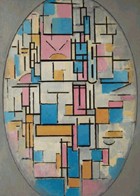
At the end of the First World War Mondrian returned to Paris where he would remain until the eve of the Second World War. The city flourished artistically during the inter-war years, and Mondrian's geometric Neo-Plasticism was only one of several abstract art movements of the period. Mondrian's important paintings from this period include Composition A, 1920 and Composition B, 1920. Although the evolution of his work was less apparent than in early years (when he jumped from representational art to abstract), he continued to subtly refine his technique. His new and rigorous geometric style was a counter-statement to the emotional chaos and uncertainty of the first decades of the twentieth century. For example, he began to use fewer primary colours and relied more on white. This can be seen in his oil paintings: Lozenge Composition with Yellow, Black, Blue, Red, and Gray, 1921 (The Art Institute of Chicago); Composition with Large Blue Plane, Red, Black, Yellow, and Gray, 1921 (Dallas Museum of Art) and Lozenge Composition with Red, Black, Blue, and Yellow, 1925 (Private collection). The lines on these works extend to the edge of the canvas, which help give the impression that the paintings are fragments of a larger work. Although most people assume that his paintings are perfectly smooth planes of colour, on closer inspection brush strokes are clearly evident.
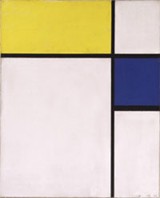
In 1938 he moved briefly to London, but when Paris fell to the Nazis he left London and moved to New York. He remained there until his death. His later works contain many more horizontal and vertical lines, giving his paintings a 'busier' look - Broadway Boogie Woogie is a prime example of this form of abstract geometric painting. The colours seem to shimmer, like neon lights, drawing you into the canvas, just as a person is drawn to the bright lights of a city. Other works from this time include Composition with Yellow, Blue and Red, 1937-42 (Tate Gallery, London); Vertical Composition with Blue and White, 1936 (Kunstsammlung Nordrhein-Westfalen, Dusseldorf) and New York City, 1941 (Centre Georges Pompidou, Paris). Mondrian died of pneumonia in 1944 and was buried in the Cypress Hills Cemetery, New York.
The apparent simplicity of his works has led many people to believe that anyone, even a child, could paint them. But on closer inspection, it is clear that his final works were the culmination of over 30 years of study, and his Neoplastic compositions were in fact incredibly complex and wholly original. His Reductionist style of design continues to inspire painters, fashion designers, and creative departments in advertising and packaging - covering almost every facet of modern life. As well as being seen as one of the most inventive of 20th century painters, he is also considered the father of graphic design, which was founded on his basic grid-style structure. Paintings by Piet Mondrian hang in the best art museums across the world. |
|
• For information about abstract artists, see: Homepage.
ENCYCLOPEDIA OF VISUAL ARTISTS |